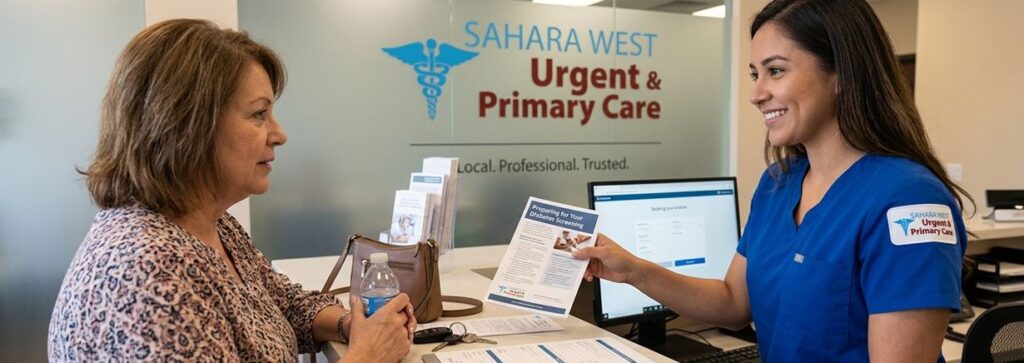
Most diabetes screenings take a few minutes and one blood sample. The preparation, though, depends on which test you get: an A1C needs no fasting, while a fasting glucose test does. Knowing that before you go can save you a wasted trip, a rescheduled visit, or a misleading result.
At Sahara West Urgent Care & Wellness in Las Vegas, walk-ins are welcome, and our free A1C and Lipoprotein(a) screening gives you a no-appointment place to start. This guide covers what to know before you go: who should be screened, which tests exist, how to prepare, what to bring, what the numbers mean, and what happens next.
What to Know Before a Diabetes Screening
- Find out which test you are getting. An A1C test does not require fasting. A fasting plasma glucose test means no food or drink except water for at least 8 hours. An oral glucose tolerance test (OGTT) means fasting plus a sweet drink and about two hours at the clinic.
- Do not change your medications on your own. Tell the provider everything you take, including steroids and supplements.
- Mention anything that can affect an A1C result, such as anemia, an inherited blood condition, pregnancy, or recent blood loss.
- Know your risk. The American Diabetes Association (ADA) says testing should begin at age 35, and earlier for adults with overweight or obesity plus one or more risk factors.
- A screening is not a diagnosis. A high result is usually confirmed with a second test.
- You can start for free. Walk in to Sahara West at 6125 W Sahara Ave, Las Vegas, and ask about the free A1C screening.
What Is a Diabetes Screening, and Is It the Same as a Diagnosis?
A diabetes screening is a blood test for people who have no known diabetes. Its job is to catch prediabetes or type 2 diabetes early, often before any symptoms appear. According to the ADA, fasting plasma glucose, the 2-hour glucose from a 75-g OGTT, and A1C are all appropriate for screening and diagnosis.
That overlap causes confusion. The tests are the same, but the question is different. Screening asks, “Is there a reason to look closer?” A diagnosis is made when results meet the ADA’s thresholds and, in most cases, are confirmed on a second test. A single high number on a screening does not automatically mean you have diabetes, and a normal number does not mean you never need testing again.
Prediabetes means your blood sugar is higher than normal but not yet in the diabetes range. The ADA notes that people almost always pass through prediabetes before developing type 2 diabetes, which is why catching it matters: it is the stage where lifestyle changes and medical follow-up can make the biggest difference.
Who Should Get a Diabetes Screening?
The ADA’s 2026 Standards of Care set out when testing makes sense. In plain terms:
| Who | What the ADA guidance says |
|---|---|
| Adults 35 and older | Begin testing at 35. If results are normal, repeat at a minimum of every 3 years, sooner if symptoms or risk change (for example, weight gain). |
| Adults of any age with overweight or obesity and one or more risk factors | Consider testing earlier. |
| People with prediabetes | Monitor for diabetes at least once a year. |
| People with a history of gestational diabetes | Lifelong screening every 1 to 3 years. |
| People planning pregnancy | Screen if risk factors are present, and consider testing anyone of childbearing potential. |
| Children and teens with overweight or obesity | Consider risk-based screening after puberty begins or after age 10 (whichever comes first) if there is at least one additional risk factor. If normal, repeat at least every 2 years. |
Common risk factors to mention to your provider
- A parent or sibling with diabetes
- Overweight or obesity, or limited physical activity
- High blood pressure or abnormal cholesterol or triglycerides
- A history of heart disease or stroke
- Polycystic ovary syndrome (PCOS)
- A history of gestational diabetes
- Belonging to a group with higher type 2 risk, which the ADA lists as including African American, Latino, Native American, Asian American and Pacific Islander communities
Prediabetes is also linked to higher cardiovascular risk, and the ADA suggests screening for and addressing heart disease risk factors when prediabetes is found. That is why Sahara West pairs A1C with Lipoprotein(a), an inherited cholesterol-related heart risk marker, in its free screening.
Symptoms that mean you should not wait for a routine screening
Increased thirst, frequent urination, blurry vision, unusual fatigue, unexplained weight loss, slow-healing cuts, and tingling or numbness in the hands or feet are all reasons to be tested sooner. Severe symptoms such as vomiting, confusion, fruity-smelling breath or trouble breathing need emergency care, not a screening visit. Call 911 or go to the nearest emergency room.
Not sure whether you qualify? You do not need to figure it out alone. Walk in for a free A1C screening and a provider can help decide what makes sense for your age, history and family background. Questions first? Call (702) 248-0554.
Which Diabetes Screening Tests Are There?
Four blood tests are commonly used. Which one you get decides how you should prepare.
| Test | What it measures | Fasting needed? | Time commitment |
|---|---|---|---|
| A1C (HbA1c) | Average blood glucose over roughly the past 2 to 3 months | No | A few minutes |
| Fasting plasma glucose (FPG) | Blood glucose after at least 8 hours without food or drink (water allowed) | Yes | A few minutes, usually done in the morning |
| Oral glucose tolerance test (OGTT) | Blood glucose before and 2 hours after a special sweet drink | Yes | About 2 hours or more |
| Random plasma glucose | Blood glucose at any time of day | No | A few minutes. Used mainly when symptoms are present |
Which test is right for you?
There is no single “best” test for everyone. An A1C is convenient because you can take it at any time of day. Fasting glucose and the OGTT look at blood sugar at specific moments, and the ADA notes the OGTT is more sensitive in certain situations, which is why it is used after gestational diabetes. Your provider chooses based on your age, history, symptoms and what is practical for you. If the first result is unclear, a second test is common.
How to Prepare for a Diabetes Screening
Do you need to fast?
It depends entirely on the test:
- A1C: No fasting is generally required. Follow any specific instructions your provider gives you.
- Fasting plasma glucose: Nothing to eat or drink except water for at least 8 hours beforehand. Many people schedule it first thing in the morning for that reason.
- OGTT: Fasting plus the glucose drink. The ADA also advises getting adequate carbohydrates, at least 150 grams a day, for 3 days before an OGTT, so this is not the week to start a strict low-carb diet.
Not sure which test you are having? Ask before you skip breakfast. If you are walking in for the free A1C screening, fasting is generally not needed.
Should you stop taking your medications?
No, not unless a provider has told you to. Bring a list of everything you take, including prescriptions, over-the-counter products and supplements, and mention anything new. Some medicines, such as steroids, can raise blood sugar, and your provider will want to interpret your result with that in mind.
Should you change what you eat before the test?
Only if you are fasting. Otherwise, eat normally. Cutting back for a few days before an A1C will not erase months of blood sugar history, and it can make your result less representative of your real health, which defeats the purpose of screening.
Tell the provider about conditions that can affect results
A1C is a very useful test, but it can be less reliable in some situations. Let the provider know if you have anemia or another blood disorder, an inherited hemoglobin variant (such as sickle cell trait), kidney disease, recent significant blood loss or a recent transfusion, or if you are pregnant. In those cases a fasting glucose or another test may give a clearer picture.
What to bring
- Photo ID and your insurance card (if you have insurance)
- A list of your medications and supplements
- Notes on family history of diabetes, heart disease or stroke
- Any recent lab results or medical records you have
- Your questions, including anything about symptoms you have noticed
What Happens During a Diabetes Screening Visit?
- Check in. The front desk collects the information needed for your visit.
- Talk with a provider. They ask about symptoms, family history and risk factors, and decide which screening fits your situation.
- Blood sample. A short blood draw is collected for the test. Most people feel a quick pinch, and mild bruising afterward is possible.
- Discuss next steps. Your provider explains what your results mean and whether further testing or follow-up makes sense. Ask the team how and when you will receive your results.
At Sahara West, the clinic is open Monday to Friday 9 AM to 8 PM and Saturday 9 AM to 3 PM, so a fasting test can be done right when the doors open, and an A1C fits easily into an after-work visit. Ask the front desk which tests are available on the day you come in.
Ready to get it done? Walk in for a free A1C screening at 6125 W Sahara Ave, Las Vegas, NV 89146, call (702) 248-0554, or book an appointment.
What Do Diabetes Screening Results Mean?
The ADA uses these ranges for adults:
| Test | Normal | Prediabetes | Diabetes |
|---|---|---|---|
| A1C | Below 5.7% | 5.7% to 6.4% | 6.5% or higher |
| Fasting plasma glucose | Below 100 mg/dL | 100 to 125 mg/dL | 126 mg/dL or higher |
| OGTT (2-hour glucose) | Below 140 mg/dL | 140 to 199 mg/dL | 200 mg/dL or higher |
| Random plasma glucose | Not used to rule out prediabetes | Not used | 200 mg/dL or higher with classic symptoms |
These numbers are guides, not a verdict. In most cases a result in the diabetes range is repeated on a second day before a diagnosis is made. A provider may skip the second test if your blood sugar is very high or you have classic symptoms alongside a positive result.
What Happens After an Abnormal Result?
A high result is a reason to follow up, not a reason to panic. Typical next steps include:
- Confirmation testing, such as a repeat A1C or a fasting glucose test
- A broader risk review, including blood pressure, cholesterol and heart health, since prediabetes and diabetes raise cardiovascular risk
- A plan you can actually follow, which may include nutrition changes, more physical activity, weight management support and, when appropriate, medication
- Ongoing monitoring. The ADA recommends people with prediabetes be checked for diabetes at least once a year
Sahara West’s primary care team helps patients with diabetes evaluations, blood sugar monitoring, medication management and preventive recommendations. If weight is part of your risk picture, you can also ask about our weight loss program.
What If Your Result Is Normal?
Good news, but not a lifetime pass. The ADA says that if results are normal, testing should be repeated at a minimum of every 3 years, and sooner if you gain weight, develop symptoms, or your risk factors change.
How Much Does a Diabetes Screening Cost in Las Vegas?
At Sahara West, you can start with a free A1C screening. Ask the team at check-in about eligibility and what is included on the day you visit.
For additional testing or follow-up care, the clinic accepts a wide range of insurance plans, including Medicare, Medicaid, Aetna, Cigna, UnitedHealthcare and Humana. If you do not have insurance, ask about self-pay pricing and the clinic’s membership plan. Eligible patients can also explore payment options through Cherry and CareCredit. Coverage varies by plan, so call (702) 248-0554 if you want to confirm before you come in.
Diabetes Screening Near You in Las Vegas
Sahara West Urgent Care & Wellness is on West Sahara Avenue, serving patients from Las Vegas, Summerlin, Spring Valley, Enterprise, Paradise, Winchester, Henderson and North Las Vegas. Tagalog- and Hawaiian-speaking providers are available on site, which helps many patients feel comfortable asking questions about their results.
FAQs
Do I need to fast for a diabetes screening?
Only for some tests. A fasting plasma glucose test requires at least 8 hours without food or drink other than water, and an OGTT requires fasting too. An A1C test generally does not require fasting.
Can I drink water before a fasting blood sugar test?
Yes. Water is allowed during the fast and helps keep you hydrated. Avoid coffee with sugar or milk, juice, soda and gum.
How long does a diabetes screening take?
The blood draw itself takes only a few minutes. Your total visit depends on check-in and consultation time, and an OGTT takes about 2 hours because blood is drawn before and after the sweet drink.
What is a normal A1C level?
Below 5.7% is considered normal. An A1C from 5.7% to 6.4% falls in the prediabetes range, and 6.5% or higher is in the diabetes range.
How often should I be screened for diabetes?
The ADA recommends starting at age 35 and repeating at least every 3 years if results are normal. People with prediabetes should be monitored at least annually, and those with a history of gestational diabetes every 1 to 3 years.
Does a diabetes screening test for type 1 diabetes too?
Routine A1C and glucose screening is aimed mainly at prediabetes and type 2 diabetes. The ADA’s 2026 standards recommend offering autoantibody-based screening for presymptomatic type 1 diabetes to people with a family history of type 1 or other known high genetic risk, so ask your provider if that applies to you.
Can I get a diabetes screening without an appointment in Las Vegas?
Yes. Sahara West welcomes walk-ins at 6125 W Sahara Ave, Las Vegas, NV 89146, Monday to Friday 9 AM to 8 PM and Saturday 9 AM to 3 PM. Ask about the free A1C and Lp(a) screening.
Is urgent care or the ER the right place for high blood sugar symptoms?
For a routine screening or mild symptoms such as increased thirst or fatigue, a clinic visit is appropriate. For severe symptoms, including confusion, repeated vomiting, fruity-smelling breath or trouble breathing, go to the nearest emergency room or call 911.
Get Your Diabetes Screening at Sahara West
The most useful preparation for a diabetes screening is simply showing up with the right information: which test you need, your medication list, your family history and your questions. Everything else we can handle on the day.
Free A1C + Lp(a) screening. Walk-ins welcome.
- Address: 6125 W Sahara Ave, Las Vegas, NV 89146
- Hours: Monday to Friday 9 AM to 8 PM, Saturday 9 AM to 3 PM
- Phone: (702) 248-0554
- Learn about the free screening | Book an appointment | Contact us
This article is for general education and does not replace advice from a licensed healthcare professional. Screening needs vary by age, health history and risk factors.