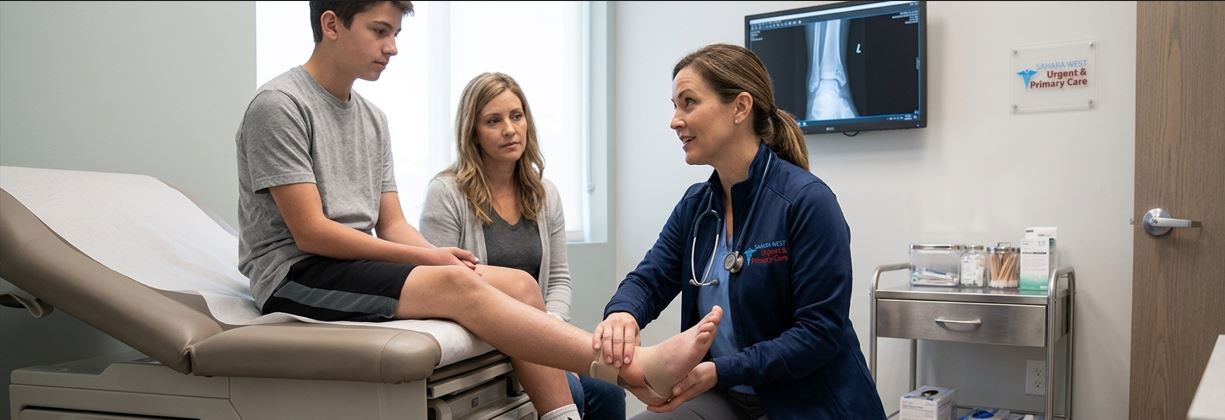
You rolled your ankle on a curb, landed wrong on a pickleball court, or slipped on a wet pool deck. Now it’s swollen, it hurts, and you’re wondering: is this a sprain, or did I break something?
It’s a fair question, because the two injuries can look and feel almost identical. This guide explains how they differ, which warning signs point toward a fracture, when to go to the ER instead, and what to expect at an urgent care visit in Las Vegas.
Quick answer: A sprain is a stretched or torn ligament. A fracture is a cracked or broken bone. Both cause pain, swelling, and bruising, so you can’t reliably tell them apart at home. Pain directly over a bone, trouble taking four steps, a visibly out-of-place joint, or numbness all point toward a possible fracture. An X-ray is the way to confirm.
Hurt and not sure? Call Sahara West Urgent Care at (702) 248-0554 to confirm same-day X-ray availability, or book an appointment online.
Sprain vs. Fracture at a Glance
| Sprain | Fracture | |
|---|---|---|
| What’s injured | Ligament (connects bone to bone at a joint) | Bone (crack, partial break, or complete break) |
| Where it hurts | Soft tissue around the joint | Often a specific spot directly over the bone |
| At the moment of injury | Often a pop or silent twist | Sometimes a crack or snap |
| Swelling and bruising | Common | Common (not a reliable way to tell them apart) |
| Using the limb | Often possible, with pain | Sometimes impossible, but not always |
| Deformity | Uncommon | Possible |
| Numbness or tingling | Less common | More likely |
| How it’s confirmed | Clinical exam; imaging if a fracture is possible | X-ray |
Important: This table shows tendencies, not rules. A small fracture can feel like a mild sprain, and a bad sprain can hurt more than a small fracture.
What Is a Sprain?
A sprain happens when a ligament is stretched or torn, usually from twisting or rolling a joint. Ankles, wrists, and knees are the most common spots. Providers often grade sprains by severity:
- Mild (Grade 1): the ligament is stretched. There is some tenderness and swelling, and you can usually still bear weight.
- Moderate (Grade 2): a partial tear. There is more swelling and bruising, the joint may feel loose, and walking is painful.
- Severe (Grade 3): a complete tear. The joint can feel unstable, and weight-bearing is often very difficult.
A strain is different: it’s an injury to a muscle or tendon, not a ligament.
What Is a Fracture?
A fracture is a break in the bone. It can range from a hairline crack to a bone broken into pieces.
- Hairline or stress fracture: a tiny crack, often from repetitive impact such as running or hiking. Pain tends to build gradually and worsens with activity.
- Stable (non-displaced) fracture: the bone is broken, but the pieces are still lined up.
- Displaced fracture: the pieces have shifted out of position.
- Open (compound) fracture: the bone breaks through the skin. This is an emergency.
Can You Tell the Difference at Home?
Not reliably. But some clues should push you toward getting an X-ray.
Signs that point toward a possible fracture
- Pain when you press directly on a bone, rather than the soft tissue beside it
- A joint or limb that looks bent, crooked, or “off”
- Difficulty taking even four steps, or being unable to use the hand or arm
- A cracking or snapping sound or feeling at the time of injury
- Numbness or tingling in the injured area
- Rapid, significant swelling or bruising
- Pain that’s severe, or getting worse instead of better over the first day or two
Signs a sprain is more likely (but not guaranteed)
- Soreness mostly in the soft tissue around the joint
- A twisting or rolling injury, with no pain over the bone itself
- You can bear weight, with a limp
- Swelling and stiffness that slowly improve over the first several days
The “four-step test” doctors use for ankle and foot injuries
Clinicians commonly use a decision tool called the Ottawa Ankle Rules to decide whether an ankle or foot X-ray is needed. In plain English, an X-ray is generally recommended if you have pain in the ankle or midfoot and any of the following:
- Bone tenderness at the ankle: pain when gently pressing the bony point on either side of the ankle, or along the back edge of that bone for about 2½ inches up from the point
- Bone tenderness in the midfoot: pain over the bone on the outer edge of the middle of your foot (the base of the fifth metatarsal), or the bony bump on the inner arch (the navicular)
- Trouble bearing weight: you couldn’t take four steps right after the injury, or you can’t now
Use this to decide whether to get checked, not to rule a fracture out. These rules can be unreliable with children, pregnancy, intoxication, multiple injuries, head injury, or reduced sensation, which is another reason an in-person evaluation is the safer route.
Can you walk on a fracture?
Sometimes, yes. Being able to walk doesn’t rule out a broken bone, especially with hairline fractures, stress fractures, and some foot, toe, and wrist fractures. If it hurts to walk, or the pain is getting worse, get it checked.
Don’t guess with a swollen joint. Walk in to Sahara West Urgent Care for an exam. Our providers decide whether an X-ray is medically needed, and no referral is required.
When to Go to the ER Instead
Urgent care is a good fit for many non-life-threatening injuries. Go to the nearest emergency room or call 911 if you have:
- Bone visible through the skin, or a wound over a suspected fracture
- A limb or joint that is obviously deformed or out of place
- A hand, foot, or limb that is pale, blue, cold, or numb
- Heavy bleeding that won’t stop
- A suspected injury to the hip, thigh bone, pelvis, neck, or back
- A head injury, loss of consciousness, or confusion
- Trouble breathing or chest pain after a fall or crash
- A major accident, such as a high fall or serious car crash
Not sure which is right? Our guide to freestanding ERs vs. urgent care in Las Vegas explains the differences, including billing.
What Happens at Urgent Care for a Possible Sprain or Fracture
Here’s what a typical visit looks like (see our full urgent care visit walkthrough):
- Check-in. Walk-ins are welcome; no referral from another doctor is needed.
- Exam. A provider asks how the injury happened, checks swelling and bruising, tests movement, and feels for bone tenderness.
- Imaging if appropriate. If an X-ray will help confirm or rule out a fracture, it is ordered and done on-site. See our walk-in X-ray guide and when you need an X-ray.
- Review and plan. The provider reviews results with you and explains next steps, which may include splinting or bracing, medication, home care, or a specialist referral.
Good to know: Images are also sent to a radiologist for a formal report, typically finalized within 24 to 48 hours, and can be forwarded to your primary doctor or specialist.
X-ray days at Sahara West
On-site digital X-rays are offered every Tuesday and Thursday, with no appointment needed. If you’re hurt on another day, call us at (702) 248-0554. Our team can tell you the best next step.
What if the X-ray is normal but it still hurts?
A normal X-ray is reassuring, but it doesn’t always end the story. Some fractures, such as small stress fractures or wrist fractures, may not show up right away. Providers sometimes splint an injury and recheck or re-image it later. If pain persists or worsens, go back.
What to Do Right Now While You Wait
Until you’re seen, protect the injury:
- Rest. Stop activity and avoid putting weight on it.
- Ice. Apply for 15–20 minutes at a time with a cloth between the ice and your skin.
- Compress. A light elastic wrap can help. If toes or fingers tingle, turn cold, or change color, loosen it.
- Elevate. Raise the injury above heart level when you can.
- Pain relief. Over-the-counter options may help if they’re safe for you. Follow the label, and ask a clinician first if you have kidney, stomach, or heart conditions or take blood thinners.
Avoid: “walking it off” to test it, massaging the area, applying heat in the first day or two, or removing a splint to check.
Quick Guide by Body Part
Ankle and foot. The most common sprain site in Las Vegas, whether from curbs, stairs, hiking trails, or uneven pavement. Use the four-step test above. Toe injuries are often dismissed as “just a stubbed toe” but can be fractures.
Wrist, hand, and fingers. Falls onto an outstretched hand are a classic cause. Pain at the thumb side of the wrist deserves attention, because a scaphoid fracture can be missed on a first X-ray. A “jammed” finger that is crooked, can’t straighten, or feels numb needs evaluation.
Knee and leg. Get checked if you can’t bear weight, the knee locks or gives way, or swelling develops quickly.
Ribs. Sharp pain with breathing or coughing after a fall should be evaluated. Trouble breathing is an ER situation.
Children, Older Adults, and Athletes
- Children: Kids’ bones have growth plates, and an injury that looks like a sprain can be a growth plate fracture. If a child refuses to use a limb, cries when it’s touched, or won’t bear weight, get it checked. Call ahead if you have questions about your child’s age.
- Older adults and people with bone loss: Low-force falls can cause fractures, so a lower threshold for getting checked is wise.
- Athletes and active adults: Pain that builds with running, hiking, or training and eases with rest may be a stress fracture, not a strain. Heading back to the court too soon risks a bigger injury. We also offer sports physicals.
Typical Recovery Timelines
| Injury | General timeline* |
|---|---|
| Mild sprain | Days to about 1–2 weeks |
| Moderate sprain | Several weeks |
| Severe sprain (complete tear) | Weeks to months; may need specialist follow-up |
| Fracture | Several weeks to months, depending on the bone and type |
*Healing varies by person, injury, and follow-through. Your provider will give guidance specific to you.
Possible Sprain or Fracture in Las Vegas? Where to Go
Sahara West Urgent Care & Wellness is located at 6125 W Sahara Ave, Suite 1B, Las Vegas, NV 89146. We serve Summerlin, Spring Valley, and the surrounding west Las Vegas valley. Visitors staying near the Strip can reach us in roughly 10 minutes from the main resort corridor.
- Hours: Monday–Friday 9:00 AM–8:00 PM; Saturday 9:00 AM–3:00 PM
- On-site X-rays: Tuesdays and Thursdays, walk-ins welcome
- Phone: (702) 248-0554
- Payment: We welcome many insurance plans and offer self-pay options. Eligible patients can explore Cherry and CareCredit payment plans, and a monthly membership is available.
Hurt in a crash or on the job? We also treat car accident injuries and workers’ compensation injuries.
Call (702) 248-0554 | Book an appointment | Contact us
FAQs
How do I know if my ankle is sprained or broken?
You can’t be certain without an exam, and often an X-ray. Pain directly over the ankle bones, trouble taking four steps, deformity, or numbness raise the chance of a fracture. If you have any of these, get evaluated.
Can you walk on a broken bone?
Sometimes. Many people with hairline, stress, or toe and foot fractures can still walk, so walking doesn’t rule out a break. Persistent pain with weight-bearing is a reason to get an X-ray.
Does a sprain or a fracture hurt more?
Pain level isn’t a reliable guide. A severe sprain can hurt more than a small fracture. Where the pain is (over the bone vs. the soft tissue), whether you can bear weight, and whether the area looks deformed are more useful clues.
Do I need an X-ray for a sprain?
Not always. Providers decide based on your exam and whether a fracture is possible. If you have bone tenderness, can’t bear weight, or the injury looks deformed, an X-ray is typically recommended.
Can urgent care tell if it’s a sprain or a fracture?
Yes, for many injuries. Urgent care providers can examine the injury, order an X-ray when appropriate, and explain next steps. Severe or complicated injuries may need the ER or a specialist.
Should I go to urgent care or the ER for a possible broken bone?
Go to the ER for bone through the skin, an obviously deformed limb, a pale, blue, or numb limb, heavy bleeding, head injury, or a major accident. For many minor, stable injuries, urgent care is appropriate.
Do I need a referral or appointment for an X-ray at Sahara West?
No referral is needed. A provider evaluates you first and orders an X-ray if it’s medically appropriate. X-rays are offered Tuesdays and Thursdays, so call (702) 248-0554 to confirm availability.
Can an X-ray miss a fracture?
Occasionally. Subtle fractures, like some stress or wrist fractures, may not appear on an initial X-ray. Your provider may splint the injury and recommend a follow-up if pain continues.
What happens if a fracture goes untreated?
A broken bone that isn’t treated may heal in the wrong position or not heal well, which can mean long-term pain, stiffness, or instability. Early evaluation helps prevent that.
How long does a sprain take to heal compared to a fracture?
Mild sprains often improve in days to a couple of weeks, while moderate to severe sprains take longer. Fractures usually take several weeks to months, depending on the bone and break.
Bottom Line
You don’t have to figure out whether it’s a sprain or a fracture on your own. If the injury is swollen, painful over the bone, hard to walk on, or just not improving, a quick exam and an X-ray can give you answers.
Call Sahara West Urgent Care at (702) 248-0554 to confirm X-ray availability, or book your visit online. If you have an emergency warning sign, go to the ER or call 911.
This article is for general education and isn’t a substitute for professional medical advice, diagnosis, or treatment. If you think you have a medical emergency, call 911.