
What Is a Risk Factor for Type 2 Diabetes?
A risk factor is any trait, habit, or health condition that raises your chance of developing a disease. In type 2 diabetes, the body becomes resistant to insulin and eventually cannot keep blood sugar in a healthy range.
Risk factors work together. Your chances depend on a combination of factors. You can’t change family history, age, race, or ethnicity, but you may be able to influence others, such as weight and activity level. saharawesturgentcare
The 7 Risk Factors for Type 2 Diabetes
1. Overweight or Obesity (Especially Belly Fat)
Excess weight is one of the most common risk factors. Fat stored around the abdomen is a particular concern, so waist circumference can be as informative as the number on the scale. Storing fat mainly in the abdomen is linked with greater risk than storing it in the hips and thighs. emedihealth
BMI thresholds can differ by background. Most adults with a BMI of 25 or higher are considered overweight. For Asian Americans the threshold is 23, and for Pacific Islanders it is 26. This matters in a diverse community like Las Vegas. nih
What you can do: Even modest weight loss helps. Our weight loss program is one option to explore.
2. A Family History of Diabetes
Having a parent or sibling with type 2 diabetes raises your risk. There is no single “diabetes gene.” Genetics, shared habits, and environment all play a part.
What you can do: Tell your provider about your family history. It can affect when and how often you should be tested.
3. Age 35 or Older
Risk rises with age. You can develop type 2 diabetes at any age, but the risk increases as you get older, and it is higher at age 35 and over. Type 2 diabetes is also increasingly diagnosed in younger adults. saharawesturgentcare
What you can do: Age 35 is also when routine screening begins for most adults (see “When Should You Get Tested?” below).
4. Physical Inactivity
Regular movement helps your muscles use glucose and improves insulin sensitivity. The less active you are, the higher your risk tends to be.
What you can do: Aim for about 150 minutes of moderate activity per week, for example brisk walking. Short walks after meals count. In Las Vegas heat, early mornings, evenings, indoor gyms, and malls are practical options.
5. Prediabetes
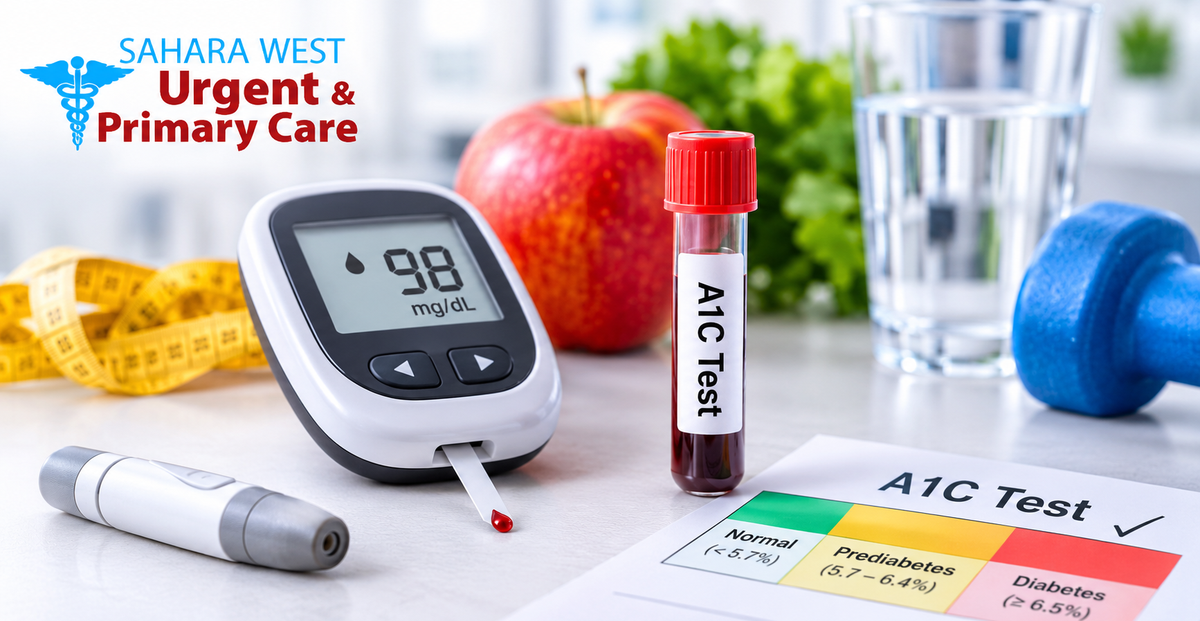
Prediabetes means your blood sugar is higher than normal but not yet in the diabetes range. It is one of the strongest warning signs. An A1C of 5.7% to 6.4% falls in the prediabetes range. Most people with prediabetes have no symptoms. iatrox
What you can do: Prediabetes is a chance to act early. People with prediabetes need to be tested for diabetes every year. cham
6. High Blood Pressure or Abnormal Cholesterol
Blood pressure, cholesterol, and blood sugar are closely linked. ADA risk criteria include low HDL (“good”) cholesterol, high triglycerides (above 250 mg/dL), or both. Diabetes and heart disease also share many risk factors, so managing one often helps the other. wolterskluwer
What you can do: Get your blood pressure and cholesterol checked and follow your provider’s plan.
7. A History of Gestational Diabetes or PCOS
Developing diabetes during pregnancy (gestational diabetes) raises your future risk of type 2 diabetes. The ADA recommends screening at least every 3 years for people with a history of gestational diabetes. Polycystic ovary syndrome (PCOS) is also on the ADA’s list of risk factors. cham
What you can do: Share your pregnancy and hormone history with your provider, even if it was years ago.
Risk Factors at a Glance
| Risk Factor | Can You Change It? | A Helpful First Step |
|---|---|---|
| Overweight or abdominal fat | Often | Talk to a provider about realistic weight goals |
| Family history | No | Share your history with your provider |
| Age 35+ | No | Start routine screening |
| Physical inactivity | Yes | Build up to about 150 minutes/week |
| Prediabetes | Often | Retest yearly and use lifestyle changes |
| High blood pressure / abnormal cholesterol | Often | Check numbers; follow your care plan |
| Gestational diabetes or PCOS history | No | Mention it at your next visit |
Other Factors Worth Knowing
- Race and ethnicity: CDC data show diagnosed diabetes is most common among American Indian and Alaska Native, Black, and Hispanic adults, followed by Asian and White adults. Because ADA screening criteria include race and ethnicity as a risk factor, mention your background to your provider. It may change when you should be tested. cdc
- Smoking: Smoking increases the risk of developing type 2 diabetes and can worsen complications. cmeded
- Certain medications: Some medicines can affect blood sugar. Ask your provider about any you take.
Can You Lower Your Risk?
Often, yes. The National Diabetes Prevention Program sets goals of 5% to 7% body weight loss and 150 minutes of physical activity per week for people with prediabetes. In the landmark Diabetes Prevention Program trial, intensive lifestyle changes reduced progression from prediabetes to type 2 diabetes by 58%. open-exam-prepopen-exam-prep
Small, steady changes add up:
- Choose more fiber and whole foods, and fewer sugary drinks
- Move more during the day, including short walks
- Stop smoking, with your provider’s help
- Keep up with blood pressure, cholesterol, and A1C checks
When Should You Get Tested for Type 2 Diabetes?
Guidelines vary slightly, so your provider will tailor this to you. Under the ADA’s 2026 guidance:
- Adults should begin screening at age 35, or earlier if they are overweight or obese and have at least one other risk factor. diabetesnet
- If results are normal, repeat testing at least every 3 years, sooner if your risk changes. iatrox
- If you already have prediabetes, testing is typically done yearly.
An A1C test measures your average blood sugar over roughly the past three months, and fasting is generally not required.
Don’t wait for a screening date if you notice symptoms. Increased thirst, frequent urination, blurry vision, unusual fatigue, slow-healing cuts, or tingling in the hands or feet should be evaluated promptly. For severe symptoms such as confusion, trouble breathing, or persistent vomiting, call 911 or go to the nearest emergency room.
Get Your Diabetes Risk Checked in Las Vegas
Sahara West Urgent Care & Wellness makes it easy to find out where you stand:
- Free A1C diabetes screening: Walk-ins are welcome. Call (702) 248-0554 to confirm current screening details and eligibility.
- Ongoing care: Our primary care team can review your results and next steps. For a sudden, non-life-threatening concern, urgent care is available the same day.
- Flexible payment: We accept many insurance plans and offer self-pay and financing options. Explore our membership plans too.
- Language support: Tagalog and Hawaiian-speaking providers are available on-site.
Visit us: 6125 W Sahara Ave, Las Vegas, NV 89146
Hours: Mon–Fri 9 AM–8 PM, Sat 9 AM–3 PM
Call: (702) 248-0554
Patients also visit us from Spring Valley, Summerlin, Henderson, and across Las Vegas.
FAQs
What are the biggest risk factors for type 2 diabetes?
The most commonly cited are excess weight (especially abdominal fat), family history, age, physical inactivity, and prediabetes. High blood pressure, abnormal cholesterol, gestational diabetes, and PCOS also raise risk.
Can I get type 2 diabetes if I have no risk factors?
Yes, though it is less likely. Risk factors raise the odds but do not guarantee or rule out diabetes, which is why routine screening matters.
Is type 2 diabetes hereditary?
Family history raises your risk, but genes are only part of the picture. Weight, activity, and other health conditions also play major roles.
Can young adults and children get type 2 diabetes?
Yes. It is more common with age, but it can develop at any age, including in children and teens.
What A1C level means prediabetes?
An A1C of 5.7% to 6.4% is in the prediabetes range. An A1C of 6.5% or higher is in the diabetes range and is confirmed with follow-up testing by your provider.
Do I need to fast for an A1C test?
Fasting is generally not required, but follow any specific instructions your provider gives you.
How often should I be screened?
If results are normal, at least every 3 years, or sooner if your risk changes. If you have prediabetes, yearly testing is typically recommended.
Can I get screened for diabetes at an urgent care in Las Vegas?
Yes. Sahara West Urgent Care & Wellness accepts walk-ins and offers A1C screening. Call (702) 248-0554 to confirm current availability and eligibility.
Can prediabetes be reversed?
Lifestyle changes can prevent or delay progression to type 2 diabetes for many people. Your provider can help you set a plan.
Medical disclaimer: This article is for general education and is not a substitute for professional medical advice, diagnosis, or treatment. A screening result is not a diagnosis. Talk with a healthcare professional about your individual risk.
Sources: NIDDK: Risk Factors for Type 2 Diabetes · CDC National Diabetes Statistics Report · ADA Standards of Care in Diabetes—2026 (DOI 10.2337/dc26-S002)