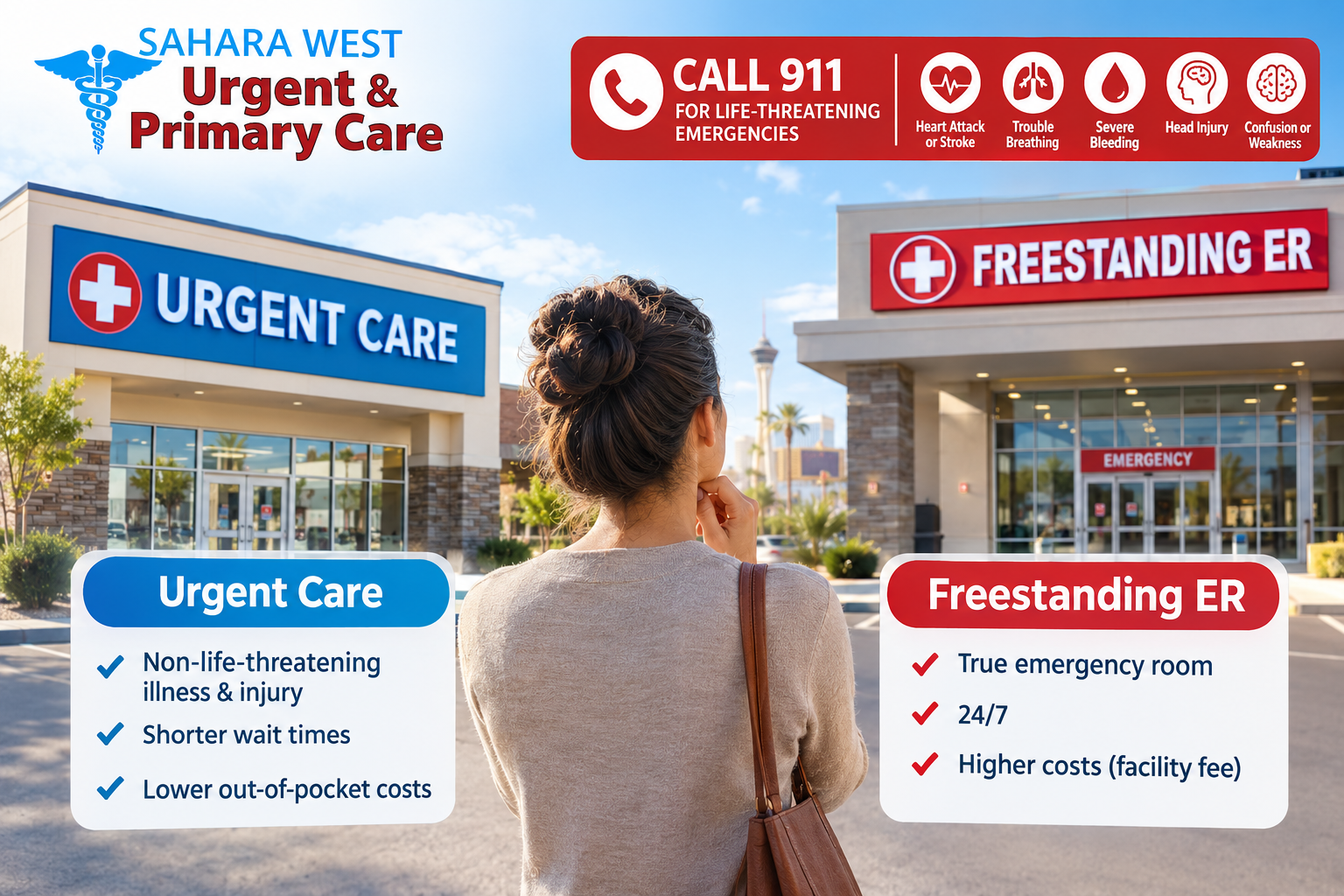
If you think you’re having a heart attack or stroke, can’t breathe, or have severe bleeding, a serious head injury, or sudden confusion or weakness, call 911 now. Don’t read further and don’t worry about the bill.
Freestanding ER vs. urgent care in Las Vegas
A freestanding ER is a true emergency room that isn’t attached to a hospital. It can look like a strip-mall urgent care, but billing at a freestanding ER works like a hospital ER visit, complete with a facility fee, while an urgent care bills more like a doctor’s office. For a non-life-threatening problem, that difference can be the gap between a copay and a bill in the thousands.
This isn’t hypothetical in Las Vegas. A local family was billed more than $2,000 by a standalone ER for a dislocated elbow that took only minutes to treat, and says it never received the itemized bill it requested.
Why people get fooled
The confusion is documented. A local emergency physician interviewed by KTNV said many people assume that a facility not attached to a hospital must be an urgent care. A Florida legislative analysis made the same point: urgent care centers and freestanding emergency departments sometimes look and feel the same.
Many freestanding ERs are legitimate, well-staffed facilities, and they fill a real access gap. The problem isn’t the care. It’s walking in expecting an urgent care price and getting an emergency room invoice.
Urgent care vs. freestanding ER vs. hospital ER
| Urgent Care | Freestanding ER | Hospital ER | |
|---|---|---|---|
| Best for | Non-life-threatening illness and injury | Emergencies when a hospital isn’t nearby | Life-threatening conditions |
| Open | Set hours, not 24/7 | Typically 24/7 | 24/7 |
| Bills like | A doctor’s office visit | A hospital ER, often with a facility fee | A hospital ER |
| Insurance cost-share | Usually urgent care copay | Usually ER copay/deductible | ER copay/deductible |
| Specialists and admission | Refers out if needed | May transfer you to a hospital | Full access to specialists |
Table reflects general patterns described by Dallas County’s public health guidance and NBC reporting on freestanding ER billing. Your plan may differ.
How big is the price gap?
Las Vegas-specific price data is scarce, but studies from other states point the same way:
- A Florida legislative analysis cited an average of $193 at an urgent care center versus more than $2,000 in an emergency room.
- A UnitedHealth study found the same level of care cost about 22 times more at a freestanding ER in Texas than at an urgent care ($3,217 vs. $167 on average).
- An Anthem Colorado study put it at roughly $200 vs. $2,300.
These are averages from other states, not Las Vegas quotes. Still, the pattern is consistent.
A Las Vegas example for locals. The Culinary Health Fund tells members that from September 1, 2026, a freestanding ER visit carries a $750 copay, versus $300 at a hospital ER and $50 at an urgent care. Check your own plan, because many plans treat freestanding ERs as ERs.
Your 60-second check before you walk in
Do these before you register, not after.
- Read the name and signs. Words like “Emergency,” “ER,” or “Emergency Center” mean you’re likely at an ER, not an urgent care.
- Check the hours. Urgent care centers aren’t open 24 hours, and a facility open around the clock is usually an ER.
- Ask the front desk directly:
- “Are you licensed as an emergency room or an urgent care?”
- “Will my visit be billed as an emergency visit, and is there a facility fee?”
- “Are you in-network with my plan?”
- Read before you sign. In one Texas case, the patient had signed a form saying the facility would bill under her emergency department benefits, which the facility later pointed to when she disputed the charge. Never sign consent forms you haven’t read.
- Check with your insurer. Most plans list in-network urgent cares and publish a nurse line.
Rule of thumb: if it’s not an emergency, confirm “urgent care,” not “emergency,” before you’re registered.
Visiting from out of town?
Tourists are the easiest to catch off guard because you don’t know the local landscape and you’re often hurting at an odd hour. Practical steps:
- Look up your plan’s urgent care options before the trip.
- Ask any facility about self-pay pricing if your insurance is out of state.
- Keep your insurance card and ID on you.
- If you’re dehydrated, overheated, or have a minor injury, see our guide on heat exhaustion and dehydration on the Strip to judge how serious it is.
What the law says (and doesn’t)
The federal No Surprises Act covers more than hospitals. It protects you from unexpected out-of-network bills for emergency services at hospital ERs, hospital outpatient departments, and independent freestanding emergency departments. For emergency services, the most an out-of-network facility can bill you is your plan’s in-network cost-sharing amount
Know the limits:
- It doesn’t make the visit cheap. You still owe your plan’s ER copay, deductible, or coinsurance.
- It applies to emergency services. If your condition wasn’t an emergency, the protections may not apply the same way.
- You are never required to give up your protections, so be wary of any form asking you to.
Already got a surprise bill? Do this
- Request a fully itemized bill and your insurer’s Explanation of Benefits. Put the request in writing.
- Compare the two. Look for the facility fee, billing codes, and whether the facility was billed as in- or out-of-network.
- Call your insurer and ask whether it was processed under emergency benefits and whether No Surprises Act protections apply.
- Ask the facility about a financial assistance or billing review.
- File an appeal or complaint with your insurer and, if needed, the Nevada Division of Insurance or the federal No Surprises Help Desk.
- Don’t ignore it. Get an explanation in writing before the balance goes to collections.
When urgent care is the right call
Choose urgent care for non-life-threatening problems such as flu, infections, minor injuries, cuts, sprains, and rashes. At Sahara West Urgent Care & Wellness on West Sahara Avenue, you can:
- Walk in with no appointment for urgent care, plus X-rays Tuesdays and Thursdays (how walk-in X-rays work; X-ray services).
- Know your price up front. Our self-pay fee is $95 (call to confirm what’s included), and we accept Kaiser Permanente, Tricare, Humana, CareCredit, and most major insurance plans.
- Pay over time through Cherry or CareCredit for eligible patients.
- Save with a membership plan, which waives the $95 self-pay fee.
- See what to expect from our urgent care visit walk-through.
What urgent care can’t do: we aren’t a 24-hour facility (Mon-Fri 9am-8pm, Sat 9am-3pm) and we don’t replace an ER for life-threatening conditions. If we determine you need a higher level of care, we’ll tell you directly.
Not sure whether it’s urgent care or ER? Call (702) 248-0554 before you go. Our team can tell you whether we can treat you. Book an appointment or contact us.
Frequently asked questions
What is a freestanding ER?
A licensed emergency room that isn’t physically connected to a hospital. It can treat most emergencies and may transfer you to a hospital if you need admission.
Is a freestanding ER the same as urgent care?
No. It can look the same, but it typically bills like a hospital ER, often with a facility fee, while urgent care bills more like a doctor’s office.
How can I tell if a clinic is an urgent care or an ER?
Check the name, the hours (24/7 usually means ER), and ask directly whether you’ll be billed as an emergency visit and whether there’s a facility fee.
Is urgent care cheaper than the ER in Las Vegas?
For non-life-threatening conditions, usually yes, often dramatically. Studies in other states show freestanding ER visits costing many times more than urgent care for comparable care. Your cost depends on your plan.
Does the No Surprises Act cover freestanding ERs?
It protects against out-of-network balance billing for emergency services at independent freestanding emergency departments. You still owe in-network cost-sharing.
What if I don’t have insurance?
Ask for the self-pay price before you’re treated. At Sahara West the self-pay fee is $95, and eligible patients can use Cherry or CareCredit financing.
Should I avoid the ER to save money?
No. For chest pain, trouble breathing, stroke symptoms, severe bleeding, or serious injury, go to the ER or call 911. A delay can cost far more than any bill.
Where is Sahara West Urgent Care?
6125 West Sahara Avenue, Las Vegas, NV 89146. Mon-Fri 9am-8pm, Sat 9am-3pm. Call (702) 248-0554.
This article is for general information and isn’t medical or legal advice. Costs and coverage vary by plan and facility.