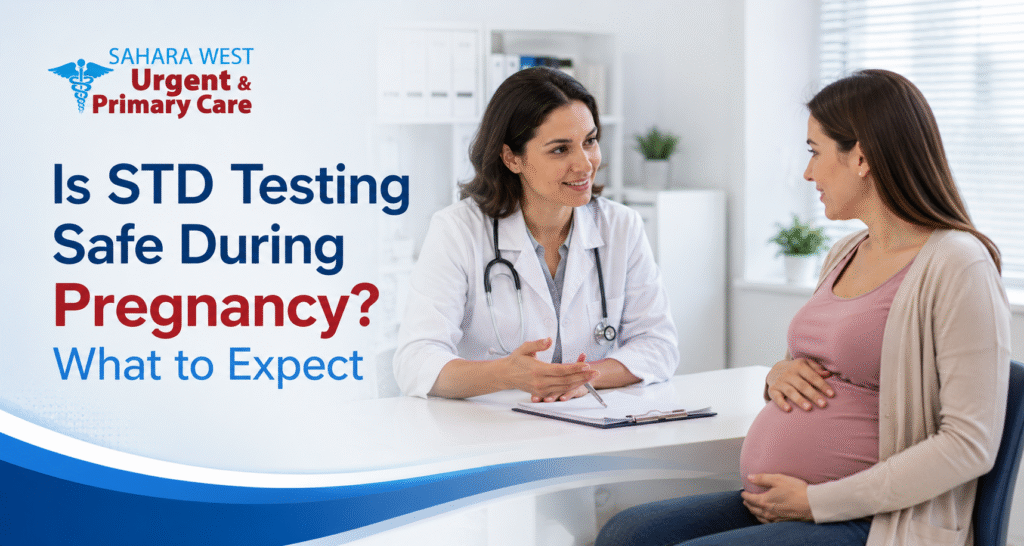
You just found out you are pregnant. Your mind is racing through a hundred things at once, prenatal vitamins, OB appointments, what foods to avoid. STD testing might not be at the top of that list. But it absolutely should be.
Understanding how STD testing works can help you feel more confident about getting screened.
Here is the reality that most pregnancy guides gloss over: some of the most serious threats to your baby’s health during pregnancy are not rare complications. They are sexually transmitted infections that can be present with zero symptoms, pass silently from mother to child, and cause devastating outcomes including stillbirth, blindness, neurological damage, and premature birth.
The good news is that virtually every STI that poses a risk during pregnancy is either treatable or manageable when caught early. Testing is fast, confidential, and in many cases available at your nearest walk-in urgent care clinic the same day you walk in. This guide covers everything you need to know, including what tests you need, when to get them, what happens if a result is positive, and where Las Vegas residents can access fast, affordable care without waiting weeks for an appointment.
For a complete overview of timing, read our guide on how soon after unprotected sex to test for STDs.
Why STD Testing During Pregnancy Is Not Optional
Many people assume that because they have been with the same partner for years, or because they feel healthy, they do not need STD screening during pregnancy. This line of thinking puts both mother and baby at serious risk.
The CDC recommends that all pregnant people be tested for a core panel of STIs at their first prenatal visit, regardless of risk factors, relationship status, or symptoms. Some tests are recommended again in the third trimester for those with ongoing risk factors.
Consider these statistics:
| Infection | U.S. Prevalence in Pregnant People | Risk to Baby if Untreated |
| Chlamydia | Approximately 4 to 5% | Premature birth, neonatal eye infection, pneumonia |
| Gonorrhea | Approximately 1 to 2% | Stillbirth, newborn blindness, joint infection |
| Syphilis | Rising sharply, up 218% since 2018 | Congenital syphilis, stillbirth, organ damage |
| HIV | Estimated 5,000+ deliveries annually | Mother-to-child transmission without treatment |
| Hepatitis B | Approximately 1 in 500 pregnancies | Chronic liver disease, liver cancer in child |
| Bacterial Vaginosis | Up to 20% of pregnancies | Preterm labor, low birth weight |
STD testing after a new partner is critical during pregnancy, even if you feel fine.
Congenital syphilis rates in the United States have reached a 30-year high, according to CDC data. Nevada has consistently ranked among states with elevated STI rates. That makes access to testing not just medically important but genuinely urgent for Las Vegas residents.
Many of these infections are completely asymptomatic. You can carry chlamydia, gonorrhea, or syphilis for months or years without a single noticeable sign. Pregnancy does not cause symptoms to appear. Only a test will tell you.
Which STD Tests Are Recommended During Pregnancy?
The standard prenatal STD screening panel is well-established and medically supported. Here is a complete breakdown of what is recommended and when.
First Trimester Testing (At Your First Prenatal Visit)
Every pregnant person should receive the following tests at their first prenatal appointment, ideally before 10 weeks:
| Test | Method | Why It Matters |
| HIV | Blood test | Antiretroviral treatment reduces transmission to baby to under 1% |
| Syphilis (RPR/VDRL) | Blood test | Congenital syphilis is fatal in 40% of untreated cases |
| Hepatitis B (HBsAg) | Blood test | Newborn vaccination + HBIG can prevent transmission |
| Chlamydia | Urine or cervical swab | Most common bacterial STI in the U.S., often asymptomatic |
| Gonorrhea | Urine or cervical swab | Can cause blindness and sepsis in newborns |
| Hepatitis C | Blood test (recommended since 2020) | Antiviral treatment now available and highly effective |
At-home STD testing vs. urgent care which is right for prenatal screening? Urgent care offers faster, more reliable results.
Additional Tests Based on Risk or History
Depending on your history, your provider may also recommend:
- Herpes HSV-1 and HSV-2 serology if you or your partner has a history of oral or genital herpes
- Trichomoniasis screening if symptoms are present
- Bacterial vaginosis assessment, particularly if you have a history of preterm labor
- HPV is not routinely screened during pregnancy, but a Pap smear may be included in your first visit if you are overdue
Third Trimester Repeat Testing
The following tests are recommended again between 28 and 36 weeks for people with ongoing risk factors or for all patients in high-prevalence areas:
- HIV (repeat test recommended in all pregnancies by most guidelines)
- Syphilis (repeat strongly recommended given rising national rates)
- Gonorrhea and chlamydia for those with new or multiple partners
- Group B Streptococcus (GBS) at 35 to 37 weeks, which is bacterial but follows a similar testing pathway
At Sahara West Urgent Care in Las Vegas, all of these tests are available on a walk-in basis. If you are early in your pregnancy and have not yet been able to see an OB, or if your prenatal care has gaps, you can come in the same day and get screened without delay. Early results mean early protection for your baby.
What Happens If You Test Positive During Pregnancy?
A positive result during pregnancy is not a catastrophe. It is information that gives you and your provider the power to act. Here is what treatment looks like for the most common infections.
Chlamydia and Gonorrhea
Both are treated with antibiotics that are safe during pregnancy. Azithromycin and amoxicillin are commonly used for chlamydia. Ceftriaxone is the standard treatment for gonorrhea. Treatment clears the infection and dramatically reduces the risk of passing it to your baby during delivery. A test of cure is recommended 3 to 4 weeks after treatment to confirm the infection is resolved.
Syphilis
Penicillin G remains the gold-standard treatment for syphilis during pregnancy and is the only medication proven effective against congenital transmission. Even in penicillin-allergic patients, desensitization protocols exist because treatment is that important. When syphilis is caught and treated before 20 weeks, the risk of congenital transmission can be reduced to near zero.
HIV
A positive HIV result during pregnancy triggers immediate referral to an infectious disease specialist and initiation of antiretroviral therapy. With consistent treatment, the risk of transmitting HIV to a baby drops from approximately 25% to less than 1%. Cesarean delivery and formula feeding may also be recommended in certain cases. An HIV diagnosis during pregnancy is manageable with proper care.
Hepatitis B
If you test positive for hepatitis B surface antigen, your newborn will receive both the hepatitis B vaccine and hepatitis B immune globulin (HBIG) within 12 hours of birth. This combination is over 90% effective at preventing transmission to the baby.
Herpes (HSV)
If you have genital herpes, your provider will prescribe suppressive antiviral therapy such as acyclovir or valacyclovir beginning at 36 weeks to reduce the risk of an active outbreak at the time of delivery. A cesarean section is recommended if active lesions are present at the time of labor.
The key message: knowing your status gives you options. Not knowing eliminates them.
STD Testing in Las Vegas During Pregnancy: Why Timing and Access Matter
Prenatal care access in Nevada is uneven. Ob-gyn appointment wait times in Las Vegas can stretch from several weeks to over a month for new patients. In those early, critical weeks before your first official OB visit, infections can go undetected and untreated.
This is where walk-in urgent care becomes genuinely valuable for pregnant patients.
Sahara West Urgent Care in Las Vegas offers:
| Service Feature | Details |
| Walk-in STD testing | No appointment required |
| Comprehensive STD panels | Including all CDC-recommended prenatal tests |
| Same-day results for many tests | Blood draw and urine results processed quickly |
| Confidential care | HIPAA-protected, results shared only with you |
| Bilingual providers | Tagalog and Hawaiian-speaking providers available |
| Insurance accepted | Kaiser, Tricare, Humana, CareSource, and most major plans |
| Affordable self-pay | $95 flat visit fee, waived with monthly membership |
| Convenient hours | Monday through Friday 9am to 8pm, Saturday 9am to 3pm |
Protecting Your Baby: The Impact of Early Detection by Trimester
Timing matters enormously in prenatal STD care. Here is a trimester-by-trimester look at what testing and treatment can prevent.
| Trimester | What to Test | Why It Matters at This Stage |
| First (Weeks 1 to 12) | Full panel: HIV, syphilis, hep B, hep C, chlamydia, gonorrhea | Maximum time for treatment before fetal organ development completes |
| Second (Weeks 13 to 27) | Retest if exposure occurred, treat any positive results from first trimester | Prevent placental complications, preterm labor risk |
| Third (Weeks 28 to 40) | Repeat HIV, syphilis; GBS screening at 35 to 37 weeks | Prevent transmission during delivery; plan delivery method if needed |
| At Delivery | GBS status, HIV status, hepatitis B | Guides immediate newborn treatment protocols |
STD testing after a new partner should happen within 2-3 weeks even during pregnancy.
According to the American College of Obstetricians and Gynecologists (ACOG), early and repeated screening throughout pregnancy remains the single most effective strategy for preventing congenital STI complications. Testing is the intervention.
Take Action Now for Your Baby’s Health
Pregnancy is one of the most important times in your life to know your complete health status. An STD test takes minutes. The results can shape the entire course of your prenatal care and protect your child from preventable harm.
Do not let lack of time, insurance uncertainty, or the anxiety of not knowing hold you back. The providers at Sahara West Urgent Care in Las Vegas are here to help you get answers quickly, compassionately, and confidentially.
Walk any day of the week. No appointment needed. Bring your questions and leave with clarity.
Sahara West Urgent Care and Wellness Phone: (702) 248-0554 Hours: Monday through Friday, 9am to 8pm. Saturday, 9am to 3pm. Website: saharawesturgentcare.com Insurance accepted. Self-pay options available. Monthly membership plans available to eliminate visit costs entirely.
My child has a fever? We treat newborns and children too — your whole family’s health is our priority.
Your health and your baby’s health are worth a 15-minute stop.
First come First serve!
Schedule your appointment now!
FAQs
Is it safe to have STD testing done while pregnant?
Yes, completely. Blood draws, urine tests, and swab collections are all safe during pregnancy and cause no harm to the fetus. There is no medical reason to avoid STD testing at any stage of pregnancy.
Can I get tested for STDs at an urgent care clinic instead of waiting for my OB?
Absolutely. Walk-in urgent care clinics are fully equipped to run the standard prenatal STD panel. If you need a test quickly and cannot wait for an OB appointment, a clinic like Sahara West Urgent Care in Las Vegas can provide the same testing same day.
What if I tested negative at the start of pregnancy but had a new exposure later?
Repeat testing is recommended. The CDC guidelines specifically call for re-screening in the third trimester for syphilis and HIV in high-prevalence areas like Nevada. If you had a new partner or unprotected exposure at any point during your pregnancy, retest immediately.
Will a positive STD test affect my pregnancy legally or with child protective services?
A positive STD test result is a medical finding, not a legal one. It is protected under HIPAA. Healthcare providers are focused on getting you treatment, not reporting you. Seeking care is always the right move.
Can STDs cause miscarriage?
Yes, some untreated infections can contribute to pregnancy loss. Untreated syphilis in particular is associated with stillbirth in 25 to 40% of untreated cases. Bacterial vaginosis and gonorrhea have also been linked to increased miscarriage and preterm birth risk.
What STD causes the most danger to a newborn?
Congenital syphilis carries some of the most severe outcomes, including stillbirth, bone deformity, neurological damage, and organ failure. Neonatal herpes, though less common, can cause fatal encephalitis if the baby is exposed during vaginal delivery with an active outbreak. Untreated HIV poses significant transmission risk. All are preventable with timely testing and treatment.
Does my partner need to be tested too?
Yes. If you test positive for any STI, your partner should be tested and treated simultaneously. Reinfection during pregnancy is possible if a partner remains untreated. Many clinics, including Sahara West, can test partners on the same visit.
How long does it take to get STD test results when pregnant?
At Sahara West Urgent Care, many results are available within 24 to 48 hours. Some rapid tests, such as HIV rapid testing, deliver results within minutes. You will receive your results privately and have the opportunity to discuss next steps with a provider directly.
Is there a cost difference for STD testing during pregnancy?
Most major insurance plans cover prenatal STD screening as a mandatory preventive service with no copay under the Affordable Care Act. If you are uninsured or on a self-pay plan, Sahara West Urgent Care offers a flat $95 visit fee, which is waived entirely for membership plan holders.
Can I be treated for an STD at an urgent care clinic if I am pregnant?
For bacterial infections like chlamydia, gonorrhea, and syphilis, yes. Treatment can be initiated the same day. For viral infections like HIV or hepatitis B, you will receive a referral to a specialist alongside any immediate care needed. Urgent care is an excellent first stop for diagnosis and initial management.