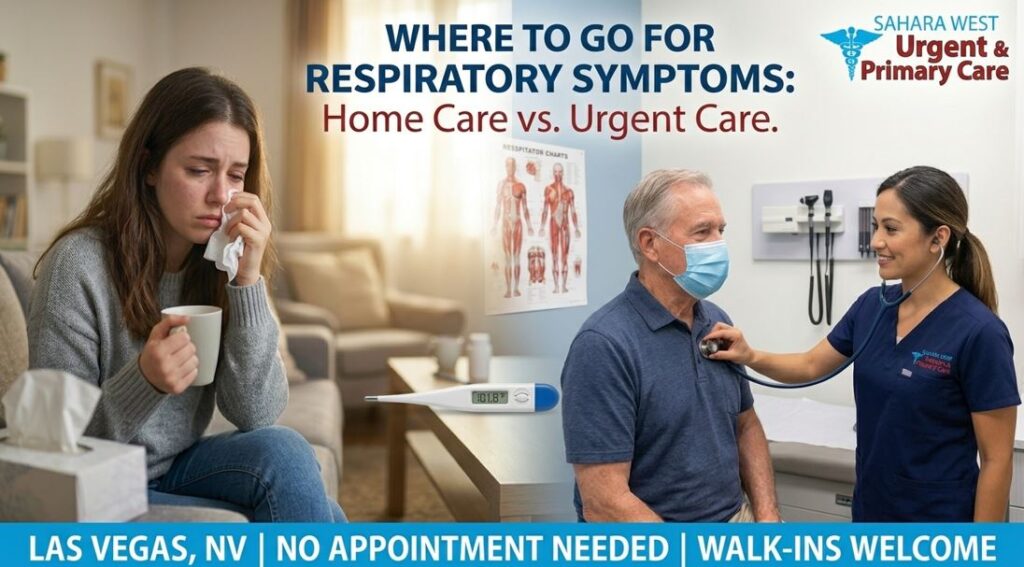
Most cases of cough, fever, congestion and sore throat are caused by viruses (a cold, flu, COVID-19 or RSV) and improve within 7 to 10 days with rest and fluids. Get seen the same day if your fever lasts more than 3 days, your symptoms get worse after starting to improve, you have a severe sore throat without a cough, or you have asthma, diabetes, heart or lung disease. Go to the ER or call 911 for trouble breathing, chest pain, confusion, or blue lips.
If you are not sure which group you fall into, you can walk into Sahara West Urgent Care at 6125 W Sahara Ave, Suite 1B. We are open Monday to Friday 9 AM to 8 PM and Saturday 9 AM to 3 PM, and no appointment is needed. Prefer to call first? (702) 248-0554
Where Should You Go for Respiratory Symptoms?
| Your situation | Best next step |
|---|---|
| Mild cough, stuffy nose, scratchy throat, low or no fever, improving daily | Rest, fluids and home care. See a provider if nothing improves after 10 days. |
| Fever for more than 3 days, painful swallowing, worsening cough, wheezing, symptoms that returned after improving | Walk-in urgent care today |
| Asthma, COPD, diabetes, heart disease, pregnancy, age 65+, or a weakened immune system, with a fever or worsening cough | Walk-in urgent care today, and don’t wait it out |
| Trouble breathing at rest, chest pain or pressure, confusion, blue lips, coughing up blood, unable to keep fluids down | ER / call 911 |
| Fever of 100.4°F or higher in a baby under 3 months | ER or pediatrician immediately |
What’s Probably Causing Your Symptoms?
Cough, fever, congestion and a sore throat overlap across many illnesses, so the pattern matters more than any single symptom.
| Condition | How it usually starts | Clues that point to it |
|---|---|---|
| Common cold | Gradual | Runny or stuffy nose and sore throat first, mild cough, little or no fever |
| Flu (influenza) | Sudden | High fever, chills, body aches, severe fatigue, dry cough, headache |
| COVID-19 | Varies | Can look like a cold or the flu; loss of taste or smell may occur. Only testing can tell them apart. |
| RSV | Cold-like | Cough and congestion, sometimes wheezing; can be serious in infants and older adults |
| Strep throat | Sudden | Severe throat pain, fever, swollen tonsils (sometimes white patches), tender neck glands, usually no cough or runny nose |
| Acute bronchitis | After a cold | Cough that lingers for 1 to 3 weeks, mucus, chest soreness |
| Sinus infection | Late in a cold | Congestion with facial pressure lasting more than 10 days, or worsening after initial improvement |
| Allergies | Seasonal or exposure-related | Sneezing, itchy eyes, congestion, postnasal drip cough, no fever |
| Pneumonia | Can follow a cold or flu | Fever, productive cough, shortness of breath, chest pain, which always needs evaluation |
A cough and runny nose alongside a sore throat usually point to a virus rather than strep. A sudden, severe sore throat with fever and no cough is the pattern that deserves a strep test.
Symptom by Symptom: What to Watch For
Cough: how long is too long?
- Under 3 weeks: Usually a cold, flu, COVID-19 or bronchitis. It can linger well after other symptoms fade.
- 3 weeks or longer: Get evaluated. Causes include asthma, postnasal drip, reflux, pertussis (whooping cough) and others.
- Any duration with shortness of breath, wheezing, chest pain, coughing up blood, or thick green, yellow or bloody mucus alongside fever: be seen promptly.
If your provider suspects pneumonia or another lung problem, a chest X-ray can help. X-ray services at Sahara West are available on Tuesdays and Thursdays, walk-ins welcome. Our guide to when you need an X-ray in urgent or primary care explains what to expect.
Fever: what counts and what’s concerning
For adults, a fever generally starts at 100.4°F (38°C). Mild fevers are the body fighting infection and often don’t need treatment beyond comfort. Seek care if:
- A fever lasts more than 3 days
- A fever returns after going away
- A fever reaches 103°F or higher, or does not respond to fever reducers
- Fever comes with confusion, a stiff neck, a seizure, or a severe headache (go to the ER)
- A child’s fever lasts more than a couple of days, or the child is not drinking, is unusually sleepy, or has trouble breathing
Congestion: cold, allergy or sinus infection?
Congestion alone is rarely urgent. Clear mucus and sneezing with itchy eyes point toward allergies. Congestion that lasts more than 10 days, gets worse after a few days of improvement, or comes with facial pain and fever may be a bacterial sinus infection. If allergies keep recurring, our primary care team offers allergy testing and long-term management.
Sore throat: strep or viral?
Most sore throats are viral and do not need antibiotics. Strep throat is caused by bacteria and does need treatment. It cannot be reliably diagnosed by looking at your throat, so a quick test is the way to know. Get a sore throat checked if it is severe, comes on suddenly with fever, is not improving after a few days, or makes swallowing, drinking or opening your mouth difficult.
Red Flags: Go to the ER or Call 911
Urgent care is for non-life-threatening illness. Go to the nearest emergency room or call 911 if you or someone in your family has:
- Severe shortness of breath, or trouble speaking in full sentences
- Chest pain or pressure
- Blue or gray lips or face
- Confusion, extreme drowsiness, or trouble waking up
- A fever with a stiff neck or seizure
- Coughing up blood
- Drooling, inability to swallow saliva, or a muffled “hot potato” voice with noisy breathing
- Signs of severe dehydration, or inability to keep any fluids down
- A fever of 100.4°F or higher in an infant under 3 months
When Urgent Care Is the Right Choice
A walk-in clinic is a good fit when you feel truly sick but are not in an emergency. Come in if:
- Your fever has lasted more than 3 days
- You have a severe or sudden sore throat, especially with fever and no cough
- Your cough is getting worse, producing colored mucus, or causing wheezing
- You started to recover and then got worse
- Symptoms have lasted longer than 10 days without improving
- You have a higher-risk condition (asthma, COPD, diabetes, heart disease, pregnancy, a weakened immune system) or are 65 or older
- You need a diagnosis for work, school or peace of mind, or want to know if testing or treatment could help
Timing matters for flu. Antiviral medication works best when started within the first 2 days of symptoms, so don’t wait if your symptoms hit hard and fast.
Not sure whether you need to come in? Call (702) 248-0554 or book an appointment. Walk-ins are always welcome.
What to Expect at Sahara West Urgent Care
Our urgent care in Las Vegas is set up to evaluate respiratory illness in one visit:
- Check-in and vitals. Temperature, oxygen level, heart rate and symptom history. Most patients are registered and seen in about 15 to 30 minutes, though waits can vary.
- Exam. A provider examines your throat, ears, nose and lungs.
- Testing when it’s useful. Point-of-care testing can screen for conditions like strep throat and flu, and our providers also care for RSV and acute bronchitis.
- Imaging if needed. If a lung problem is suspected, digital X-rays are available on-site on Tuesdays and Thursdays.
- A clear plan. You leave with a diagnosis or next steps, including prescriptions when appropriate, home-care guidance and a return-to-work or school plan.
For a walkthrough of the full process, see what happens during an urgent care visit.
Cost and coverage. We accept most major insurance plans (see our insurance page) and offer self-pay pricing, so uninsured patients can still be seen. Our membership plans can waive the $95 self-pay fee, and eligible patients can explore Cherry and CareCredit payment options.
Home Care That Actually Helps
For mild illness without red flags:
- Rest and fluids. Water, broth and warm tea help thin mucus and prevent dehydration. Fever, dry air and hot weather can dehydrate you quickly. See our post on dehydration and heat in Las Vegas.
- Soothe your throat. Warm liquids, lozenges, ice chips or a saltwater gargle. Honey can calm a cough in adults and children over 1 year. Never give honey to infants under 12 months.
- Ease congestion. Saline spray or rinse, steam from a shower, and a clean humidifier.
- Reduce fever and aches. Acetaminophen or ibuprofen, following the label. Don’t give aspirin to children or teens.
- Be careful with children’s medicine. Check with a provider before giving cough and cold medicine to young children.
- Avoid irritants. Smoke, vaping and strong fragrances can prolong a cough.
Antibiotics don’t work on viruses, so taking them for a cold or flu will not help and can cause side effects.
When Can You Go Back to Work or School?
CDC guidance for common respiratory viruses like flu, COVID-19 and RSV is to stay home until your symptoms are improving overall and you’ve been fever-free for at least 24 hours without fever-reducing medicine. For the next several days after returning, extra precautions such as handwashing, covering coughs and wearing a mask around others help limit spread. If you have strep throat, your provider will tell you when it is safe to return, typically after starting antibiotics.
Why Respiratory Symptoms Can Linger in Las Vegas
Las Vegas has several factors that can make a cough or sore throat feel worse or last longer:
- Dry desert air can irritate the throat and nasal passages and thicken mucus.
- Dust and seasonal allergens can mimic or worsen cold symptoms, so some “colds” are really allergies.
- Heavy travel and crowds, including conventions, flights and shared indoor spaces, make it easy to catch and spread respiratory viruses.
- Air conditioning and temperature swings between hot outdoors and cold indoors can leave your throat feeling raw.
If you’re visiting from out of town and feel sick, our clinic is a short drive from the resort corridor. See directions for The Strip. We also serve Summerlin, Spring Valley, Winchester, Paradise and Enterprise.
How to Lower Your Risk
- Stay current on flu, COVID-19 and RSV vaccines if you’re eligible. Ask a provider what’s right for you.
- Wash your hands often and avoid touching your face.
- Cover coughs with a tissue or your elbow.
- Stay home when you’re sick, and keep distance from high-risk people.
- Manage allergies, asthma and chronic conditions with a regular provider. Our primary care team can help.
FAQs
Should I go to urgent care for a cough, fever and sore throat?
Yes, if your fever lasts more than 3 days, symptoms worsen, your throat pain is severe, or you have a chronic condition like asthma or diabetes. For mild symptoms that are improving, home care is usually enough. If you have trouble breathing or chest pain, go to the ER.
How can I tell if my sore throat is strep or a cold?
A sore throat with cough, runny nose or hoarseness is usually viral. Strep typically brings sudden severe throat pain, fever, swollen tonsils and tender neck glands, usually without a cough. Only a strep test can confirm it, and Sahara West can screen for strep on-site.
How long does a cough last after a cold or flu?
A cough can linger 1 to 3 weeks after other symptoms fade. If it lasts longer than 3 weeks, or comes with wheezing, shortness of breath, chest pain or coughing up blood, get it evaluated.
When is a fever too high for an adult?
A fever starts at 100.4°F. Seek care for a fever lasting more than 3 days or reaching 103°F or higher. Go to the ER if a fever comes with confusion, a stiff neck, a seizure or trouble breathing.
Is it a cold, the flu or COVID-19?
They overlap heavily. Colds are gradual and milder, while the flu hits suddenly with high fever and body aches. COVID-19 can look like either. Testing is the only reliable way to tell them apart, and it matters most for people at higher risk.
Do I need antibiotics for a cough or sore throat?
Usually not. Most coughs and sore throats are viral, and antibiotics don’t treat viruses. They help only for bacterial infections like strep throat or some sinus infections and pneumonia, which a provider has to diagnose.
Urgent care or the ER for a cough and fever?
Urgent care is right for stable, non-life-threatening symptoms. Go to the ER for severe breathing trouble, chest pain, confusion, blue lips, coughing up blood, or a fever in an infant under 3 months.
Does Sahara West take walk-ins for cough and cold symptoms?
Yes. No appointment is needed during our hours, Monday to Friday 9 AM to 8 PM and Saturday 9 AM to 3 PM. You can also call (702) 248-0554 or book online.
Can urgent care do a chest X-ray for a cough?
If your provider thinks imaging is needed, Sahara West offers on-site digital X-rays on Tuesdays and Thursdays, with walk-ins welcome. Our team will tell you the best next step based on the day and your symptoms.
What if I don’t have insurance?
You can still be seen. We offer self-pay pricing, and our monthly membership can waive the $95 self-pay fee. Eligible patients can also explore Cherry and CareCredit payment options. Call (702) 248-0554 for details.
Feeling Sick? Get Checked Today
You don’t have to guess whether it’s a cold, the flu or something that needs treatment. Walk in to Sahara West Urgent Care & Wellness, meet our care team, and get clear answers in one visit.
- Address: 6125 W Sahara Ave, Suite 1B, Las Vegas, NV 89146
- Hours: Mon to Fri 9 AM to 8 PM | Sat 9 AM to 3 PM
- Phone: (702) 248-0554
- Book an appointment or contact us
This article is for general information and is not a substitute for professional medical advice, diagnosis or treatment. If you think you are having a medical emergency, call 911.