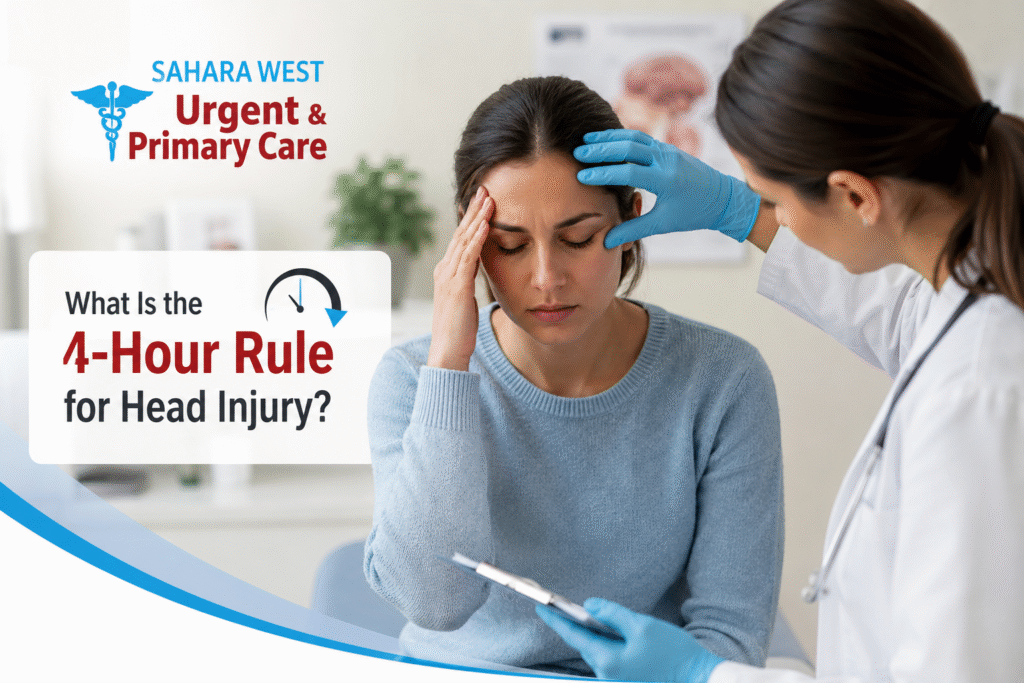
A minor bump to the head can leave you guessing whether you need an emergency room visit, a CT scan, or simply careful observation. At Sahara West Urgent Care, we frequently evaluate patients for mild traumatic brain injuries (TBI) and concussions. Understanding clinical protocols like the 4-hour rule helps you make informed decisions about your health while avoiding unnecessary, expensive ER bills.
Why the 4-Hour Window Matters for Monitoring?
Symptoms of a traumatic brain injury do not always appear immediately. Internal bleeding, swelling, or shifting pressure inside the skull can develop gradually over the hours following an impact.
Medical providers rely on this observation window to catch red-flag indicators early. If a patient remains stable and passes serial neurological checks by the end of this period, the immediate risk of rapid clinical decline significantly decreases, though extended monitoring instructions are still given for the next 24 to 48 hours.
Key Symptoms Monitored During the 4-Hour Observation
During a head injury evaluation, providers and caregivers carefully track specific behavioral and physical indicators, including:
-
Level of Consciousness: Assessing whether the patient is fully alert, easily wakes up, or experiences abnormal drowsiness.
-
Neurological Function: Checking for slurred speech, confusion, disorientation, or memory loss regarding the incident.
-
Visual Changes: Monitoring for unequal pupil sizes, blurred vision, or persistent sensitivity to light.
-
Physical Stability: Watching for repeated vomiting, severe worsening headaches, dizziness, or loss of balance.
-
Motor Responses: Observing limb weakness, numbness, or difficulty walking.
When to Seek Immediate Emergency Room Care
Not all head injuries can be safely monitored at an urgent care facility or at home. If you or a loved one experience any severe trauma indicators, you should bypass standard clinics or wait times and go directly to a hospital emergency department. Warning signs requiring emergency intervention include:
-
Seizures or convulsions following the impact.
-
Clear fluid or blood draining from the nose or ears.
-
Inability to wake up from sleep.
-
A worsening headache that rapidly escalates in intensity.
-
Deep lacerations, skull indentations, or obvious physical deformities.
Why Choose Sahara West Urgent Care for Head Injury Evaluation?
Determining the severity of a concussion or minor head trauma requires professional medical judgment. Urgent care treatment for minor injuries provides a fast, effective alternative to crowded hospital ERs when symptoms are non-life-threatening.
Our providers perform focused physical exams, rule out severe complications, and supply comprehensive post-injury discharge guidelines. If diagnostics indicate a higher-risk injury, we facilitate immediate emergency transport or specialist referrals.
Suffered a minor bump or concussion and need professional medical reassurance? Book an appointment today or walk right into our clinic for immediate, expert evaluation and patient-focused care.