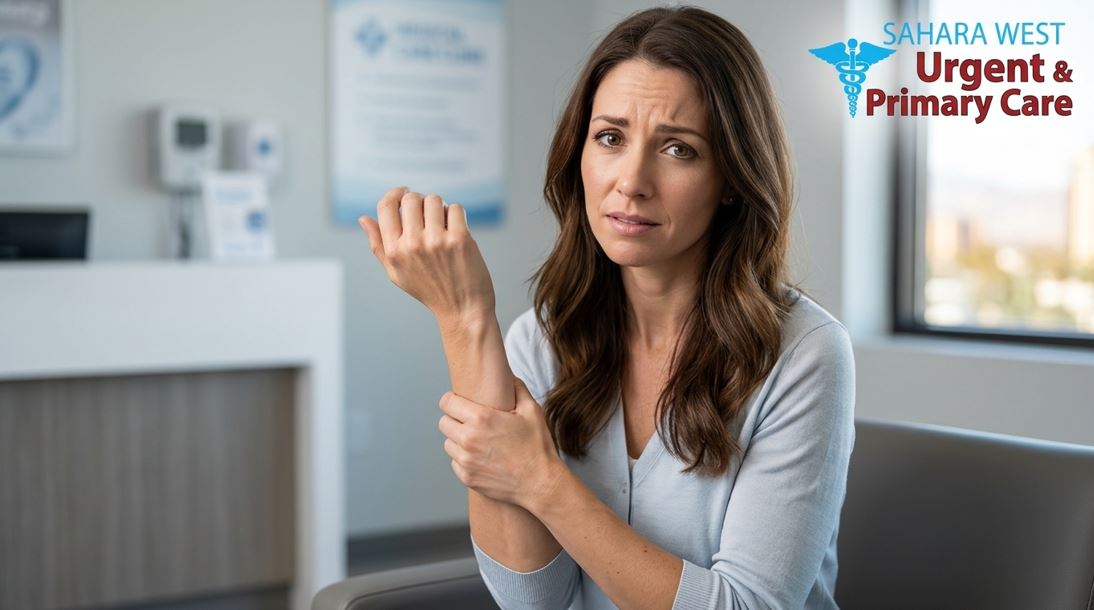

Most minor sports injuries, like a mild muscle strain, a bruise, or a slightly rolled ankle, improve with a few days of rest and home care. But some injuries that feel minor are actually fractures, torn ligaments, or head injuries. Pain level alone doesn’t tell you which one you have.
This guide shows you what you can safely handle at home, what signs mean it’s time to get checked, and when to skip urgent care and go straight to the ER. If you’re in Las Vegas and unsure, Sahara West Urgent Care welcomes walk-ins Monday to Friday 9am–8pm and Saturday 9am–3pm. You can also call (702) 248-0554.
When Should You See a Doctor for a Sports Injury?
Get a sports injury checked if you:
- can’t put weight on the limb or take four steps
- have severe pain, a visible deformity, or numbness or tingling
- have swelling or bruising that is significant or keeps getting worse
- feel the joint is unstable or “giving way”
- heard or felt a pop at the moment of injury
- aren’t clearly improving after several days of home care
- still have pain after about a week of rest
If none of these apply and the pain is mild and improving, home care is usually reasonable.
Green, Yellow, and Red Flags at a Glance
| Level | What it looks like | What to do |
|---|---|---|
| Green: manage at home | Mild soreness, minor swelling, full or near-full movement, can bear weight, improving each day | Rest, ice, compression, elevation, and gentle movement as pain allows |
| Yellow: get checked within a day or two | Swelling or bruising that’s increasing, pain that’s not improving after several days, joint feels loose, can’t fully bend or straighten it, pain that keeps returning | Visit urgent care for an exam and, if needed, an X-ray |
| Red: go to the ER | Bone visible or limb clearly deformed, severe uncontrolled pain, numb, cold or pale limb, head injury with confusion or repeated vomiting, uncontrolled bleeding | Call 911 or go to the nearest ER |
What You Can Safely Treat at Home
For the first 48 to 72 hours after a minor sprain, strain, or bruise, most people do well with the classic RICE approach:
- Rest: Stop the activity and avoid putting stress on the injured area.
- Ice: Apply a cold pack wrapped in a thin cloth for about 15 to 20 minutes at a time. Never put ice directly on the skin.
- Compression: A snug elastic wrap can limit swelling. It shouldn’t cause numbness, tingling, or throbbing.
- Elevation: Raise the injured limb above heart level when you can.
Over-the-counter pain relievers may help if they’re safe for you. Check with a provider or pharmacist if you have kidney, stomach, or heart conditions or take blood thinners.
Gentle movement within a comfortable range usually helps recovery more than complete immobility. Most minor sprains and strains should improve noticeably within a few days to a week.
Signs Your “Minor” Sports Injury Needs a Doctor
You can’t bear weight or use the limb normally
If you can’t take about four steps after a leg, ankle, or foot injury, you could have a fracture or a significant ligament injury. This is true even if there’s little swelling. For arm, wrist, or hand injuries, the equivalent warning sign is being unable to grip, lift, or rotate without sharp pain.
Pain is severe, or it’s getting worse
Pain that eases a little each day is a good sign. Pain that stays the same or gets worse after rest and ice suggests the injury may be more than a simple strain.
Swelling, bruising, or deformity
Rapid swelling in the first hour can point to bleeding inside a joint. Large or spreading bruising, or any bump, bend, or angle that looks wrong, deserves a prompt exam.
The joint feels unstable, locks, or catches
A knee that buckles, an ankle that keeps rolling, or a joint that locks or catches can signal torn ligaments or cartilage damage. Playing on an unstable joint risks a bigger injury.
Numbness, tingling, or color changes
Numbness, pins and needles, or a pale, blue, or cold hand or foot can mean nerve or blood vessel involvement. Treat that as urgent.
You heard or felt a “pop” or “snap”
A pop at the moment of injury, especially with immediate swelling or weakness, can mean a ligament tear, tendon rupture, or fracture.
Pain isn’t improving after about a week
If a “minor” injury still hurts after roughly a week of rest, it probably isn’t minor. Overuse injuries like shin splints can also be early stress fractures, especially if the pain is pinpoint and hurts at rest or at night.
Signs of infection after a scrape or cut
Spreading redness, warmth, pus, red streaks, or fever after a turf burn, road rash, or cut should be checked. So should any cut that gapes open and may need stitches or skin adhesive.
Go to the ER, Not Urgent Care, If You Have…
Call 911 or go to the nearest emergency room for:
- a bone piercing the skin, or an obviously deformed limb
- severe, uncontrolled pain or bleeding
- a cold, pale, or blue limb, or loss of feeling
- a head injury with loss of consciousness, seizure, worsening headache, repeated vomiting, confusion, or unusual drowsiness
- neck or back pain after impact with weakness, numbness, or loss of bladder or bowel control
- chest pain or trouble breathing
- heat stroke symptoms such as confusion, fainting, or hot, dry skin after exercise in the heat
Common Minor Sports Injuries and When to Get Checked
| Injury | Typical signs | Get checked if… |
|---|---|---|
| Ankle sprain | Swelling and bruising around the ankle, pain with walking | You can’t bear weight, the bone is tender to touch, or it’s not improving in a few days |
| Muscle strain (“pulled muscle”) | Sudden sharp pain, tightness, soreness with movement | You see a visible gap or bulge, can’t use the muscle, or bruising is extensive |
| Knee sprain or strain | Pain, swelling, stiffness | The knee locks, gives way, swells quickly, or you can’t straighten it |
| Bruise (contusion) | Tenderness, discoloration | Swelling is severe, pain is out of proportion, or it doesn’t fade over a couple of weeks |
| Jammed finger or toe | Pain, swelling, stiffness | It looks crooked, can’t bend or straighten, or still hurts after a few days |
| Shin splints / overuse pain | Aching along the shin during or after activity | Pain is pinpoint, present at rest or at night, or keeps returning |
| Tendon irritation (tendinitis) | Pain with specific movements, stiffness | Pain lingers beyond a week or two of rest or interrupts sleep |
| Cuts and scrapes | Broken skin, bleeding | The wound is deep or gaping, won’t stop bleeding, or looks infected |
Sprain vs. Fracture: Can You Tell the Difference at Home?
Not reliably. Sprains and fractures can look and feel alike, with swelling, bruising, and pain on movement. Some fractures even allow limited movement. Features that raise suspicion for a fracture include tenderness directly over bone, a pop at the time of injury, and inability to bear weight.
An X-ray shows bones, not ligaments, so a normal X-ray doesn’t rule out a sprain. A provider examines the area first and then decides whether imaging is useful.
Kids and Teen Athletes: Don’t Wait and See
Children’s bones have growth plates, which are softer areas near the ends of long bones that can be injured even when an X-ray or the surface looks mild. A young athlete who limps, avoids using an arm, or complains of persistent pain after a fall or collision should be examined. Don’t rely on “he’ll walk it off.”
Any head impact followed by headache, dizziness, confusion, nausea, or unusual behavior needs medical evaluation. Never send a child back into play after a suspected concussion.
If your athlete also needs clearance for the season, Sahara West offers sports physicals that meet school and athletic requirements.
How Long Should You Wait Before Getting a Sports Injury Checked?
| Timeframe | What it means |
|---|---|
| Right away | Red-flag symptoms: deformity, inability to bear weight, numbness, severe pain, head injury symptoms |
| Within 24–48 hours | Worsening swelling or bruising, joint instability, pain that isn’t easing, or uncertainty about whether it could be a fracture |
| After 5–7 days | Pain or swelling that is only slightly better or not better despite rest, ice, and gentle movement |
| Anytime | Recurring pain in the same spot, a “weak” joint, or pain that keeps you from sleeping or training |
Waiting is the bigger risk when the signs are there. An untreated ligament tear can leave a joint chronically unstable, and a stress fracture can turn into a complete break.
Urgent Care, ER, or a Specialist: Where Should You Go?
| Situation | Best starting point |
|---|---|
| Sprain, strain, or suspected simple fracture, no red flags | Urgent care |
| Cut that may need stitches | Urgent care |
| Deformity, bone through skin, severe bleeding, head injury with serious symptoms | Emergency room |
| Ongoing joint pain, recurring injury, or follow-up after an acute injury | Primary care or an orthopedic/sports medicine specialist |
| Injury from a car crash or at work | Urgent care that handles car accident and workers’ compensation evaluations |
Urgent care is a good first stop for most non-life-threatening injuries. You don’t need an appointment, and your provider can tell you whether imaging, follow-up, or specialist care is the right next step.
What to Expect at Sahara West Urgent Care
At Sahara West, our providers evaluate sprains, strains, and suspected joint or bone injuries in a single visit:
- Quick history and exam: How the injury happened, where it hurts, what movement you have, and whether there’s swelling, instability, or nerve involvement.
- X-ray when it’s helpful: X-ray services are available every Tuesday and Thursday, and walk-ins are welcome. Call ahead on other days to plan your visit.
- Clear next steps: You’ll leave knowing what you have, how to care for it, what to watch for, and when to follow up or see a specialist if needed.
You can walk in during clinic hours or book an appointment online. We accept many major insurance plans and offer self-pay options. Eligible patients can also explore payment plans through Cherry and CareCredit, and our membership plans may be worth a look if you expect repeat visits.
Hurt yourself and not sure if it’s serious? Walk in or call (702) 248-0554. Sahara West Urgent Care is at 6125 W Sahara Ave, Suite 1B, Las Vegas, NV 89146, open Mon–Fri 9am–8pm and Sat 9am–3pm.
Las Vegas Athletes: Local Things to Keep in Mind
Las Vegas has some injury risks of its own:
- Heat and dehydration: Cramps, dizziness, and fatigue during outdoor runs, hikes, or pickleball can raise your injury risk. Confusion, fainting, or hot, dry skin is an emergency.
- Rocky desert terrain: Hiking and trail running around the valley lead to a lot of rolled ankles, falls, and scrapes.
- Weekend-warrior sports: Pickleball, basketball, soccer, and golf are common sources of strains and overuse injuries.
- Visitors: If you’re hurt while visiting, we’re about a 10-minute drive from the north end of the Strip, and we also serve Summerlin and Spring Valley.
How to Lower Your Risk of Sports Injuries
- Warm up before activity and cool down afterward.
- Build intensity and mileage gradually rather than jumping in at full speed.
- Wear shoes and protective gear that suit your sport and fit properly.
- Hydrate before, during, and after exercise, especially in the heat.
- Build strength and balance, particularly in the ankles, knees, hips, and core.
- Treat early aches as information instead of playing through them.
FAQs
How do I know if a sports injury is serious?
Serious injuries tend to involve inability to bear weight, deformity, severe or worsening pain, rapid swelling, numbness or tingling, joint instability, or a pop at the time of injury. If you’re unsure, an in-person exam is the only reliable way to tell a sprain from a fracture.
Should I see a doctor for a sprained ankle?
Yes, if you can’t take four steps, the bone is tender to the touch, swelling and bruising are significant, or you’re not improving after a few days. A mild sprain you can walk on, with swelling that shrinks daily, can usually be managed at home.
How long should I wait before getting a minor sports injury checked?
Don’t wait if you have red-flag symptoms. For otherwise mild injuries, get checked if pain or swelling isn’t clearly improving after several days, or if it still hurts after about a week of rest.
Can urgent care treat sports injuries?
Yes. Urgent care can evaluate sprains, strains, suspected fractures, and minor cuts, and arrange X-rays when appropriate. Serious emergencies like open fractures or severe head injuries need the ER.
Does an X-ray show a sprain?
No. An X-ray shows bones, so it can detect fractures and dislocations but not ligament or muscle injuries. A provider examines you first and decides whether imaging will help.
What’s the difference between a sprain and a strain?
A sprain is a stretched or torn ligament, the tissue connecting bone to bone. A strain is a stretched or torn muscle or tendon. Both cause pain, swelling, and reduced movement, and both can range from mild to severe.
Is it okay to keep playing through pain?
Playing through sharp, worsening, or joint pain can turn a minor injury into a major one. Mild muscle soreness that fades as you warm up is different from sharp pain that makes you change how you move.
Should kids with sports injuries see a doctor?
Yes, if they limp, avoid using a limb, have pain over a bone, or have any head impact with symptoms. Growth-plate injuries can be easy to miss without a proper exam.
Do I need an appointment at Sahara West Urgent Care?
No. Walk-ins are welcome during clinic hours. You can also book online or call (702) 248-0554. X-ray services are available Tuesdays and Thursdays.
Urgent care or ER for a sports injury?
Choose urgent care for non-life-threatening sprains, strains, and suspected simple fractures. Choose the ER for deformity, bone through skin, severe bleeding, loss of feeling in a limb, or a head injury with serious symptoms.
Don’t Guess About a Sports Injury
If your injury isn’t getting better, or you’re not sure whether it’s minor, a quick exam can save you weeks of pain and a longer recovery. Walk into Sahara West Urgent Care or call (702) 248-0554 to get checked today.
This article is for general education and is not a substitute for professional medical advice, diagnosis, or treatment. If you think you’re having a medical emergency, call 911.