
Introduction
Airbags save lives. That’s not in question.
But what almost nobody tells you is this: the same device that just kept you from going through your windshield can also break your wrist, burn your skin, or bruise your ribs hard enough to crack them.
Most Las Vegas drivers walk away from a collision, see the deployed airbag, and think one thing: thank god that worked. Few stop to consider that “the airbag worked” and “I wasn’t injured” are two completely different statements.
That’s the misconception this guide exists to correct. Airbag deployment injuries are common, often underestimated, and like most collision trauma can hide behind adrenaline for hours or days after the crash.
Below, we’ll walk through exactly how airbags cause injury, which trauma patterns show up most often, and why a professional evaluation at Sahara West Urgent Care should be your very next stop after any collision involving airbag deployment.
The Physics of Airbag Deployment
To understand why airbags can hurt you, you have to understand how violently fast they actually work.
High-Speed Inflation Mechanics
Airbags don’t gently puff open. They deploy at speeds of up to 200 mph, fully inflating within roughly 20 to 30 milliseconds faster than the blink of an eye. That split-second inflation is what makes the device effective at preventing your body from hitting the steering wheel or windshield.
It’s also what makes direct contact with the bag itself a source of real physical trauma.
The Direct Kinetic Impact
At the moment of deployment, the airbag is essentially a rapidly expanding cushion striking your face, chest, and arms with significant force. For context, this is similar to being struck by a fast-moving, semi-rigid surface, not a soft pillow.
This kinetic impact is the root cause of most airbag-related injuries, independent of anything else happening in the crash.
Chemical and Thermal Exposure
Airbags inflate using a rapid chemical reaction that produces gas and that reaction generates heat, propellant residue, and fine powder. Drivers frequently experience skin irritation, minor burns, or respiratory irritation from this byproduct, especially in warmer cabin conditions common in Las Vegas.
Expert tip: The force and byproducts of airbag deployment mean that even accidents where “nothing else really happened” can produce real physical injury from the airbag alone.
Common Physical Injuries Caused by Airbags
Airbag trauma tends to follow recognizable patterns based on where the body makes contact. Here’s what to watch for.
Facial and Ocular Trauma
The face is often the first point of contact. Common injuries include:
- Corneal abrasions from powder or fabric contact
- Facial contusions and swelling
- Nasal fractures from direct impact
- Eye strain, redness, or irritation following explosive deployment
Chest and Rib Cage Injuries
The chest absorbs significant force, particularly for drivers seated close to the wheel. This can result in:
- Bruised or fractured ribs
- Sternal fractures from direct steering wheel module impact
- Soft tissue trauma and deep bruising across the chest wall
Wrist, Hand, and Arm Fractures
If your hands were positioned across the steering wheel or dashboard at the moment of deployment, the explosive force can cause:
- Wrist fractures
- Hand and finger injuries
- Forearm soft tissue trauma or fractures
Neck and Whiplash Trauma
The rapid head snapback triggered by airbag deployment combined with the collision’s own deceleration forces places heavy strain on the cervical spine, frequently resulting in whiplash and related neck injuries.
Chemical Burns and Skin Abrasions
Contact with the bag’s fabric and residual propellant chemicals can cause:
- Friction burns on the face, neck, or arms
- Thermal irritation from residual heat
- Contact dermatitis or rash from chemical exposure
Hearing Damage and Tinnitus
The concussive blast of the airbag’s detonator produces a genuinely loud noise at extremely close range. This acoustic trauma can result in temporary or, in some cases, lasting tinnitus or hearing impairment.
Real-world example: A driver involved in a moderate-speed collision on Rainbow Boulevard may walk away thinking their only issue is “a sore chest” only to later be diagnosed with a mild rib fracture and corneal abrasion, both caused by airbag contact rather than the collision impact itself.
Why Immediate Medical Evaluation Is Critical
Adrenaline and Shock Mask Acute Trauma
Just like whiplash and other collision injuries, airbag-related trauma is frequently hidden in the first hour by adrenaline and shock. Facial pain, chest soreness, or wrist discomfort can feel like minor irritation initially even when a fracture or corneal injury is present.
Delayed-Onset Symptoms
Bruising, swelling, and inflammation from airbag impact commonly intensify over 24 to 72 hours, following the same predictable delayed-symptom timeline seen across most collision-related injuries.
Preventing Minor Trauma From Becoming Chronic
A minor rib contusion left unchecked can complicate breathing and healing. An untreated corneal abrasion can lead to infection or lasting vision issues. Early evaluation isn’t just about comfort, it’s about preventing small injuries from becoming long-term problems.
Mistake to avoid: Assuming “the airbag did its job” means you’re in the clear. The airbag’s job was preventing a worse outcome not guaranteeing zero injury.
Urgent Care vs. Emergency Room for Airbag Injuries
When to Seek Immediate Hospital Emergency Care
Go directly to the emergency room if you experience:
- Severe chest pain or difficulty breathing
- Loss of consciousness at any point
- Significant, uncontrolled bleeding
- Signs of major trauma (severe deformity, inability to move a limb)
Why Sahara West Urgent Care Is the Ideal Alternative for Non-Life-Threatening Injuries
For the majority of airbag deployment injuries, bruising, minor fractures, facial abrasions, chest soreness, urgent care is the faster, smarter path.
-
Avoiding Long Las Vegas Hospital Wait Times
Skip the multi-hour ER wait common across Las Vegas hospitals for non-critical injuries, and get seen promptly instead.
-
Immediate Access to Digital X-Rays and Physical Evaluations
Get fractures, rib injuries, and soft tissue trauma assessed the same day without a separate imaging referral.
-
Cost-Effective Outpatient Care
Receive high-quality diagnostic and treatment care at a fraction of typical emergency room costs for comparable non-critical injuries.
Soft CTA: If you’re dealing with chest soreness, facial bruising, or wrist pain after airbag deployment, Sahara West Urgent Care can get you evaluated today with no lengthy ER wait required.
Comprehensive Diagnostics and Care at Sahara West Urgent Care
Physical Range-of-Motion and Neurological Screenings
Clinical evaluation of arm, wrist, neck, and chest mobility helps isolate exactly which structures were affected by airbag impact and rules out related neurological concerns.
On-Site Digital X-Rays
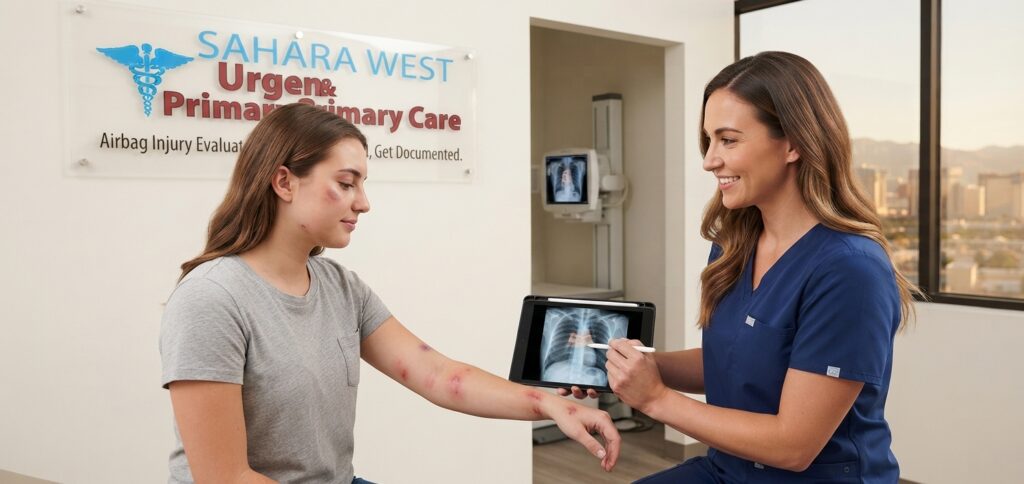
Rapid, same-visit imaging identifies rib fractures, wrist fractures, and other skeletal damage without delay critical for injuries caused by direct airbag contact.
Tailored Treatment Plans
Every airbag-related injury profile is different. Treatment plans may include:
- Wound cleaning and management for abrasions or chemical burns
- Anti-inflammatory treatment for bruising and soft tissue trauma
- Immobilization or splinting guidance for suspected fractures
- Referral for specialized eye or hearing evaluation when indicated
- Structured follow-up to track healing
Insurance Documentation and Personal Injury Claims in Las Vegas
The Necessity of a Prompt Medical Paper Trail
Airbag-related injuries are exactly the type of trauma insurance adjusters scrutinize most because they’re not always visible and often get dismissed as “normal” post-crash discomfort. A medical visit within the critical 72-hour window creates the documented link between your injury and the collision.
How Clinical Notes Support Your Claim
Detailed medical records from Sahara West Urgent Care diagnosis, imaging, and treatment documentation give your insurance company and any attorney concrete evidence that your airbag-related injury is real, documented, and accident-related.
Overcoming Insurance Pushback on Delayed Reporting
Insurers frequently argue that safety-device injuries “would have been reported immediately” if they were genuine. Prompt evaluation and clear clinical documentation directly counter that argument protecting your car accident injury claim from being minimized or denied.
Bottom line: An airbag injury without documentation is an argument waiting to happen with your insurance company. An airbag injury with documentation is a supported, defensible claim.
Conclusion & Next Steps
Airbags are one of the most important safety innovations in modern vehicles but that doesn’t mean they leave you unharmed. Facial trauma, rib fractures, wrist injuries, chemical burns, and hearing damage are all realistic outcomes of airbag deployment, and many of them hide behind adrenaline for hours or days.
Key takeaways:
- Airbags deploy with enough force to cause real physical injury on their own
- Facial, chest, wrist, neck, and skin injuries are all common outcomes of airbag contact
- Adrenaline and shock frequently mask symptoms for 24 to 72 hours
- Prompt medical evaluation protects both your recovery and your insurance claim
- Urgent care offers faster, more affordable diagnostics than a crowded ER for non-life-threatening airbag injuries
Don’t assume “the airbag worked” means you’re unharmed. Get the evaluation that confirms it.
Visit Sahara West Urgent Care at 6125 West Sahara Avenue, Las Vegas, NV, or call (702) 248-0554 for a fast, expert airbag injury evaluation today. Your health and your claim deserve certainty, not guesswork.
Frequently Asked Questions (FAQs)
Can an airbag break bones even in a low-speed collision?
Yes. Because airbags deploy at speeds up to 200 mph within milliseconds, the force of contact alone separate from the collision itself can cause wrist fractures, rib injuries, and facial trauma, even in lower-speed crashes.
What should I do if I experience skin burns or eye irritation after an airbag pops?
Rinse the affected area gently if chemical residue is present, avoid rubbing your eyes, and seek prompt medical evaluation. Airbag propellant residue can cause corneal abrasions, chemical burns, or skin irritation that need professional assessment and treatment.
Is chest soreness normal after an airbag deploys, or does it require a doctor’s visit?
Some soreness is common, but chest pain after airbag deployment should always be evaluated. It can indicate bruised or fractured ribs, or sternal injury, which require imaging to properly diagnose and treat.
Why is urgent care documentation vital for a Las Vegas car accident claim involving airbag trauma?
Airbag injuries are often subtle and easy for insurers to dispute. A documented urgent care visit including exam findings, X-rays, and treatment notes provides objective proof that your injury is genuine and directly tied to the accident, strengthening your claim significantly.