
Introduction
You checked your neck. You checked your back. Nobody checked your knee.
That’s the pattern nearly every collision victim follows and it’s exactly why so many knee and leg injuries from car accidents go undiagnosed until they’ve already become a long-term problem.
Neck and back pain get all the attention after a crash. Meanwhile, the knee that slammed into the dashboard or the leg that got wedged against the pedals during impact quietly develops swelling, instability, and cartilage damage that nobody’s watching for.
Here’s the medical reality: lower-extremity trauma from a collision can lead to permanent joint instability if it isn’t examined and treated early. Torn ligaments don’t heal themselves. Meniscus damage doesn’t “walk itself off.”
This guide is built to change that blind spot. We’ll cover exactly how car accidents damage the knee and leg, which injuries hide behind mild soreness, and why a prompt evaluation at Sahara West Urgent Care should be part of every Las Vegas driver’s post-accident checklist, not an afterthought.
How Car Accidents Cause Knee and Leg Injuries
Lower-extremity injuries aren’t random bad luck. They follow predictable mechanical patterns rooted in vehicle design and crash physics.
The Dynamics of a Crash
During a collision, your vehicle decelerates violently in a fraction of a second but your legs, locked into a cramped footwell, have almost nowhere to absorb that force except through the knees, ankles, and lower leg bones themselves.
Tight footwell spacing means there’s little room for your lower body to move safely during impact, concentrating force into a small, vulnerable area.
“Dashboard Knee”: The Physical Mechanics
One of the most common lower-body injuries in frontal collisions is what’s often called “dashboard knee.” As your body lurches forward, your kneecap (patella) strikes the lower dashboard or center console with significant force frequently transmitting impact energy straight through the joint and into the femur.
This single mechanism accounts for a large share of patellar fractures and knee trauma seen after front-end collisions.
Twisting and Rotational Forces
If your foot is wedged against the floorboard or pedals at the moment of impact, sudden rotational or twisting forces can be transmitted directly into the knee joint, a common cause of ligament and meniscus tears, especially in side-impact collisions or rollovers.
Expert tip: The position of your foot and knee at the exact moment of impact often determines whether you walk away with a bruise or a torn ligament. This is precisely why a clinical exam, not a mirror check is the only reliable way to know which one happened.
Common Knee and Leg Injuries Resulting From Car Crashes
Lower-extremity trauma from collisions tends to fall into a few well-documented categories.
Ligament Tears (ACL, MCL, PCL)
Rotational and twisting forces during a crash can tear the knee’s stabilizing ligaments the ACL, MCL, or PCL leading to significant joint instability, swelling, and a feeling that the knee may “give way” under normal movement.
Meniscus Tears
The meniscus is the cartilage cushion inside the knee joint. Sudden compressive or twisting force can tear this cartilage, producing deep joint pain along with locking, clicking, or catching sensations during movement.
Patellar Fractures and Knee Cap Trauma
Direct impact against the dashboard or console the classic dashboard knee mechanism can fracture the kneecap itself, requiring imaging to properly diagnose and treat.
Lower Leg Fractures (Tibia, Fibula, Ankle)
Crush injuries from footwell intrusion or forceful impact against the pedals can cause structural fractures of the tibia, fibula, or ankle some of the most serious lower-extremity injuries seen in moderate-to-severe collisions.
Soft Tissue Contusions and Deep Bruising
Even without a fracture, extensive muscle trauma, swelling, and hematomas in the thigh, knee, or calf are common and can mask more serious underlying joint damage if not properly examined.
Real-world example: A driver involved in a moderate-speed collision near the Las Vegas Strip may notice only mild knee stiffness at first, later discovering through imaging at urgent care a partial meniscus tear that requires orthopedic follow-up. Without early evaluation, that tear could easily be mistaken for a passing bruise until the joint destabilizes months later.
Delayed-Onset Symptoms: Why You Might Feel Fine Initially
Feeling okay immediately after a crash tells you very little about what’s actually happening inside your knee or leg.
Adrenaline and Shock Mask Acute Pain
In the minutes following a collision, your body releases adrenaline and endorphins as part of its natural fight-or-flight response chemically suppressing pain signals from the lower body, sometimes for hours.
The 24–72 Hour Progression
As those chemicals wear off, inflammation, swelling, and joint stiffness typically build progressively, often peaking somewhere between 24 and 72 hours after the crash, well after most people assume they’re “in the clear.”
The Risk of Walking It Off
Continuing to walk, drive, or bear weight on an injured knee without a clinical diagnosis can accelerate cartilage wear and destabilize an already-compromised joint turning a treatable injury into a chronic one.
Mistake to avoid: Assuming that being able to walk means your knee wasn’t seriously injured. Many ligament and meniscus tears allow for limited walking initially, especially before swelling sets in.
Red Flag Symptoms: When Knee and Leg Pain Requires Immediate Medical Attention
Certain symptoms mean you should seek care immediately, not “wait and see.”
Get evaluated right away if you experience:
- Inability to bear weight or stand on the affected leg
- Visible joint deformity, severe swelling, or an unnatural angle in the leg or knee
- Acute locking, popping, or a sensation of the knee “giving out” unexpectedly
- Numbness, coldness, or discoloration in the lower leg or foot a possible sign of vascular or nerve compromise
These symptoms can indicate fractures, ligament ruptures, or circulation issues that require prompt clinical assessment.
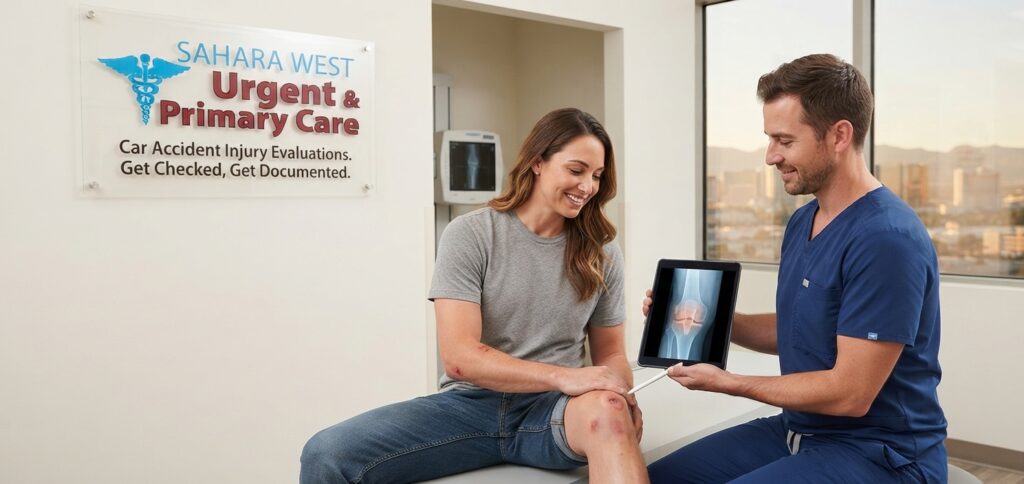
Comprehensive Evaluation and Diagnostics at Sahara West Urgent Care
A proper post-accident knee and leg evaluation goes well beyond a visual check.
Professional Physical Examinations and Joint Stability Tests
Experienced Las Vegas medical providers perform hands-on stability and range-of-motion testing to identify ligament laxity, meniscus involvement, or other structural concerns.
On-Site Digital X-Rays
Same-visit digital X-ray imaging quickly rules out or confirms fractures, bone chips, and structural damage to the knee, tibia, fibula, or ankle.
Tailored Treatment Plans
Every lower-extremity injury calls for a different recovery approach. Depending on findings, your plan may include:
- Anti-inflammatory protocols to reduce swelling and pain
- Bracing or immobilization guidance for joint stability
- Activity and weight-bearing restrictions to prevent further damage
- Specialized orthopedic referrals for suspected ligament or meniscus tears
- Physical therapy recommendations to restore strength and mobility
Soft CTA: If your knee or leg still feels “off” days after a collision, don’t guess what’s wrong. A same-day evaluation at Sahara West Urgent Care gives you clarity and a clear path to recovery.
The Importance of Early Documentation for Insurance and Legal Claims in Las Vegas
Getting your knee or leg checked protects more than your mobility; it protects your car accident injury claim too.
Why the 72-Hour Window Matters
Seeking care within the critical 72-hour window after your accident creates an official, timestamped medical record connecting your knee or leg injury directly to the collision, a detail insurance adjusters look for closely.
Protecting Your Claim Against Denied Coverage
Delayed medical visits give insurance companies room to argue your injury wasn’t serious, or wasn’t caused by the accident at all. Prompt evaluation removes that argument before it can be made.
How Detailed Clinical Records Strengthen Your Case
Comprehensive documentation exam findings, X-ray results, diagnosis, and treatment notes from Sahara West Urgent Care gives your insurance company and any attorney the objective evidence needed to support fair compensation for your injury.
Bottom line: Insurance adjusters don’t compensate for injuries you can’t prove. Early documentation is what turns “I think I hurt my knee” into a credible, defensible medical claim.
Conclusion & Next Steps
Knee and leg pain after a car accident deserves the same attention as neck and back pain, not an afterthought once the “obvious” injuries are addressed. Ligament tears, meniscus damage, and fractures can all hide behind adrenaline and mild initial soreness, quietly progressing toward long-term joint instability if left unchecked.
Key takeaways:
- Dashboard knee and pedal-related trauma are common, predictable injury patterns in collisions
- Ligament tears, meniscus damage, patellar fractures, and lower leg fractures often don’t hurt immediately
- Adrenaline can mask serious lower-extremity injury for 24 to 72 hours
- Certain red-flag symptoms inability to bear weight, locking, numbness demand immediate evaluation
- Early diagnosis protects both your long-term mobility and your insurance claim
Don’t let a treatable knee injury become a lifelong limp. Don’t let a delayed visit weaken your case.
Walk into Sahara West Urgent Care at 6125 West Sahara Avenue, Las Vegas, NV, or call (702) 248-0554 for a fast, expert knee and leg injury evaluation with zero long ER wait times. Your mobility, and your claim, deserve answers now.
Frequently Asked Questions (FAQs)
What is a “dashboard knee” and how is it treated?
“Dashboard knee” refers to the kneecap striking the lower dashboard or console during a frontal collision, often causing patellar fractures, bruising, or joint trauma. Treatment depends on severity and can range from anti-inflammatory care and bracing to orthopedic referral for suspected fractures or ligament damage.
How can I tell the difference between a simple bruise and a torn knee ligament after a crash?
You typically can’t tell by symptoms alone. Both can cause swelling and pain, but a ligament tear often involves instability, a feeling of the knee “giving way,” or a popping sensation at the time of injury. A physical stability exam and imaging are needed to confirm the diagnosis.
Do I need to visit an emergency room for a knee injury, or is urgent care sufficient?
For most knee and leg injuries without visible deformity, inability to bear weight, or signs of nerve or vascular compromise, urgent care is a faster and more cost-effective option, offering on-site X-rays and physical evaluations without long ER wait times. Severe deformity or circulation issues warrant an ER visit.
Why is immediate medical documentation essential for a Las Vegas car accident injury claim?
Knee and leg injuries like ligament and meniscus tears aren’t always visible externally, making early documentation critical. A prompt clinical evaluation establishes a clear, timestamped connection between your injury and the accident protecting your claim from being disputed or minimized later.