
Introduction
You walked away from the crash. No cuts, no broken bones, just a dull ache creeping into your shoulder that wasn’t there yesterday.
It’s tempting to write it off as “just muscle tension” from gripping the wheel too hard. Most Las Vegas drivers do exactly that and it’s one of the most common post-collision mistakes on the road.
Here’s the medical reality: shoulder pain after a car accident is rarely “just soreness.” It can signal torn tendons, damaged cartilage, joint instability, or nerve compression injuries that don’t always announce themselves with dramatic symptoms right away.
This guide breaks down exactly why car accidents damage the shoulder, which injuries hide behind mild discomfort, and when Las Vegas drivers need a professional evaluation at Sahara West Urgent Care before a treatable injury becomes a permanent one.
Why Do Car Accidents Cause Shoulder Pain?
Shoulder injuries in car crashes aren’t random; they’re the predictable result of physics acting on one of the body’s most mobile, least protected joints.
The Physics of a Collision
In a collision, your vehicle stops suddenly but your body wants to keep moving at the original speed. That sudden deceleration forces your torso, arms, and shoulders to absorb energy your body was never designed to handle in a fraction of a second.
This violent forward-and-back (or side-to-side) motion places enormous mechanical stress directly on the shoulder joint and its surrounding soft tissue.
The Mechanics of the Seatbelt
Your seatbelt saves your life but it does so by concentrating force across your chest and shoulder. As your torso lurches forward, the shoulder strap restrains your body while your shoulder joint absorbs the brunt of the kinetic energy, often twisting or compressing the joint in the process.
This is why so many seatbelt-related shoulder injuries occur even in accidents where no other part of the body makes contact with anything.
Impact Positioning Matters
Where and how your body meets the point of impact changes the injury pattern significantly:
- Steering wheel contact during frontal collisions can drive direct force into the shoulder and collarbone
- Side-impact collisions compress the shoulder against the door or center console
- Airbag deployment while life-saving delivers a powerful, rapid blow that can jolt or hyperextend the shoulder joint
Pro insight: The type of collision (rear-end, T-bone, head-on) often predicts the type of shoulder injury a driver is likely to sustain which is exactly why a clinical exam matters more than guesswork.
Common Types of Shoulder Injuries Resulting From Car Crashes
Not all shoulder pain is created equal. Here are the injuries most frequently diagnosed after Las Vegas collisions.
Rotator Cuff Tears and Strains
The rotator cuff is a group of tendons and muscles that stabilize the shoulder joint. Sudden force like bracing against a steering wheel or seatbelt can strain or fully tear these tendons, causing weakness, aching, and restricted movement that often worsens over the following days.
Labral Tears (SLAP Lesions)
The labrum is the ring of cartilage that cushions the shoulder socket. A violent jolt can tear this cartilage known as a SLAP lesion producing a deep, unstable ache and a catching or grinding sensation during arm movement.
Shoulder Impingement & Inflammation
Sudden trauma or compression can trigger bursitis and inflammation around the shoulder tendons, leading to pain that intensifies with overhead movement often mistaken for simple stiffness in the first day or two.
Clavicle Fractures and Dislocations
Direct impact from a seatbelt, door, or steering wheel can fracture the collarbone or partially dislocate the shoulder joint. These structural injuries frequently require imaging to confirm, since swelling can mask visible deformity initially.
Whiplash-Related Referred Pain
Whiplash doesn’t stay confined to the neck. Nerve irritation and muscle strain from the cervical spine commonly radiate downward, producing shoulder discomfort that has nothing to do with a direct shoulder impact at all.
Real-world example: A driver rear-ended at a red light on Sahara Avenue may feel only neck stiffness at first only to discover days later that the real source of their spreading shoulder pain is whiplash-related nerve irritation, not a shoulder injury at all. Only a proper exam can tell the difference.
Delayed-Onset Symptoms: Why You Might Feel Fine Initially
If your shoulder felt fine right after the crash, that doesn’t mean it wasn’t injured.
Adrenaline Buys You Time Not Safety
Immediately after a collision, your body releases adrenaline and endorphins as part of the fight-or-flight response. These natural chemicals suppress your perception of pain, which is why so many drivers feel deceptively “normal” in the first hour or two.
The 24–72 Hour Inflammation Window
As adrenaline wears off, inflammation, swelling, and stiffness begin building around the injured tissue. This is why shoulder pain frequently peaks not on day one but somewhere between 24 and 72 hours after the accident.
The Danger of Self-Treating Without a Diagnosis
Reaching for ice packs and over-the-counter pain relievers feels responsible, but without an actual diagnosis, you could be masking a rotator cuff tear or labral injury that needs targeted treatment not just rest.
Mistake to avoid: Treating shoulder pain as “just soreness” and waiting it out. Untreated soft tissue and joint injuries frequently progress into chronic instability, reduced range of motion, or long-term joint damage.
Red Flag Symptoms: When Shoulder Pain Requires Immediate Medical Attention
Some symptoms mean you shouldn’t wait, you need evaluation right away.
Seek immediate medical care if you experience:
- Inability to lift or rotate your arm, or a sharp mechanical locking sensation in the joint
- Visible deformity, severe swelling, or deep bruising around the shoulder or collarbone
- Numbness, tingling, or radiating pain traveling down the arm toward the hand a possible sign of nerve compression
These symptoms often point to fractures, dislocations, or nerve involvement that require prompt clinical assessment and imaging.
Comprehensive Evaluation and Diagnostics at Sahara West Urgent Care
A proper post-accident shoulder evaluation should never be a guessing game. Here’s what thorough diagnostic care looks like.
Immediate Physical & Range-of-Motion Assessments
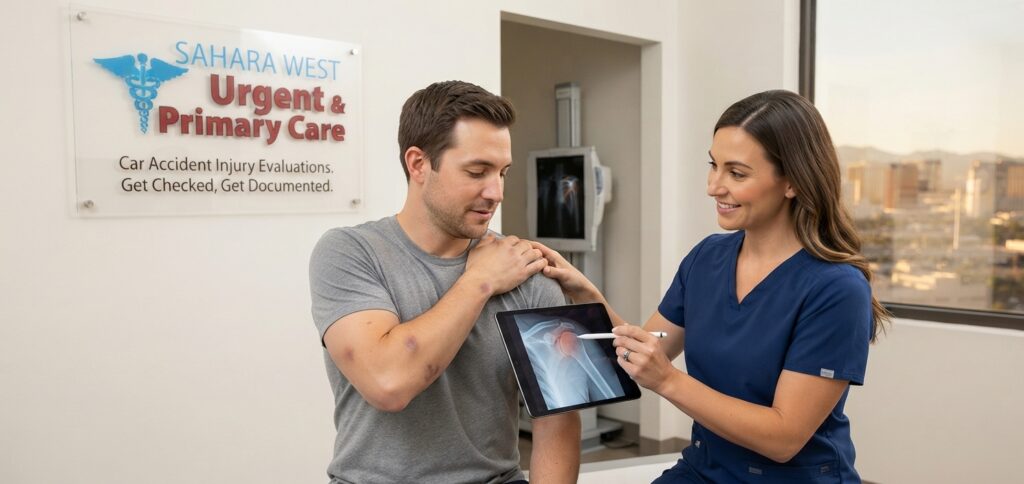
Experienced medical providers perform hands-on clinical testing checking strength, stability, and range of motion to pinpoint exactly which structures in the shoulder are affected.
On-Site Digital X-Rays
Same-visit digital X-ray imaging rapidly rules out (or confirms) fractures, dislocations, and structural skeletal damage without the delays of an outside imaging referral.
Personalized Treatment Planning
Every shoulder injury is different, so recovery plans are tailored to the specific diagnosis. This may include:
- Anti-inflammatory therapy to control swelling and pain
- Activity modification guidance to prevent re-injury
- Physical therapy referrals for structured rehabilitation
- Scheduled follow-up visits to track healing progress
Soft CTA: Not sure if your shoulder pain is muscular or something more serious? A same-day evaluation at Sahara West Urgent Care gives you a clear answer fast.
The Importance of Early Documentation for Insurance and Legal Claims in Las Vegas
Getting checked isn’t just about your recovery, it’s about protecting your car accident insurance claim too.
Why the 72-Hour Window Matters for Your Paper Trail
Visiting urgent care within 72 hours of your accident creates an official, timestamped medical record linking your shoulder injury directly to the crash closing the door on disputes over causation.
Protecting Your Claim Against Denied Coverage
Insurance adjusters routinely challenge claims where medical treatment was delayed, arguing the injury wasn’t serious or wasn’t accident-related. A prompt evaluation removes that argument entirely.
How Detailed Clinical Records Support Your Case
Comprehensive documentation exam findings, imaging results, diagnosis, and treatment notes from Sahara West Urgent Care gives your insurance company and any attorney the objective evidence needed to support a fair settlement.
Bottom line: A documented shoulder injury is a defensible shoulder injury. An undocumented one is a vulnerability in your claim.
Conclusion & Next Steps
Shoulder pain after a car accident is never something to shrug off. Behind that “muscle tension” feeling could be a rotator cuff tear, a labral injury, or nerve compression that only gets worse with time and self-treatment.
Key takeaways:
- Collision forces and seatbelt mechanics place major stress directly on the shoulder joint
- Rotator cuff tears, labral tears, impingement, fractures, and referred whiplash pain are all common outcomes
- Adrenaline can mask real injury for the first 24 to 72 hours
- Certain red-flag symptoms numbness, deformity, inability to lift the arm demand immediate care
- Early evaluation protects both your long-term shoulder health and your insurance claim
Don’t let a treatable injury turn into a permanent limitation. Don’t let a delayed visit weaken your claim.
Walk into Sahara West Urgent Care at 6125 West Sahara Avenue, Las Vegas, NV, or call (702) 248-0554 for a fast, expert shoulder injury evaluation with zero long ER wait times. Your shoulder and your case deserve answers now, not later.
Frequently Asked Questions (FAQs)
Can a seatbelt cause long-term shoulder damage during a crash?
Yes. While seatbelts prevent far more serious injuries, the force they transfer across the shoulder during a collision can cause rotator cuff strains, labral tears, or joint inflammation. Left undiagnosed, these injuries can develop into chronic shoulder instability or reduced range of motion.
How can I tell the difference between a muscle strain and a torn rotator cuff after an accident?
You generally can’t tell on your own. Both can cause aching and stiffness, but a rotator cuff tear typically involves weakness, a catching sensation, and pain that worsens with specific movements. A physical exam and imaging are needed to accurately diagnose the difference.
Do I need to go to the emergency room for shoulder pain, or is urgent care enough?
For most non-life-threatening shoulder pain without visible deformity, severe swelling, or numbness down the arm, urgent care is the faster, more cost-effective option, offering on-site X-rays and physical assessments without long ER wait times. Go to the ER for visible dislocation, severe deformity, or signs of nerve damage.
Why is medical documentation critical for a Las Vegas car accident claim involving soft tissue injuries?
Soft tissue injuries like rotator cuff strains and labral tears don’t show up as clearly as broken bones, making early clinical documentation essential. Detailed records establish that the injury is real, accident-related, and medically significant protecting your claim from being minimized or denied.