
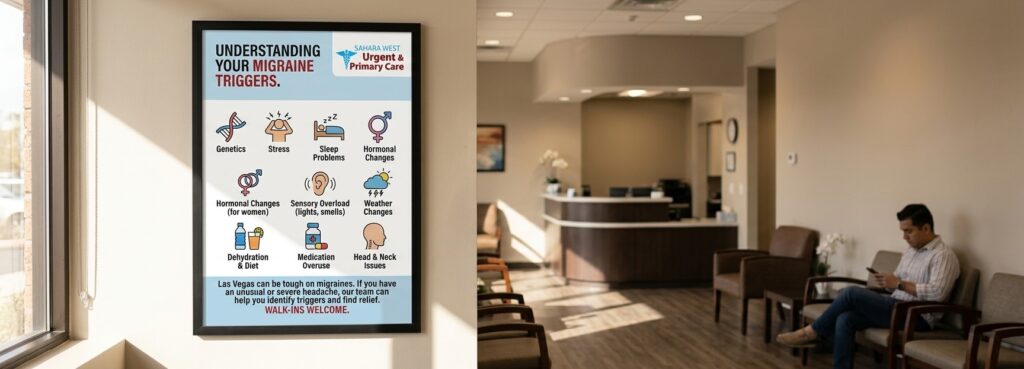
Migraines are mainly caused by a mix of inherited sensitivity in the nervous system and changes in brain chemistry and pain pathways. Triggers then set an attack off. Common triggers include stress, poor or irregular sleep, hormonal shifts, skipped meals, dehydration, certain foods and drinks, bright lights, strong smells, and weather changes. Doctors don’t fully understand every step, and triggers vary from person to person.
If you’re in the middle of a migraine now, or you’ve had a headache that feels different from your usual ones, our Las Vegas urgent care team can see you today. Walk-ins are welcome.
What Actually Happens in the Brain During a Migraine?
A migraine is a neurological condition, not just a bad headache. It affects roughly 39 million people in the United States.
Researchers believe migraines involve:
- The trigeminal nerve, a major pain pathway in the head and face. When it’s activated, it can release chemical messengers that cause inflammation and pain around the brain’s outer covering.
- Brain chemicals such as serotonin and calcitonin gene-related peptide (CGRP), which help regulate pain signals.
- The brainstem, which appears to interact with the trigeminal nerve in people who get migraines.
- Genetics. Migraines run in families, and a parent with migraines raises your own odds.
Think of it as a sensitive alarm system. Some people’s nervous systems react strongly to changes that others barely notice. A trigger is the thing that sets the alarm off. It isn’t the underlying cause.
The Main Reasons for Migraines
| Reason | How it contributes | What you might notice |
| Family history (genetics) | Inherited sensitivity in how the brain processes pain and sensory input | A parent, sibling, or relative with migraines |
| Brain chemistry and nerve pathways | Changes involving serotonin, CGRP, and the trigeminal nerve | Throbbing pain, nausea, light and sound sensitivity |
| Hormonal changes | Estrogen shifts can set off attacks | Migraines around periods, pregnancy, or menopause |
| Stress and emotional strain | Stress, anxiety, and the “let-down” after stress can trigger attacks | A migraine after a hard week ends |
| Sleep problems | Too little, too much, or irregular sleep | Attacks after late nights or travel |
| Food, drink, and dehydration | Skipped meals, alcohol, caffeine changes, and some foods | Attacks after fasting or heavy drinking |
| Sensory triggers | Bright or flickering light, strong smells, loud noise | Attacks in glare, crowds, or smoky rooms |
| Weather changes | Shifts in barometric pressure, heat, humidity, or altitude | Attacks before storms or after temperature swings |
| Medication overuse | Taking pain relievers too often can make headaches worse | Daily or near-daily headaches despite treatment |
| Head or neck issues | Neck pain, jaw problems, or head injury can trigger or worsen migraines | Migraines alongside neck tension or jaw pain |
1. Genetics and Family History
If one or both of your parents have migraines, you’re more likely to get them too. Inherited traits appear to shape how your nervous system responds to stimulation. Genetics load the gun, and your environment and habits help pull the trigger.
2. Brain Chemistry and Nerve Pain Pathways
Serotonin levels change during migraine attacks, and CGRP plays a role in the pain itself. Those chemical shifts can activate the trigeminal nerve, which is why migraine pain often feels throbbing and concentrated on one side of the head.
3. Hormonal Changes
Migraines are about three times more common in women than in men, and estrogen fluctuations are a likely reason. Many people notice attacks around their period, during pregnancy, or during perimenopause and menopause.
4. Stress and Emotional Strain
Stress is one of the most commonly reported triggers. Some people get migraines during stressful periods, and others get them right after, when the tension lets go.
5. Sleep Problems
Both too little and too much sleep can trigger attacks. Irregular schedules, shift work, and jet lag are common culprits.
6. Food, Drink, and Dehydration
Skipped meals, dehydration, alcohol (especially red wine), and too much or too little caffeine are frequent triggers. Aged cheeses, processed meats, MSG, and artificial sweeteners are often blamed. The evidence is mixed, and food triggers differ from person to person.
7. Light, Smell, and Sound
Bright or flickering lights, strong perfume, paint fumes, cigarette smoke, and loud noise can set off an attack on sensitive people.
8. Weather and Environment
Changes in weather, barometric pressure, humidity, heat, and altitude are well-known migraine triggers.
9. Overusing Pain Relievers
Taking pain medication too often can lead to medication-overuse headache and make migraines more frequent. If you reach for pain relievers several days a week, tell a provider.
10. Head, Neck, and Jaw Problems
Head injuries, neck pain, and jaw (TMJ) problems can trigger or worsen migraines.
Why Las Vegas Can Be Tough on Migraine Sufferers
Several common migraine triggers are part of daily life in Southern Nevada:
- Heat and dry desert air make dehydration easier, and dehydration is a common trigger.
- Intense sun and glare can trigger light-sensitive migraines. Sunglasses help.
- Late nights, irregular schedules, and travel disrupt sleep.
- Alcohol, skipped meals, and long days out are easy to fall into on a busy trip or weekend.
- Casino and venue lighting, noise, and smoke are sensory triggers for some people.
- Seasonal weather swings, such as monsoon-season pressure changes, can set off weather-sensitive migraines.
None of these are guaranteed to cause a migraine. They’re worth watching if you get attacks. Most people with migraines have more than one trigger, and nearly three out of four report at least one.
Migraine vs. Other Headaches
Not every headache is a migraine. Here is how they often compare:
- Migraine: Moderate to severe throbbing pain, often on one side, with nausea and sensitivity to light or sound. Untreated attacks commonly last 4 to 72 hours. About one in four people with migraines also get an aura, such as flashing lights or blind spots, beforehand.
- Tension headache: A dull, tight band of pressure on both sides, usually without nausea.
- Sinus-related headache: Facial pressure with congestion. Many “sinus headaches” are actually migraines.
- Headache from high blood pressure: Very high readings can cause headaches, which is one reason a blood pressure check is worthwhile if headaches are new or frequent.
A provider can help sort out which type you have.
When a Headache or Migraine Needs Urgent Attention
Most migraines aren’t dangerous, but some headaches are warning signs. Call 911 or go to a hospital emergency room right away if you have:
- A sudden, explosive headache that reaches peak pain within seconds or minutes (“thunderclap”)
- “The worst headache of your life”
- Weakness, numbness, drooping on one side of the face, trouble speaking, or vision loss
- Confusion, trouble staying awake, or a seizure
- A headache with fever, stiff neck, or a new rash
- A headache after a head injury
- Chest pain or trouble breathing with the headache
Sahara West is a walk-in urgent care clinic, not a hospital. Life-threatening symptoms belong in an emergency room.
When Same-Day Urgent Care Makes Sense
Without those red flags, urgent care is a practical option when:
- You have a migraine that isn’t responding to your usual home treatment
- Your headaches are more frequent or more painful than usual
- You’ve been vomiting or can’t keep fluids down
- You feel dehydrated and your head pain is getting worse
- You want to rule out other causes and get a clear next step
- You can’t get in to see your regular doctor soon
At Sahara West Urgent Care & Wellness, you can walk in without an appointment, and our providers will evaluate your symptoms, review your history, and talk through treatment options. Depending on your evaluation, that may include supportive care such as IV hydration. Not sure if you should come in? Call us at (702) 248-0554.
Book an appointment or walk in today →
Need to know when we’re open? See our contact page, or check Saturday walk-in availability and urgent care open now. Coming from the Henderson side of the valley? See our Henderson urgent care page.
How to Find Your Own Migraine Triggers
Triggers are personal, so tracking beats guessing. For 4 to 6 weeks, log:
- Date, time, and how long each attack lasted
- Pain level and symptoms (nausea, aura, light sensitivity)
- What you ate and drank in the 24 hours before
- Sleep the night before
- Stress level and weather
- For women, where you were in your cycle
- What you took for relief, and whether it worked
Bring the log to your appointment. It helps a provider spot patterns and choose treatment. Avoiding every possible trigger can be excessive and restrictive, so focus on the ones your log actually supports.
Everyday Habits That Can Help Reduce Migraines
- Keep a consistent sleep and wake schedule
- Eat regular meals and don’t skip breakfast
- Drink water steadily, especially in Las Vegas heat
- Limit alcohol, and watch your caffeine pattern
- Wear sunglasses outdoors and reduce screen glare
- Build in stress breaks and relaxation time
- Avoid taking pain relievers more often than directed
These habits don’t cure migraines, but they can lower how often attacks happen for many people. If you have frequent or disabling migraines, ask a provider about preventive options.
FAQs
What is the main cause of migraines?
There isn’t one single cause. Migraines come from a mix of inherited sensitivity and changes in brain chemistry and pain pathways, including the trigeminal nerve, serotonin, and CGRP. Triggers then set off individual attacks.
What are the most common migraine triggers?
Stress, irregular sleep, hormonal changes, skipped meals, dehydration, alcohol, certain foods, bright lights, strong smells, and weather changes are among the most common. Triggers differ from person to person.
Are migraines genetic?
Often, yes. Migraines run in families, and having a parent with migraines raises your risk.
Can dehydration cause a migraine?
Dehydration is a common trigger. In hot, dry climates like Las Vegas, drinking water consistently matters.
Can stress cause migraines?
Yes. Stress is one of the most frequently reported triggers, and some people get attacks after the stress ends.
Why do I get migraines around my period?
Estrogen levels change around menstruation, and those shifts can trigger attacks in many women.
Can weather cause migraines?
Some people are sensitive to changes in barometric pressure, heat, humidity, or altitude.
Can you get a migraine without a headache?
Rarely. Some people have migraine symptoms without head pain, but other causes should be ruled out first.
Is it a migraine or something more serious?
A sudden, severe headache, or one with weakness, vision loss, confusion, fever with a stiff neck, or a recent head injury, needs emergency care. If your headache is unusual for you, get evaluated.
Can urgent care treat a migraine?
Urgent care can evaluate migraine symptoms, rule out common concerns, and discuss treatment options for people without emergency warning signs. Services vary by clinic, so call Sahara West at (702) 248-0554 to ask what we can do for your symptoms.
Do I need an appointment?
No. Walk-ins are welcome at Sahara West, and you can also book ahead.
Get Same-Day Care for Migraines in Las Vegas
Migraine pain disrupts your whole day, and you don’t have to wait for a doctor’s appointment to feel better. Sahara West Urgent Care & Wellness is at 6125 W Sahara Ave, Las Vegas, NV 89146. Walk in, book online, or call (702) 248-0554.
This article is for general education and isn’t a substitute for professional medical advice, diagnosis, or treatment. If you think you’re having a medical emergency, call 911.