Medically Reviewed by Dr. Samuel Barredo, DNP, APRN, FNP-BC, Sahara West Urgent Care & Wellness •
Eligible adults in Las Vegas can walk into Sahara West Urgent Care & Wellness (
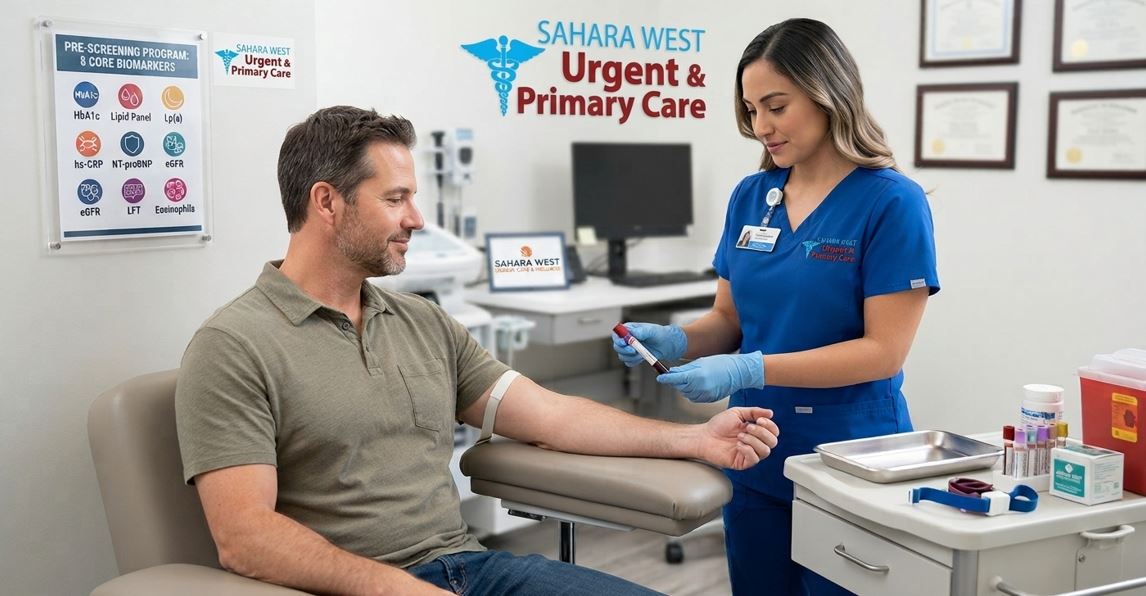
6125 W. Sahara Ave, Las Vegas, NV 89146) for a complimentary one-time preventive blood panel covering 8 core biomarkers—HbA1c, Lipid Panel, Lipoprotein(a), hs-CRP, NT-proBNP, eGFR, Liver Function (LFT), and Eosinophils. No health insurance or outside doctor’s referral is required, and walk-ins are welcome Monday–Friday (9:00 AM–8:00 PM) and Saturday (9:00 AM–3:00 PM).
Reserve Your Free Screening Online | Call Our West Sahara Desk: (702) 248-0554
Why a Single Blood Sugar or Cholesterol Check Isn’t Enough
Most adults assume that if they feel fine—or had a normal basic glucose check years ago—their metabolic and cardiovascular health are in the clear. In clinical practice, however, type 2 diabetes, arterial inflammation, and early kidney or liver strain often progress silently for years before causing obvious symptoms.
Even a standard annual checkup can miss crucial warning signs because it rarely screens for inherited lipoprotein risk or low-grade vascular inflammation. Through our free health screening in Las Vegas, Sahara West Urgent Care & Wellness evaluates eight interconnected biomarkers from one venous blood draw, giving you a complete baseline across five major body systems.
Breakdown of All 8 Biomarkers Included in the Free Screening
Below is what each test in our Pre-Screening Program measures, the typical adult reference benchmarks clinicians review, and why each marker matters for long-term prevention:
| # | Biomarker | Body System | What It Measures & Typical Clinical Reference Benchmarks |
| 1 | HbA1c (Hemoglobin A1c) | Blood Sugar & Metabolism | Measures your average blood glucose over the past 2–3 months. Standard diagnostic benchmarks: Below 5.7% (Normal), 5.7%–6.4% (Prediabetes), 6.5% or higher (Diabetes range). For a deeper look at how this test works, see what an A1C test actually measures. |
| 2 | Lipid Panel | Cholesterol & Triglycerides | Evaluates Total Cholesterol, LDL (“bad” cholesterol, ideally <100 mg/dL), HDL (“good” protective cholesterol), and Triglycerides (<150 mg/dL fasting) to assess baseline arterial plaque risk. |
| 3 | Lipoprotein(a) [Lp(a)] | Genetic Cardiovascular Risk | Measures an inherited lipoprotein particle (<30 mg/dL or <75 nmol/L is generally considered lower risk). Because Lp(a) is determined primarily by genetics rather than diet or exercise, elevated levels can raise heart and stroke risk even when standard LDL looks normal. |
| 4 | hs-CRP (High-Sensitivity C-Reactive Protein) | Vascular Inflammation | Detects low-grade chronic inflammation in blood vessel walls (<1.0 mg/L lower cardiovascular risk; 1.0–3.0 mg/L moderate; >3.0 mg/L higher risk). |
| 5 | NT-proBNP | Cardiac Muscle Strain | Measures a hormone peptide released when heart chambers experience increased pressure or stretching, helping identify early cardiac stress before overt symptoms develop. |
| 6 | eGFR (Estimated Glomerular Filtration Rate) | Kidney Filtration | Estimates how efficiently your kidneys filter waste (60 mL/min/1.73m² or higher is typically expected in healthy adults). Elevated blood sugar and blood pressure often affect kidney filtration before any physical symptoms appear. |
| 7 | LFT (Liver Function Tests) | Liver & Metabolic Health | Evaluates key liver enzymes (such as ALT and AST) to screen for silent liver inflammation or metabolic dysfunction-associated fatty liver changes. |
| 8 | Eosinophils | Immune & Allergic Activity | Measures a specialized white blood cell involved in allergic conditions, asthma, and immune responses—especially relevant in Southern Nevada’s dry, allergen-heavy climate. |
(Clinical note: Lab reference ranges vary slightly by laboratory assay and individual medical history. A screening result identifies potential risk factors and requires clinical interpretation by a licensed healthcare provider before making any diagnosis or medication changes.)
Who Benefits Most From This Free Screening in Las Vegas?
The American Diabetes Association (ADA) recommends routine diabetes screening starting at age 35—and earlier for adults with risk factors such as family history, overweight/obesity, high blood pressure, or gestational diabetes history. You are an ideal candidate to walk in if you:
-
Have a parent or sibling with type 2 diabetes, heart disease, high cholesterol, or stroke.
-
Are uninsured, underinsured, or carrying a high deductible and have postponed routine lab work due to out-of-pocket hospital lab fees.
-
Feel healthy today but want a reliable baseline—learn why you can get a free diabetes screening even with no symptoms.
-
Work hospitality, retail, construction, or shift schedules in Las Vegas and need evening (until 8:00 PM) or Saturday walk-in lab access without taking time off work.
Step-by-Step: How to Prepare & What Happens at Your Visit
Most screening visits at our West Sahara clinic take 20 to 30 minutes from check-in to completion (see our detailed breakdown of how long a free A1C and Lp(a) screening visit takes).
Step 1: Walk In or Pre-Register Online
No appointment or outside physician referral is needed. Walk into 6125 West Sahara Avenue, Las Vegas, NV 89146 (between Jones Blvd and Torrey Pines Dr) during operating hours, or book your visit online to speed up front-desk intake.
Step 2: Follow Simple Pre-Visit Prep Guidelines
-
Fasting Guidance: HbA1c and Lipoprotein(a) do not require fasting, so you can walk in any time of day. However, if you want the most accurate triglyceride measurement on your Lipid Panel, aim to fast for 8–12 hours beforehand (plain water is encouraged) and take your regular prescribed medications unless told otherwise by your doctor. Check our complete guide on how to prepare for a preventive health screening.
-
What to Bring: Bring a valid government-issued photo ID and a list of your current medications or supplements (see what to bring to a free health screening).
Step 3: Fast On-Site Venous Blood Draw
Our trained clinical staff performs a single standard blood draw right inside our clinic—you do not have to drive to a separate off-site laboratory.
Step 4: Reviewing Your Results & Affordable Follow-Up Care
Once your results are finalized, our team reaches out to review your numbers:
-
Normal Baseline: Keep your lab summary for your personal health records and recheck annually or as advised.
-
Elevated or Borderline Marker: If your HbA1c lands in the
5.7%–6.4%prediabetes range or your cholesterol/Lp(a) is elevated, review our guide on prediabetes A1C next steps after a free screening and schedule a follow-up visit through our primary care services in Las Vegas. Even without insurance, Sahara West offers transparent $95 self-pay visits, affordable clinic membership plans, and 0% APR financing through Cherry and CareCredit so financial barriers never delay follow-up care.
When to Skip Routine Screening and Seek Emergency Care
Preventive lab screenings are strictly for non-emergency health checks. Call 911 or go directly to the nearest hospital emergency room if you experience:
-
Chest pain, pressure, squeezing, or pain spreading to your arm, back, neck, or jaw
-
Sudden shortness of breath or difficulty breathing
-
Sudden numbness or weakness in the face, arm, or leg, confusion, or trouble speaking
-
Fainting, severe dizziness, or sudden vision changes
For acute, non-life-threatening illnesses or minor injuries that need prompt same-day evaluation, visit our walk-in urgent care clinic in Las Vegas.
FAQs
Is the 8-biomarker diabetes and heart screening at Sahara West completely free?
Yes. Sahara West Urgent Care & Wellness provides this one-time preventive screening panel at no out-of-pocket cost to eligible adults while program allocations are available. Because program eligibility and monthly lab allocations can update, you can contact our Las Vegas clinic or call (702) 248-0554 before visiting to confirm current availability.
Do I need health insurance or a doctor’s order to get tested?
No. Both uninsured and insured Las Vegas residents are welcome, and no outside physician referral is required.
Do I have to fast before my blood draw?
Fasting for 8–12 hours (water only) gives the most accurate triglyceride level on your Lipid Panel, though HbA1c and Lipoprotein(a) remain accurate even if you have eaten. Read what to know before a diabetes screening for full preparation tips.
What are your clinic hours, location, and language options?
Sahara West Urgent Care & Wellness is located at 6125 West Sahara Avenue, Las Vegas, NV 89146, open Monday–Friday from 9:00 AM to 8:00 PM and Saturday from 9:00 AM to 3:00 PM. Led by Dr. Samuel Barredo, DNP, APRN, FNP-BC, our clinical team speaks English, Tagalog, and Hawaiian so local families can discuss their lab results comfortably.
What happens if one of my 8 markers comes back abnormal?
An out-of-range screening result flags a potential risk rather than serving as a final diagnosis. You can meet with a licensed Sahara West provider to review confirmatory testing, nutrition and lifestyle strategies, or ongoing primary care in Las Vegas—with $95 self-pay visits, membership options, and Cherry / CareCredit payment plans available if you do not have insurance.
Reserve Your Free 8-Marker Screening Today
Take 20 minutes this week to check your blood sugar, cholesterol, genetic heart risk, kidney, and liver health—at zero cost.
-
Clinic Address: 6125 West Sahara Avenue, Las Vegas, NV 89146
-
Walk-In Hours: Mon–Fri: 9:00 AM – 8:00 PM | Sat: 9:00 AM – 3:00 PM
-
Call Direct: (702) 248-0554
-
Book Online: Claim Your Free Screening Appointment
Reviewed by Dr. Samuel Barredo, DNP, APRN, FNP-BC. This article is for educational purposes and does not replace individualized medical advice, diagnosis, or treatment. Screening thresholds and clinical guidance reflect standards from the American Diabetes Association (ADA), American Heart Association (AHA), and National Kidney Foundation (NKF).