
Introduction
The way we access mental healthcare has changed forever. What used to mean weeks of waiting for an office appointment now includes the option to log into a secure video call from your couch. This shift didn’t happen by accident, it happened because people needed it, and the healthcare system finally caught up.
But convenience raises a fair question: is teletherapy actually as effective as sitting across from a therapist in person? It’s not a trivial question. The format you choose can shape how comfortable you feel opening up, how consistent you are with sessions, and ultimately, how much progress you make.
This guide breaks down the clinical research, the practical trade-offs, and the personal factors that should drive your decision so you’re not guessing, you’re choosing with confidence.
From a clinical standpoint, the team at Sahara West Urgent Care has watched this conversation evolve firsthand. As a Las Vegas-based provider offering both urgent mental health support and coordinated outpatient referrals, we see patients on both sides of this decision every week and we’ve learned that the “best” format is rarely universal. It’s personal.
Understanding the Modalities
Before comparing outcomes, it helps to know exactly what you’re comparing.
What Is Teletherapy?
Teletherapy (also called online therapy or virtual counseling) is professional mental health treatment delivered remotely through technology. It typically comes in three formats:
- Video sessions the closest digital equivalent to an in-office visit, using platforms like Zoom for Healthcare or dedicated HIPAA-compliant apps
- Audio/phone counseling useful for patients without reliable video access or who feel less self-conscious without a camera
- Text-based or asynchronous therapy messaging-based support, often used between live sessions for ongoing check-ins
What Is Traditional In-Person Counseling?
In-person counseling happens in a dedicated clinical office, where the therapist and patient share physical space. This format naturally includes:
- A neutral, distraction-free setting designed specifically for therapeutic work
- Full access to non-verbal cues posture, tone, fidgeting, eye contact
- The traditional therapeutic alliance, built over time through in-room presence
The Rise of Hybrid Healthcare Models
Modern outpatient and urgent care settings are no longer choosing one format over the other; they’re blending both. Many clinics, including integrated practices like Sahara West, now combine walk-in physical evaluations with teletherapy options so patients can get the right level of care at the right time, without being locked into a single delivery method.
Efficacy Breakdown: What Does the Research Say?
Let’s get to the core of it: the clinical data.
Effectiveness for Common Conditions
Multiple peer-reviewed studies, including research published through the American Psychological Association, have found that teletherapy produces comparable outcomes to in-person therapy for many common presentations, including:
- Mild-to-moderate anxiety
- Depression
- Situational and chronic stress
- Adjustment disorders
Comparative Outcomes
Head-to-head comparisons generally show no statistically significant difference in symptom reduction between video-based and face-to-face treatment for the conditions above as long as the patient stays engaged and the clinician is trained in delivering care remotely.
Where Teletherapy Shines
Cognitive Behavioral Therapy (CBT) one of the most evidence-based approaches in mental health translates especially well to video and even phone formats. Because CBT relies heavily on structured conversation, homework assignments, and skill-building rather than physical interaction, studies have repeatedly shown equivalence between virtual and in-person CBT delivery.
Expert tip: If your primary goal is managing anxious thought patterns, reframing negative self-talk, or building coping skills, teletherapy is very likely to deliver results on par with an office visit.
Limitations of Digital Sessions
Teletherapy isn’t the right tool for every situation. It tends to fall short for:
- Active suicidal ideation or crisis situations requiring immediate, in-person stabilization
- Severe psychiatric episodes (psychosis, acute mania) where safety monitoring is essential
- Complex trauma work that benefits from tactile or somatic therapeutic techniques
- Patients without private, stable internet access, which can compromise confidentiality and session quality
Mistake to avoid: Don’t default to teletherapy out of convenience if you’re in the middle of a mental health crisis. In an acute situation, an immediate mental health evaluation at an urgent care or emergency setting is the safer, faster path.
Key Advantages of Teletherapy
1. Accessibility and Geographic Flexibility
Whether you live in Summerlin, work night shifts on the Strip, or simply don’t have reliable transportation, teletherapy removes the geography problem entirely. You can connect with a licensed therapist from anywhere with an internet connection.
2. No More Travel Barriers or Scheduling Friction
No commute, no parking, no taking half a day off work. For busy professionals and parents, this alone can be the difference between attending therapy consistently or skipping it altogether.
3. Comfort and Privacy From a Familiar Environment
Some patients open up more easily from their own space. There’s less social anxiety walking into a waiting room, and the emotional safety of home can lower the barrier to honest conversation.
4. Better Session Consistency
Research and clinical experience both point to one consistent pattern: teletherapy patients tend to have lower no-show and cancellation rates. When the “cost” of attending a session drops to a few clicks, people simply show up more.
Key Advantages of In-Person Counseling
1. The Therapeutic Alliance
There’s a depth of connection that many patients and clinicians describe as harder to replicate on a screen. Physical presence supports rapport-building in a way that feels more natural for certain personalities and certain conditions.
2. Reading Non-Verbal Communication
A skilled therapist picks up on far more than words micro-expressions, shifts in posture, the way someone holds tension in their shoulders. These cues are harder to catch through a webcam and can be critical to accurate assessment.
3. A Dedicated, Distraction-Free Space
An office is built for exactly one purpose: healing conversation. No kids knocking on the door, no notifications, no risk of a roommate walking in. That controlled environment matters more for some patients than others.
4. Better Suited for Severe Cases and Complex Trauma
For patients managing complex PTSD, dissociative symptoms, or conditions requiring tactile or experiential therapy techniques (like EMDR with certain protocols), in-person sessions generally offer more clinical control and safety.
Critical Factors to Consider When Choosing Your Format
There’s no one-size-fits-all answer. Ask yourself these questions:
- What’s my diagnosis and severity level? Mild-to-moderate symptoms often respond equally well to either format. Severe or crisis-level symptoms usually call for in-person care.
- What does my schedule and lifestyle look like? If missing appointments is a real risk due to work or family demands, teletherapy’s flexibility may directly improve your outcomes.
- Am I comfortable with the technology? Poor internet access or low comfort with video platforms can undermine the experience.
- What will my insurance actually cover? Many insurers now reimburse teletherapy at the same rate as in-person visits, but it’s worth confirming your specific plan’s out-of-pocket costs before committing.
- Where do I feel safest being honest? Some people are more guarded at home surrounded by daily life; others feel exposed in a clinical office. Be honest with yourself here it matters more than people think.
The Sahara West Urgent Care Perspective on Integrated Care
At Sahara West Urgent Care, we don’t believe mental health should be treated as separate from physical health and we don’t believe patients should have to choose blindly between formats without guidance.
Holistic, Whole-Person Health
Because we’re an established urgent care provider, our team also evaluates physical symptoms that frequently overlap with or worsen mental health conditions, things like severe sleep disruption, thyroid imbalances, chronic fatigue, and nutritional deficiencies. Treating the whole person leads to better mental health outcomes, not just symptom management.
When to Seek Immediate Evaluation vs. Ongoing Therapy
Not every mental health need is the same, and knowing which door to walk through matters:
- Walk in for an urgent evaluation if you’re experiencing an acute panic attack, an overwhelming depressive episode, or a sudden mental health crisis that can’t wait weeks for a scheduled appointment.
- Schedule ongoing outpatient therapy whether virtual or in-person for long-term management of anxiety, depression, relationship stress, or trauma recovery.
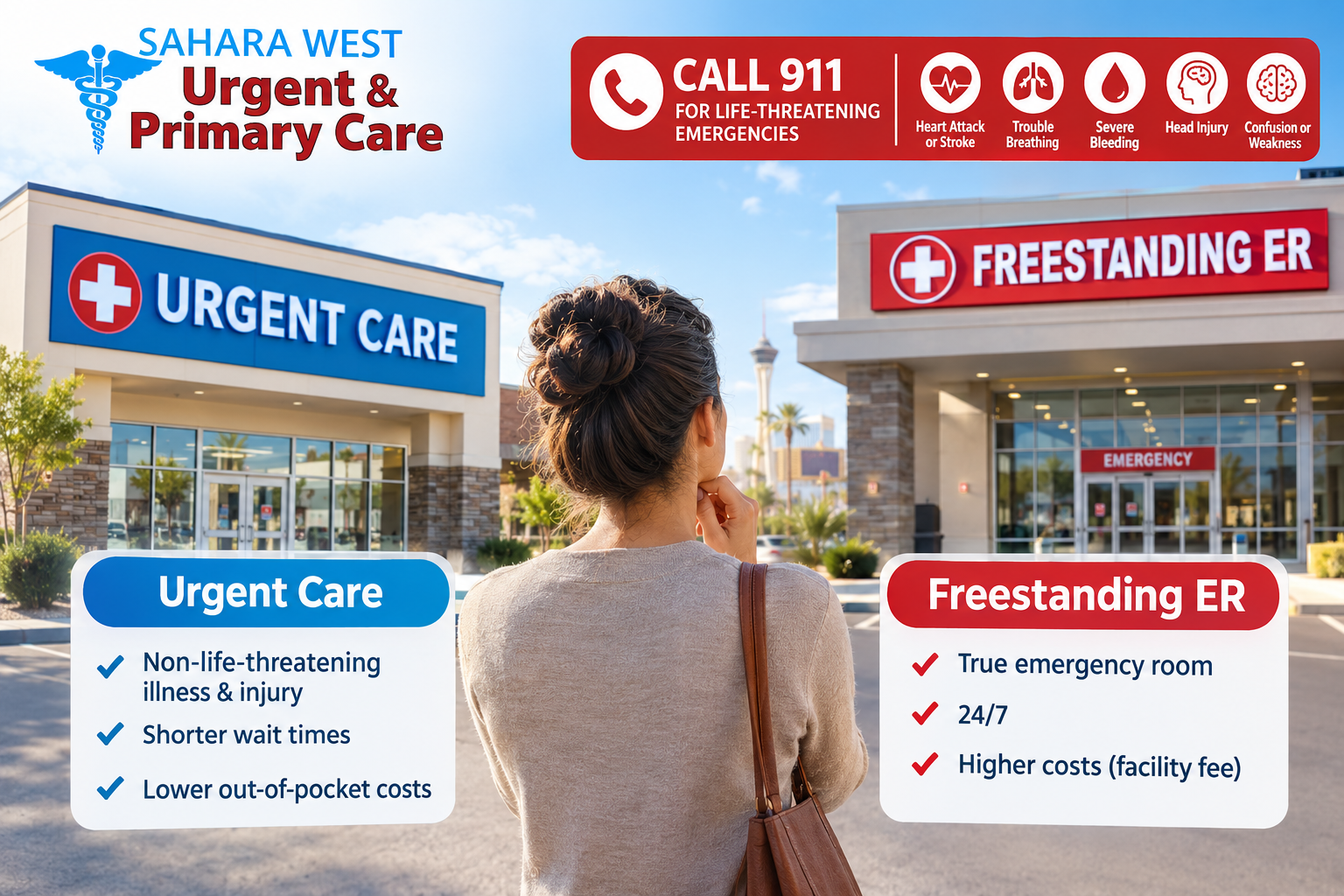
Our Las Vegas clinic bridges the dangerous gap between an overcrowded emergency room and a months-long therapy waitlist, offering same-day mental health support when you need it most.
Navigating Referrals in the Las Vegas Community
If ongoing, specialized counseling is the right next step for you, our multidisciplinary team including board-certified psychiatrists, licensed psychologists, and professional counselors helps connect patients across Clark County to the right long-term care, whether that’s individual therapy, family therapy, group support, or medication management.
Hybrid Approaches: Getting the Best of Both Worlds
You don’t have to pick a lane forever. A growing number of patients and clinicians are finding success with hybrid treatment models:
- Virtual check-ins between in-person sessions to maintain momentum without the logistical burden of weekly office visits
- Periodic face-to-face sessions for deeper trauma work, medication reviews, or moments when non-verbal assessment matters most
- Flexible adjustment over time starting in-person during an acute period, then shifting to teletherapy as symptoms stabilize (or vice versa)
The key is treating your care plan as something that evolves with you, not something set in stone on day one.
Conclusion & Next Steps
So is teletherapy as effective as in-person counseling? For most common conditions like anxiety, depression, and everyday stress, the honest, research-backed answer is: yes, in many cases, it’s just as effective, especially for approaches like CBT. But for crisis situations, severe symptoms, or complex trauma, in-person care remains the safer, more clinically supported path.
The real takeaway: there’s no universal “better” option, only the right fit for your diagnosis, your lifestyle, and your comfort level.
Here’s your next step: Don’t guess. Talk it through with a licensed provider who can assess your specific situation and point you toward the format or hybrid combination that gives you the best shot at real, lasting progress.
If you’re in the Las Vegas area and need guidance now, Sahara West Urgent Care is here for you. Whether you need an immediate mental health evaluation, want to explore teletherapy options, or need a referral into long-term outpatient care, our team can meet you exactly where you are.
📍 Visit us at: 6125 West Sahara Avenue, Las Vegas, Nevada 89146
📞 Call today: (702) 248-0554
🕒 Hours: Mon–Fri 9am–8pm | Sat 9am–3pm
Schedule your mental health consultation with Sahara West Urgent Care today →
Frequently Asked Questions
Is online therapy as good as face-to-face therapy?
For mild-to-moderate anxiety, depression, and stress, research shows online therapy can be just as effective as in-person sessions, particularly with evidence-based approaches like CBT. Severe cases and crisis situations typically require in-person care.
What are the disadvantages of teletherapy?
Teletherapy can be limited by unreliable internet access, reduced ability to read non-verbal cues, lack of privacy at home, and unsuitability for crisis intervention or certain trauma-focused techniques.
Does insurance cover teletherapy the same as in-person counseling?
Many insurance providers now reimburse teletherapy at parity with in-person visits, but coverage varies by plan. It’s best to confirm your specific benefits before booking.
Can I switch between teletherapy and in-person counseling?
Yes. A hybrid approach combining virtual check-ins with periodic in-person visits is increasingly common and can be adjusted as your needs change over time.
When should I seek in-person help instead of teletherapy?
Seek in-person or urgent care support immediately if you’re experiencing a mental health crisis, active suicidal thoughts, severe psychiatric symptoms, or a situation requiring hands-on clinical evaluation.
Does Sahara West Urgent Care offer teletherapy?
Yes. Sahara West Urgent Care offers secure teletherapy options for patients across Clark County, alongside walk-in urgent mental health evaluations and referrals to ongoing outpatient care.