By Sahara West Urgent Care & Wellness Las Vegas, Nevada
Although contracting Lyme disease after a tick bite is never guaranteed, specific symptoms and risk factors make professional medical evaluation necessary. If a tick was attached to your skin for 36 hours or longer, or if you develop a bull’s-eye rash (Erythema migrans), fever, chills, headaches, persistent fatigue, or joint pain, visiting an urgent care in Las Vegas right away is crucial. Immediate care prevents Lyme disease and other tick-borne infections from escalating into long-term health issues.
Most routine tick bites can be safely removed at home using proper techniques. However, knowing exactly when to transition from home care to professional evaluation helps you avoid severe complications. Consulting a trusted Las Vegas primary care doctor ensures that any potential exposure is tracked accurately.
This comprehensive guide outlines how to handle tick bites at home, when to seek treatment at Sahara West Urgent Care, and when your situation requires an emergency room visit.
Not Every Tick Bite Requires a Doctor Visit
It is helpful to remember that discovering a tick does not automatically mean you will get sick. If you spot a tick and remove it right away especially within 24 hours of attachment the likelihood of transmitting a tick-borne disease remains extremely low. In these early situations, careful monitoring and basic home hygiene are usually the best steps forward.
However, specific risk factors can quickly change your treatment needs. When those red flags appear, scheduling a consultation through primary care in Las Vegas at Sahara West Urgent Care becomes the safest, most effective choice for your health.
When to Visit Sahara West Urgent Care After a Tick Bite
You can walk into Sahara West Urgent Care without an appointment whenever any of these critical situations occur:
-
The tick was attached for over 36 hours: The longer a tick feeds, the higher the risk of bacterial transmission. Lyme disease bacteria (Borrelia) typically require 36 to 48 hours of continuous feeding to transfer to a host. If you are unsure about the exact timeline, look at the tick’s shape a flat tick indicates brief attachment, while a rounded, swollen tick means it has been feeding for a long time. Receiving preventive care from a walk-in clinic in Las Vegas can prevent infections before they take hold.
-
You cannot completely remove the tick: Leaving parts of the tick behind, such as its head or mouthparts, increases your risk of local skin infections. The experienced clinical staff at our Las Vegas medical clinic can safely extract remaining tick pieces and thoroughly sanitize the area.
-
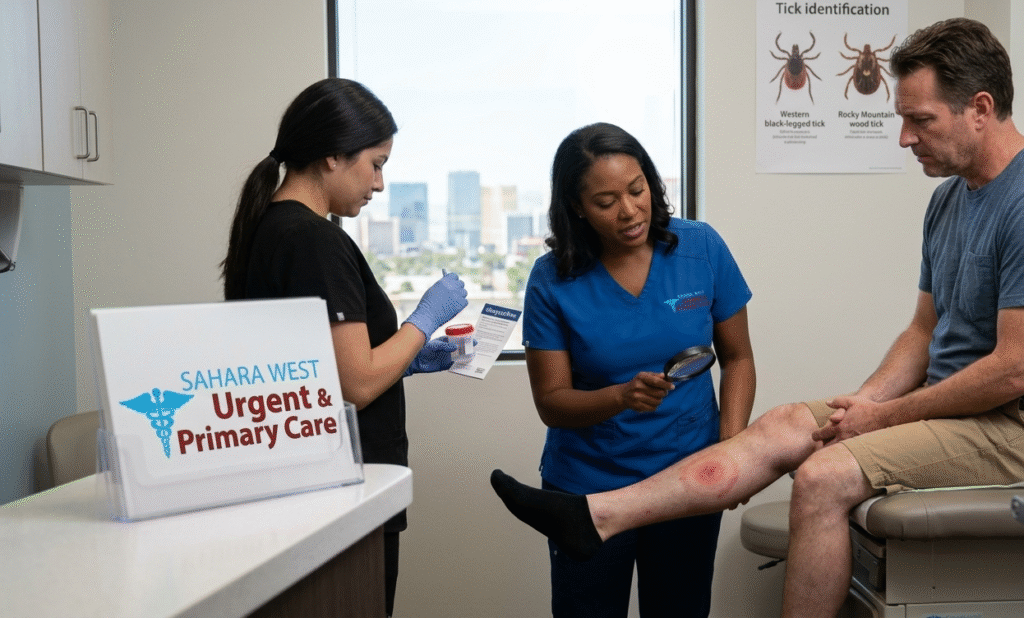
A bull’s-eye rash appears: The classic warning sign of early Lyme disease is Erythema migrans a expanding circular red mark resembling a bull’s-eye target. This rash usually shows up 3 to 30 days after the bite and may not feel itchy or painful. If you notice this pattern, get evaluated immediately by a family medicine provider in Las Vegas.
-
Flu-like symptoms develop: Fevers, chills, unexplained fatigue, head pressure, muscle soreness, and joint aches in the days following a bite indicate an underlying systemic reaction. Rather than mistaking these signs for a common cold, schedule an evaluation for same-day primary care in Las Vegas.
-
Swollen lymph nodes near the bite site: Localized swelling in your lymph nodes means your immune system is actively fighting off an intruder. A physical exam during an annual physical exam in Las Vegas or urgent care appointment helps determine if antibiotic intervention is required.
-
The bite site shows infection signs: Spreading redness, localized heat, and swelling that worsen after two days point to a bacterial skin infection. Seeking treatment for preventive health screenings in Las Vegas ensures you receive the correct antibiotic prescription without delay.
If an engorged tick was attached for 36 hours or longer and removed within the last 72 hours, providers may prescribe a single preventive dose of doxycycline to stop Lyme disease from developing. Sahara West Urgent Care offers this proactive treatment on-site.
What Happens at Sahara West Urgent Care for a Tick Bite
Your appointment at Sahara West Urgent Care is designed to be smooth, fast, and thorough. During your visit, our healthcare team will:
-
Carefully inspect the bite area for rash patterns or infection.
-
Professionally extract any remaining tick mouthparts.
-
Clean and disinfect the skin site.
-
Review your recent outdoor travel and activities.
-
Provide official doctor documentation if needed for work or school.
-
Outline important recovery symptoms to monitor at home.
-
Order appropriate Lyme disease laboratory testing.
When considering diagnostic tests, keep in mind that blood tests may not show positive results during the first few weeks following a bite because your body needs time to generate detectable antibodies. Your medical team at our top-rated primary care in Las Vegas will determine the best diagnostic timeline and can begin prescription therapy based on your symptoms alone.
How to Remove a Tick at Home – Before Your Visit
If you spot an attached tick, remove it right away rather than waiting until you arrive at the clinic. Fast removal is your best defense against disease transmission.
The Proper Removal Method:
-
Use clean, fine-tipped tweezers.
-
Grasp the tick as close to your skin’s surface as possible.
-
Pull upward with steady, even pressure without twisting or jerking.
-
Clean the bite area thoroughly with soap and water or rubbing alcohol.
-
Save the tick in a sealed bag or container so your doctor can identify the species.
What to Avoid:
-
Never attempt to smother the tick with petroleum jelly, nail polish, heat, or essential oils. These methods irritate the tick, causing it to inject fluids back into your bloodstream and increasing infection risks.
-
Do not crush the tick with your bare fingers.
After removal, note the date and observe whether the tick appeared flat or swollen with blood. Sharing these details during your affordable wellness exam in Las Vegas helps your doctor assess your risk level accurately.
Symptoms of Lyme Disease to Watch For
Whether you visit our clinic immediately or manage the initial bite at home, monitor your body closely for 3 to 30 days. Watch out for these symptoms:
Early Lyme Disease Signs:
-
The classic bull’s-eye rash (Erythema migrans) expanding outward
-
Low-grade fever and body chills
-
Unexplained physical fatigue
-
Persistent headaches
-
Muscle aches and joint discomfort
-
Swollen lymph nodes
Later Stage Symptoms (If Untreated):
-
Severe joint swelling and arthritis, especially in the knees
-
Neurological issues, including facial palsy or numbness in limbs
-
Irregular heart rhythms or palpitations
-
Deep, debilitating exhaustion
Early antibiotic treatment resolves most Lyme disease cases effectively. Establishing long-term management with comprehensive primary care services in Las Vegas ensures that subtle health shifts are addressed before complications develop.
When to Go to the Emergency Room Instead
While urgent care centers treat most tick bites, certain severe symptoms require immediate emergency room intervention. Call 911 or visit the nearest ER if you experience:
-
A severe headache accompanied by a stiff neck
-
Sudden confusion or altered mental awareness
-
Difficulty breathing or sudden facial swelling
-
Sudden chest pain or heart palpitations
-
Muscle paralysis, numbness, or weakness
If you encounter these critical signs, seek emergency medical services right away. For general follow-ups once stabilized, schedule a visit for routine preventive screenings in Las Vegas.
Tick Prevention in Nevada: What You Need to Know
While urban Las Vegas presents minimal tick risks, outdoor recreational spots across Nevada expose hikers, campers, and outdoor enthusiasts to parasites. Species like the Western black-legged tick and the Rocky Mountain wood tick inhabit regional trails, carrying threats like Lyme disease and Rocky Mountain spotted fever.
Key Prevention Strategies:
-
Wear light-colored, long-sleeved shirts and pants on trails.
-
Apply insect repellents containing DEET, picaridin, or permethrin.
-
Stick to clear path centers away from overgrown brush.
-
Conduct full-body tick checks after outdoor activities.
When returning from trips, booking a check-up at a Las Vegas urgent care center helps ensure that any unrecognized bites are evaluated early.
Sahara West Urgent Care Is Ready to Help
If you find a tick attached to your skin, cannot determine how long it has been feeding, or notice unusual symptoms, visit Sahara West Urgent Care. No appointment is ever needed. Our medical team is ready to evaluate your condition, administer preventive care, and guide your recovery.
📍 6125 West Sahara Avenue, Las Vegas, NV 89146
🕒 Monday to Friday: 9 AM to 8 PM & Saturday: 9 AM to 3 PM
Sunday is off
Frequently Asked Questions (FAQs)
Q1. Should I go to urgent care after every tick bite?
Not always. If the tick was attached for less than 24 hours and removed completely, home monitoring is usually sufficient. However, if it was attached for over 36 hours, cannot be removed, or causes a rash, consulting an urgent care clinic in Las Vegas is recommended.
Q2. Can Sahara West Urgent Care test for Lyme disease?
Yes. However, because blood tests can yield false negatives in the early weeks while antibodies develop, our providers may begin antibiotic treatment based on your physical symptoms and exposure history.
Q3. What is the bull’s-eye rash and what does it mean?
The bull’s-eye rash (Erythema migrans) is a red, expanding skin circular mark that indicates early Lyme disease. If you spot this sign, visit Sahara West Urgent Care right away.
Q4. Can urgent care prescribe antibiotics for a tick bite?
Yes. Our medical providers can prescribe single-dose preventive doxycycline within 72 hours of tick removal or full antibiotic courses for active infections.
Q5. How long does a tick need to be attached to transmit Lyme disease?
The risk of Lyme disease transmission increases significantly after 36 to 48 hours of continuous feeding. Ticks attached for under 24 hours carry a very low risk.
Q6. What should I do with the tick after I remove it?
Store the tick in a sealed plastic bag or container. Bringing it to your medical provider aids in species identification and risk assessment.
Q7. Are there ticks in Nevada that carry Lyme disease?
Yes. The Western black-legged tick found in Nevada can carry Lyme disease bacteria, while the Rocky Mountain wood tick can transmit Rocky Mountain spotted fever.
Q8. What symptoms of Lyme disease can appear weeks after a tick bite?
Symptoms appearing weeks later include expanding rashes, joint swelling, fever, fatigue, headaches, and nerve tingling. Monitoring your health long after a bite is vital.
Q9. Do I need an appointment at Sahara West Urgent Care for a tick bite?
No. Walk-ins are welcome during our regular hours: Monday–Friday 9 AM–8 PM and Saturday 9 AM–3 PM.
Q10. When should I go to the ER instead of urgent care for a tick bite?
Go to the ER immediately if you experience a stiff neck with severe headaches, chest pain, facial paralysis, or breathing difficulties following a bite.