

Millions of adults skip their annual physical every year. Most of them feel fine and that is exactly the problem.
Conditions like high blood pressure, type 2 diabetes, elevated cholesterol, and even early-stage cancer can develop silently for months or years without a single noticeable symptom. By the time symptoms appear, treatment becomes more difficult, more expensive, and far less effective.
Feeling healthy does not always mean you are healthy.
This article breaks down the 5 most important tests included in an annual physical exam, what each one detects, who needs them, and why skipping them could cost you far more than an hour of your time.
Why Annual Physical Exams Matter More Than Ever
An annual physical exam also called a wellness visit or preventive health screening, is a routine checkup with your primary care physician designed to assess your overall health before problems arise.
An annual physical exam also called a wellness, visit s a routine checkup with your Primary Care provider. While many people visit Urgent Care only when they are sick, a scheduled wellness exam is about staying ahead of potential issues.
Many people often wonder about the speed of care when choosing between providers. For a detailed breakdown, you can read our guide on urgent care vs primary care doctor: what’s faster.
Unlike a sick visit, a wellness exam focuses on early detection and risk factor management. Your doctor reviews your medical history, checks vital signs, orders lab work, and screens for conditions based on your age, sex, and family history.
According to the CDC, approximately 7 in 10 deaths in the United States are caused by chronic diseases, many of which are preventable or manageable when caught early. Heart disease, stroke, diabetes, and certain cancers account for the majority of these deaths, and all of them can be detected through routine annual screening.
The American College of Preventive Medicine confirms that preventive care reduces long-term healthcare costs by identifying disease in earlier, more treatable stages. Scheduling one yearly exam could help catch problems before they become emergencies.
Test 1: Blood Pressure Screening: The Silent Killer Detector
Blood pressure screening is one of the simplest and most critical tests performed during an annual physical, and one of the most overlooked by patients who feel well.
High blood pressure, or hypertension, affects approximately 47% of adults in the United States, according to the American Heart Association. Of those, nearly 1 in 3 do not know they have it. That is why it is called the “silent killer.” Hypertension produces no pain, no obvious symptoms, and no warning signs, until it causes a heart attack or stroke.
While hypertension is a silent killer, acute symptoms like chest pain should never be ignored. Knowing when to choose ER vs urgent care for chest pain is a life-saving skill everyone should have.
Untreated hypertension significantly increases the risk of heart damage. In some cases, doctors may use diagnostic tools like X-Rays to check for an enlarged heart or fluid in the lungs caused by long-term high blood pressure.
Normal vs. High Blood Pressure Ranges:
| Category | Systolic (mmHg) | Diastolic (mmHg) |
| Normal | Less than 120 | Less than 80 |
| Elevated | 120–129 | Less than 80 |
| High (Stage 1) | 130–139 | 80–89 |
| High (Stage 2) | 140 or higher | 90 or higher |
| Hypertensive Crisis | Higher than 180 | Higher than 120 |
The American Heart Association recommends blood pressure be checked at every healthcare visit for adults 18 and older. Adults with normal readings should be screened at least once every two years. Those with elevated readings require more frequent monitoring.
Left untreated, hypertension significantly increases the risk of heart disease, kidney damage, vision loss, and stroke, conditions that are largely avoidable with early intervention and lifestyle changes.
Test 2: Cholesterol and Lipid Panel Testing for Heart Disease Risk
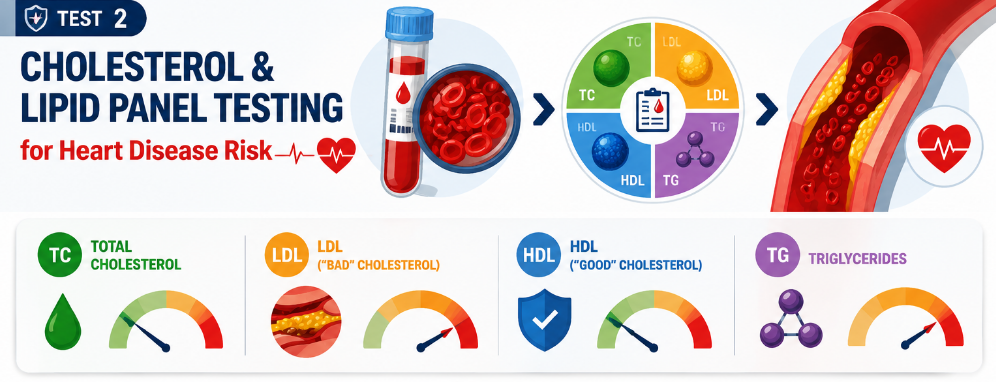
A lipid panel is a blood test that measures the levels of fats in your bloodstream. It includes total cholesterol, LDL (low-density lipoprotein), HDL (high-density lipoprotein), and triglycerides. Together, these numbers help your doctor assess your risk for cardiovascular disease.
Heart disease is the leading cause of death in the United States, responsible for approximately 1 in 5 deaths annually, per the CDC. The dangerous reality is that arterial plaque, the buildup of cholesterol in blood vessel walls, develops without symptoms until a vessel becomes blocked enough to cause a heart attack or stroke.
Cholesterol Reference Ranges:
| Cholesterol Type | Optimal Range | At-Risk Level |
| Total Cholesterol | Less than 200 mg/dL | 240 mg/dL or higher |
| LDL (Bad Cholesterol) | Less than 100 mg/dL | 160 mg/dL or higher |
| HDL (Good Cholesterol) | 60 mg/dL or higher | Less than 40 mg/dL |
| Triglycerides | Less than 150 mg/dL | 200 mg/dL or higher |
The U.S. Preventive Services Task Force recommends lipid screening for all adults aged 35 and older, and for younger adults with risk factors such as obesity, smoking, hypertension, or a family history of heart disease. If results are abnormal, your doctor may recommend dietary changes, increased physical activity, or medication.
Test 3: Blood Glucose and A1C Testing for Early Diabetes Detection
Diabetes is one of the fastest-growing chronic diseases in the world. According to the American Diabetes Association, more than 38 million Americans have diabetes, and approximately 8.5 million of them are undiagnosed. An additional 96 million adults have prediabetes, a condition that progresses to type 2 diabetes without intervention.
Blood glucose testing and the hemoglobin A1C test are the primary tools for detecting both prediabetes and diabetes during a routine physical.
The A1C test measures the average blood sugar levels over the past two to three months, giving doctors a more reliable picture than a single fasting glucose reading.
A1C Test Interpretation:
| A1C Level | Diagnosis |
| Below 5.7% | Normal |
| 5.7% – 6.4% | Prediabetes |
| 6.5% or higher | Diabetes |
Early detection is critical. Unmanaged diabetes leads to serious long-term complications including nerve damage, kidney failure, vision loss, and cardiovascular disease. When caught at the prediabetes stage, the condition is frequently reversible through diet, exercise, and weight management — without medication.
The American Diabetes Association recommends testing for all adults aged 35 and older, and for younger adults who are overweight or have additional risk factors such as a family history of diabetes, sedentary lifestyle, or a history of gestational diabetes.
Test 4: Cancer Screenings That Catch Disease Before Symptoms Appear
Cancer screenings are among the most powerful tools in preventive medicine. The 5-year survival rate for many cancers is dramatically higher when the disease is detected at an early, localized stage compared to a late, metastatic stage. For colorectal cancer, the 5-year survival rate is approximately 91% when caught locally versus only 13% at the distant stage, according to the American Cancer Society.
During your physical, your doctor might recommend additional screenings based on your lifestyle. If you’re concerned about exposure, it’s important to know how STD testing works and specifically how soon after unprotected sex to test for STDs for accurate results.
Annual physicals provide the opportunity to assess cancer risk and initiate appropriate screenings based on age, sex, and personal history.
Key Cancer Screenings Recommended by Preventive Guidelines:
| Cancer Type | Recommended Screening | Starting Age |
| Colorectal Cancer | Colonoscopy or stool-based test | Age 45 |
| Breast Cancer | Mammogram | Age 40–50 (varies by guideline) |
| Cervical Cancer | Pap smear / HPV test | Age 21 |
| Prostate Cancer | PSA blood test (discuss with doctor) | Age 50 (45 for high risk) |
| Lung Cancer | Low-dose CT scan | Age 50 (smokers, 20+ pack-years) |
The United States Preventive Services Task Force (USPSTF) updates these recommendations based on the latest evidence. Your doctor will customize screening frequency based on your individual risk profile and family history.
Beyond standard exams, specialized screenings like an Ultrasound can help visualize internal organs to detect abnormalities early.
A physical exam is not a substitute for every cancer screening, but it is the gateway through which screenings are ordered, coordinated, and followed up.
Test 5: BMI, Weight, and Metabolic Health Assessments
Body mass index (BMI) and waist circumference measurements are standard components of an annual physical that often receive less attention than bloodwork , yet they carry significant diagnostic value.
Obesity is linked to over 200 health conditions, including type 2 diabetes, heart disease, certain cancers, sleep apnea, and osteoarthritis. According to the CDC, more than 40% of American adults are classified as obese.
If your BMI indicates you are in the overweight or obese category, it’s important to remember that this is a manageable risk factor. Starting a professional Weight Loss program can significantly lower your chances of developing chronic metabolic diseases.
BMI Classification:
| BMI Range | Classification |
| Below 18.5 | Underweight |
| 18.5 – 24.9 | Normal weight |
| 25.0 – 29.9 | Overweight |
| 30.0 and above | Obese |
It is important to note that BMI has limitations, it does not account for muscle mass, bone density, or fat distribution. Physicians often combine BMI with waist circumference and metabolic markers to get a more complete picture of risk.
Metabolic syndrome, a cluster of conditions including high blood pressure, high blood sugar, excess abdominal fat, and abnormal cholesterol, affects approximately 1 in 3 American adults and significantly increases the risk of heart disease and diabetes. Annual physical assessments can identify this pattern early, allowing for intervention before organ damage occurs.
How Often Should You Get These Tests?
Screening frequency varies by age, sex, and individual risk factors. Use the following as a general reference, and always confirm recommendations with your primary care physician.
| Age Group | Key Screenings | Typical Frequency |
| 18–39 | Blood pressure, cholesterol (if risk factors), glucose, BMI | Every 1–3 years |
| 40–49 | All above + A1C, mammogram (women), cancer risk discussion | Annually |
| 50–64 | All above + colonoscopy or stool test, lung CT (if smoker), PSA (men) | Annually + per guidelines |
| 65+ | All above + bone density (women), expanded cardiovascular risk | Annually |
Family history of heart disease, cancer, or diabetes may warrant earlier or more frequent testing at any age.
What to Expect During an Annual Physical Exam
A standard annual physical typically lasts 30 to 60 minutes and includes a review of your personal and family medical history, measurement of vital signs (blood pressure, heart rate, temperature, height, and weight), a physical examination of major organ systems, and a discussion of lifestyle factors including diet, exercise, smoking, and alcohol use.
Blood work is usually ordered during the visit and completed at a lab the same day or shortly after. Results are reviewed by your physician and communicated to you with any follow-up recommendations.
To prepare for your physical: fast for 8 to 12 hours before blood work if your doctor advises it, bring a list of current medications and supplements, note any symptoms or health changes you have experienced, and prepare questions about screenings relevant to your age and risk profile.
The Biggest Mistakes People Make About Preventive Health
Waiting until symptoms appear is the most common, and most dangerous mistake adults make. Most serious diseases do not cause pain or discomfort in their early stages. By the time symptoms are noticeable, the condition has often progressed significantly.
Other costly mistakes include skipping follow-up testing after abnormal results, assuming that a healthy lifestyle eliminates the need for screening, ignoring a strong family history of chronic disease, and relying on urgent care visits instead of establishing care with a primary care physician.
Annual physicals are not just for sick people. They are specifically designed for people who feel well.
When to Schedule Your Annual Physical Immediately
You should prioritize scheduling a physical without delay if you are over 40 and have not had a checkup in the past year, you have a family history of heart disease, diabetes, or cancer, you experience unexplained fatigue, weight changes, shortness of breath, or dizziness, you smoke, have a high-stress lifestyle, or a sedentary job, or it has been more than two years since your last blood work.
Schedule your annual physical exam today!
Frequently Asked Questions
What tests are usually included in an annual physical?
A standard annual physical includes blood pressure measurement, cholesterol and lipid panel, blood glucose or A1C testing, BMI assessment, and cancer screening referrals based on age and sex. Your doctor may also check thyroid function, kidney function, and complete blood count depending on your history.
How often should adults get blood work done?
Most adults should have blood work done at least once a year as part of a routine physical. Those with chronic conditions or identified risk factors may require more frequent testing.
Can an annual physical detect cancer?
An annual physical can identify cancer risk and initiate appropriate screenings such as colonoscopies, mammograms, and PSA tests. Blood work alone does not typically detect cancer, but screenings ordered through your physical can catch it early.
What age should preventive screenings start?
Most guidelines recommend routine preventive screenings beginning at age 18 for blood pressure and at age 35 to 45 for cholesterol, blood glucose, and cancer screenings. High-risk individuals may need to start earlier.
Are annual physical exams covered by insurance?
Most private health insurance plans and Medicare cover annual wellness visits at no cost to the patient under the Affordable Care Act’s preventive care provisions. Check with your insurer for specific coverage details.
Do healthy adults still need yearly checkups?
Yes. Many serious conditions present no symptoms in their early stages. Annual physicals detect abnormalities before they become health crises, making them essential for all adults regardless of how healthy they feel.
What should I avoid before blood testing?
Most blood panels require fasting for 8 to 12 hours beforehand. Avoid food, most beverages (water is usually fine), and some medications if your doctor advises. Confirm instructions with your provider before your appointment.