Key Takeaways
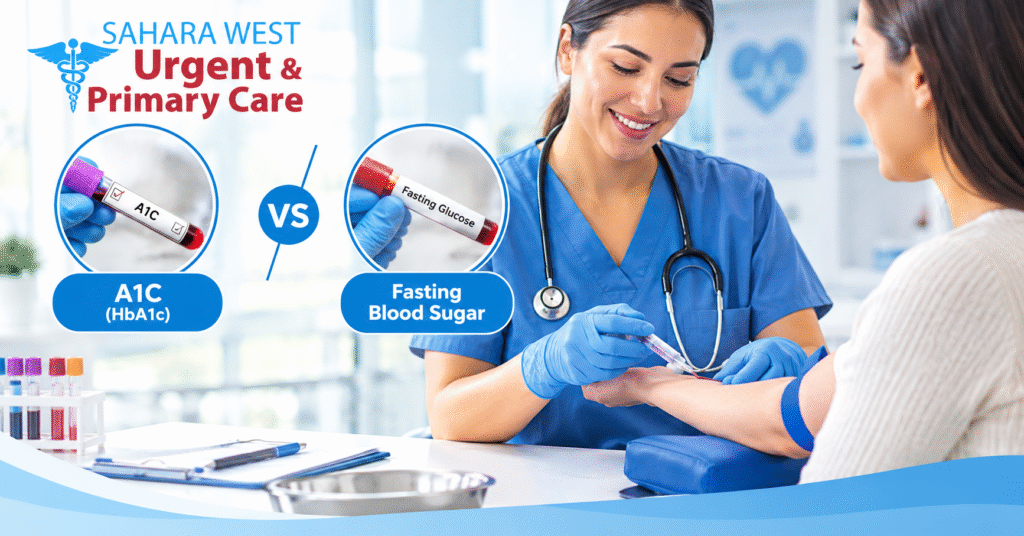
- A1C = a three-month average. No fasting needed, and you can test any time of day.
- Fasting blood sugar = a single-moment snapshot. It requires an overnight-style fast.
- Both use different cutoffs, so you can’t directly convert one result into the other.
- It’s possible for one test to look normal while the other looks high. That’s a reason for follow-up, not panic.
- Home glucose meters aren’t used to diagnose diabetes.
A1C vs. Fasting Blood Sugar at a Glance
| A1C (HbA1c) | Fasting Blood Sugar (FPG) | |
|---|---|---|
| What it shows | Average blood sugar over about 3 months | Blood sugar at one point in time |
| Fasting required? | No | Yes, at least 8 hours |
| Best time to test | Any time of day | Typically morning, after fasting |
| Result format | Percentage (%) | mg/dL |
| Affected by short-term factors | Less | More (recent meals, illness, stress) |
| Can be affected by | Certain blood and kidney conditions | Not truly fasting, illness, some medications |
| Used to diagnose diabetes? | Yes | Yes |
What Is an A1C Test?
An A1C test measures how much glucose is attached to your hemoglobin, the protein in red blood cells. It gives your average blood glucose level over the last 3 months, and it’s also called hemoglobin A1C, HbA1C or glycated hemoglobin. The result is reported as a percentage, and a higher percentage means higher average blood sugar. nih
The big advantage is convenience. A1C doesn’t require fasting and can be done at any time of day. That’s why it’s popular for walk-in screenings. unt
What Is a Fasting Blood Sugar Test?
A fasting plasma glucose (FPG) test measures the sugar in your blood at a single moment. It requires going without food or drink for 8 hours before the sample is drawn. It tells you how well your body is handling glucose when you haven’t eaten recently. medicalnewstoday
Because it’s a snapshot, it can be influenced by what you ate the night before, illness, stress, and certain medications. That doesn’t make it less useful. It just means preparation matters.
Normal, Prediabetes and Diabetes Ranges
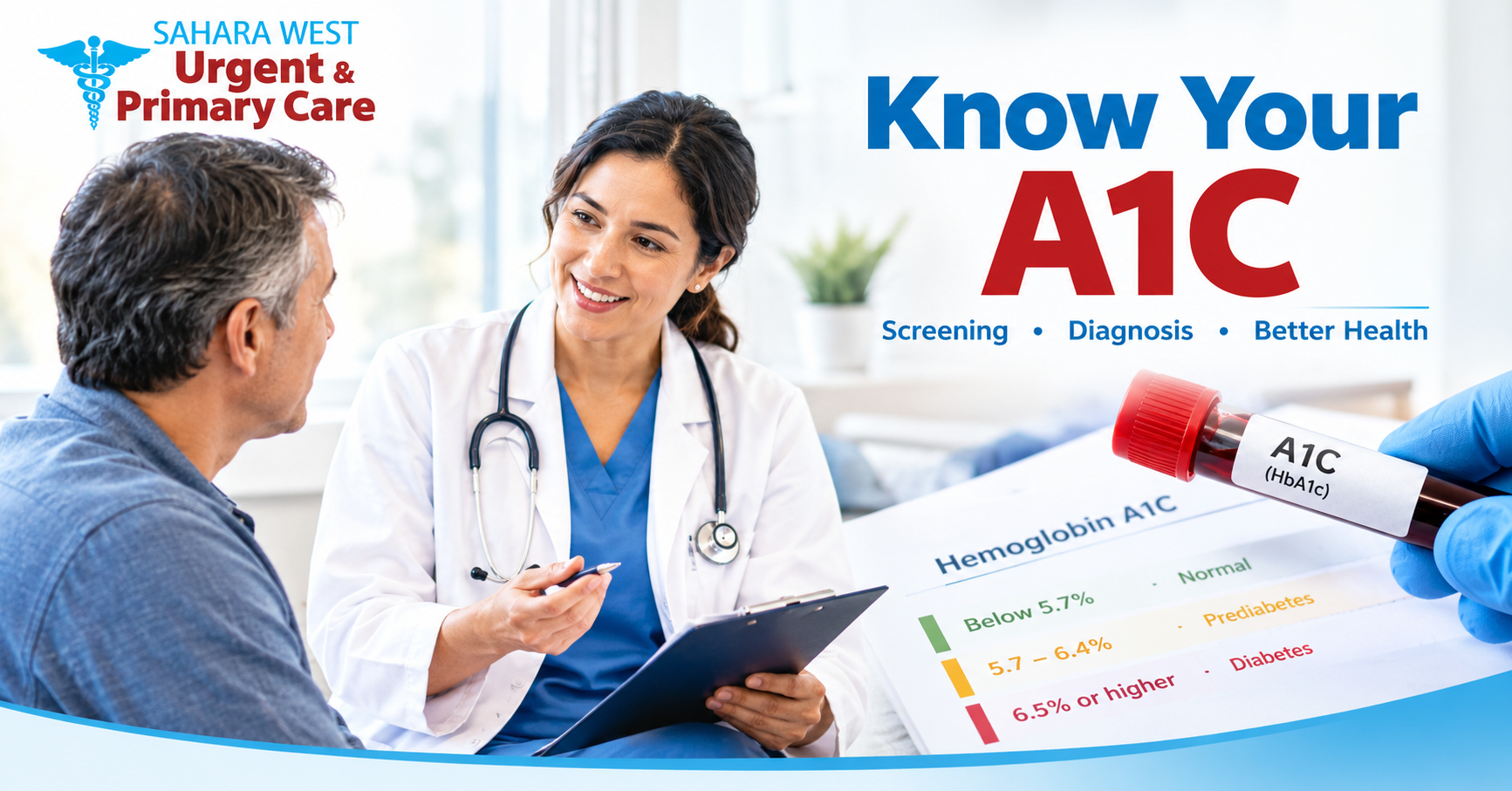
ADA criteria set diabetes at an A1C of 6.5% or higher, a fasting glucose of 126 mg/dL or higher, or a 2-hour oral glucose tolerance test result of 200 mg/dL or higher. Prediabetes falls at A1C 5.7–6.4%, fasting glucose 100–125 mg/dL, or a 2-hour glucose tolerance result of 140–199 mg/dL. nih
| Test | Normal | Prediabetes | Diabetes |
|---|---|---|---|
| A1C | Below 5.7% | 5.7%–6.4% | 6.5% or higher |
| Fasting plasma glucose | Below 100 mg/dL | 100–125 mg/dL | 126 mg/dL or higher |
| Oral glucose tolerance test (2-hour) | Below 140 mg/dL | 140–199 mg/dL | 200 mg/dL or higher |
These are general ranges. Your provider interprets results in the context of your symptoms, history and risk factors.
Not sure which number you need? Ask our team at Sahara West or walk in during clinic hours.
Which Test Is Better?
There isn’t a single winner. The ADA has listed fasting glucose, the oral glucose tolerance test and A1C as each appropriate for diagnosing diabetes. The right choice depends on your situation. nih
A1C may fit best when:
- Fasting is impractical, such as a busy schedule or a walk-in visit
- You want a longer-term picture rather than a single day
- You’re being screened as part of a routine preventive visit
Fasting blood sugar may fit best when:
- Your provider wants a precise snapshot of your current glucose
- A condition that affects red blood cells could make A1C less reliable
- You’re being evaluated alongside other morning fasting labs
Other tests may be needed when:
- You’re pregnant. An oral glucose tolerance test is typically used to diagnose gestational diabetes. Pregnancy screening follows its own schedule through your OB-GYN. orthoatlanta
- You have symptoms and need a result right away. A random glucose test can be used without fasting.
Why Your Results Can Disagree
It’s not unusual for one test to look normal while the other doesn’t, and there are real reasons for it.
The A1C test identifies fewer diabetes cases than the glucose tests. At the same time, for diabetes specifically, the two usually agree. In a national U.S. analysis, A1C and fasting glucose gave the same classification for about 97.7% of adults. Prediabetes is where they diverge more. In one study, only half of the people flagged as prediabetic by A1C also had impaired fasting glucose. Comparing Tests for DM 508 +2
If your results conflict, don’t assume the “better” number is the right one. When two different tests don’t agree, the standard approach is to repeat the test that was above the diagnostic cutoff. NIDDK also notes that if A1C and blood glucose levels don’t match, your doctor should consider that A1C may not be reliable for you. kanehealthnih
What Can Affect Your Results
A1C can be less reliable if you have:
- Anemia or other red blood cell conditions
- Certain inherited hemoglobin variants
- Kidney disease
- Recent significant blood loss or a blood transfusion
Fasting blood sugar can be thrown off by:
- Eating or drinking something other than water before the test
- Recent illness or physical or emotional stress
- Certain medications, such as steroids
Tell your provider about any medical conditions and medications before testing.
Don’t Use a Home Meter to Diagnose Diabetes
Home glucose meters aren’t appropriate for diagnosing diabetes, because laboratory standards are more precise. A meter can be useful for monitoring after a diagnosis, but a screening or diagnostic test should be done through a clinic or lab. diabetesselfmanagement
How to Prepare for Each Test
For an A1C: No fasting is generally needed. Follow any specific instructions from your provider. See our guide on how to prepare for a preventive health screening.
For a fasting blood sugar:
- Plan the test for the morning so the fast is easier
- Avoid food and caloric drinks for at least 8 hours beforehand, and check with your provider about water
- Ask whether you should take your usual medications that morning
How Often Should You Be Tested?
The CDC reports that the USPSTF and ADA recommend testing for prediabetes and type 2 diabetes starting at age 35 for many adults, and every 3 years afterward. You may need to start earlier or test more often if you have overweight or obesity, a family history of diabetes, or other risk factors. People who already have prediabetes should generally be tested yearly. cdclabce
It matters in Las Vegas. About 12.8% of Clark County adults, roughly 238,000 people, had diabetes in 2023, and the ADA estimates 816,000 Nevadans have prediabetes. southernnevadahealthdistrict
Get Tested at Sahara West Urgent Care & Wellness
If you want a quick, no-appointment check of your blood sugar, our free A1C screening is a simple place to start. Here’s what to expect:
- Walk in during clinic hours.
- Check in with our team.
- Talk with a healthcare professional about which screening fits you.
- Complete the blood test.
- Review what your result means and whether follow-up is appropriate.
If your result is outside the normal range, or if you’d like help managing blood sugar over time, our primary care team can help with follow-up. Ask our team about costs for any services beyond the screening. We accept many major insurance plans and offer self-pay options.
📍 6125 W Sahara Ave, Las Vegas, NV 89146
🕘 Mon–Fri 9 AM–8 PM | Sat 9 AM–3 PM
📞 (702) 248-0554
Walk In for Free A1C Screening | Book an Appointment
When to Get Care Sooner
Don’t wait for a routine screening if you notice increased thirst, frequent urination, unexplained weight loss, blurry vision, unusual fatigue, or slow-healing sores. Same-day urgent care is available at our clinic.
Call 911 or go to the nearest ER for confusion, extreme drowsiness, fainting, persistent vomiting, severe abdominal pain, fruity-smelling breath, or rapid breathing.
FAQs
Is A1C or fasting blood sugar more accurate?
Neither is universally more accurate. A1C reflects a three-month average and isn’t affected by what you ate yesterday, but certain blood conditions can skew it. Fasting glucose is a precise snapshot but is more affected by short-term factors. Your provider picks the test or combination that fits you.
Do I need to fast for an A1C test?
No. A1C doesn’t require fasting and can be done any time of day. Follow any specific instructions your provider gives you.
Can I have a normal A1C but a high fasting blood sugar?
Yes. The two tests measure different things and use different cutoffs, so results can disagree. Your provider may repeat a test or order an additional one to clarify.
What fasting glucose level equals an A1C of 6.5%?
There’s no direct conversion. A1C of 6.5% and fasting glucose of 126 mg/dL are separate diagnostic cutoffs for two different measurements.
Can a fasting blood sugar test diagnose diabetes?
Yes. A fasting plasma glucose of 126 mg/dL or higher is in the diabetes range, and a result is generally confirmed with repeat or additional testing.
Which test is used to monitor diabetes over time?
A1C is commonly used to track longer-term blood sugar control in people who already have diabetes. Your provider will tell you how often to test.
What do I do if my A1C is in the prediabetes range?
Prediabetes is a risk marker, not a diagnosis of diabetes. Talk with your provider about follow-up testing, lifestyle changes and how often to retest. Testing yearly is generally advised.
Can I get an A1C test without an appointment in Las Vegas?
Yes. Sahara West welcomes walk-ins for its free A1C screening. Call (702) 248-0554 to confirm current eligibility.
Know Your Number
Whether you choose A1C, fasting blood sugar, or both, the goal is the same: catch changes early so you and your provider can act. Walk in to Sahara West for a free A1C screening, or call (702) 248-0554 with questions.
This article is for general education and isn’t medical advice. A screening isn’t a diagnosis. Talk with a healthcare professional about your personal risk and results.