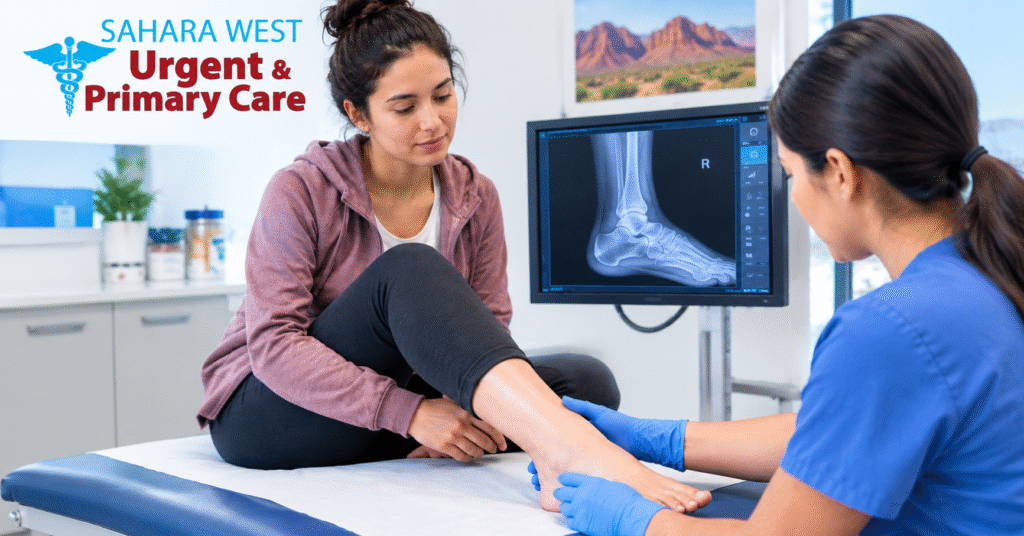
An injury may need an X-ray if it causes severe pain, swelling or bruising that is significant or doesn’t improve, trouble moving the area or putting weight on it, a visible deformity, or a snap or pop at the moment of injury. An X-ray shows bones, so it helps confirm or rule out a fracture or dislocation. It can’t show a sprain, which is a ligament injury.
Maybe you rolled an ankle on a hike at Red Rock, took a fall on the pickleball court, or jammed a finger closing a car door. Now it’s swollen, it hurts, and you’re wondering whether it’s broken or whether you can walk it off.
This guide covers the signs that point toward an X-ray, which injuries usually don’t need one, and when to go to urgent care vs. the ER. If you’re in Las Vegas, call us first so you know the X-ray schedule before you come in.
Need an injury checked? Sahara West Urgent Care offers walk-in digital X-ray services in Las Vegas every Tuesday and Thursday, no appointment needed. Call (702) 248-0554.
What Does an X-Ray Actually Show?
An X-ray uses a small, controlled dose of radiation to create an image of the dense structures in your body, mainly bones. That makes it the standard first test for:
- Fractures, including hairline and stress fractures
- Dislocations and joint alignment problems
- Foreign objects, such as embedded metal or glass
- Chest injuries or complications, such as rib problems or fluid around the lungs
An X-ray does not show soft tissue well. Sprains, strains, muscle tears, and most ligament injuries won’t appear, so a normal X-ray doesn’t mean nothing is wrong. It means a clear break wasn’t found, and your provider may still treat you for a soft-tissue injury.
7 Signs Your Injury May Need an X-Ray
Medical sources commonly point to the same warning signs. If you have one or more of these after a fall, hit, twist, or accident, get evaluated.
- Severe pain that doesn’t ease with rest.
- Swelling or bruising that is significant or doesn’t improve over time.
- Trouble putting weight on the area. A common guideline is being unable to take about four steps.
- Trouble moving the area, or a limited range of motion because of pain.
- A visible deformity, such as a bent, crooked, or out-of-place limb or finger.
- A snap, pop, or crack when the injury happened.
- Point tenderness, meaning pain when you press directly on the bone, not the surrounding muscle.
Also think about how you were hurt. A fall from a height, a car accident, a sports collision, or a heavy object landing on a limb all raise the chance of a fracture, even if the pain seems manageable at first.
Why “It Feels Better” Isn’t Always Reassuring
Pain can fade within hours even with a real injury. Some fractures, especially small ones, still allow movement. If the area stays swollen or tender after the first day or two, don’t assume it’s fine.
Sprain vs. Fracture: How Can You Tell?
You can’t reliably tell at home, because the two can look and feel alike. Here’s how they generally differ:
| Sprain | Fracture (Broken Bone) | |
|---|---|---|
| What’s injured | Ligament (connects bone to bone) | The bone itself |
| Shows on X-ray? | No | Usually yes |
| Typical clues | Swelling, bruising, pain with movement, joint feels unstable | Severe pain, point tenderness on bone, deformity, can’t bear weight, snap or pop |
| Can look the same? | Yes, often | Yes, often |
Because they overlap so much, an in-person exam is the safest way to find out. A provider checks where it hurts, how the joint moves, and whether you can bear weight, then decides whether imaging is needed.
Common Injuries and Whether They Usually Need an X-Ray
| Injury | X-ray needed? | What providers look for |
|---|---|---|
| Twisted ankle | Sometimes | Pain near the ankle bones, tenderness over the bone, or inability to take four steps |
| Wrist injury after a fall | Often | Swelling, tenderness over the bone, deformity, pain gripping or rotating |
| Finger or toe jam | Often if swollen, crooked, or very painful | Deformity, severe swelling, trouble bending |
| Knee injury | Not always | Most knee injuries involve soft tissue, but an inability to bear weight raises concern |
| Rib or chest wall injury | Often | Pain with breathing, tenderness over ribs, trauma history |
| Back or neck pain after trauma | Depends, and may need emergency care | Numbness, weakness, or severe trauma means go to the ER |
| Suspected foreign object | Yes, for metal or glass | Embedded debris or a swallowed object |
This table is general information, not a diagnosis. Only an exam can tell you whether your injury needs imaging.
The Ankle and Foot: A Quick Rule Providers Use
Clinicians often use the Ottawa ankle and foot rules to decide who needs an X-ray. In plain terms, an X-ray is usually warranted when there’s pain near the ankle or midfoot and one of these is true:
- You couldn’t bear weight right after the injury or when examined (about four steps)
- There’s tenderness over specific bony spots at the back or tip of the ankle bones
- In the midfoot, there’s tenderness over certain bones, including the base of the fifth metatarsal on the outer edge of the foot
These rules are tools for providers. They apply to recent blunt injuries and aren’t designed for every age group, so let a clinician apply them to you.
When an X-Ray May Not Be the Right First Step
Imaging isn’t always the answer. Providers may hold off or choose another test when:
- The injury is mild. There’s no deformity, you can move and use the area, and swelling is minimal. Rest, ice, compression, and elevation may be enough, with a recheck if it doesn’t improve.
- A soft-tissue injury is suspected. A torn ligament, tendon, or meniscus may need an exam first and sometimes other imaging later.
- A stress fracture is suspected. These tiny cracks, common in runners and athletes, can look normal early on. Your provider may recommend follow-up if pain continues.
This is why a hands-on exam matters. The decision is clinical, not just “does it hurt a lot?”
Urgent Care or ER: Where Should You Go?
Urgent care is often a good fit when the injury looks minor to moderate, the skin isn’t broken, the area isn’t badly out of place, and you need an exam, an X-ray, and a splint or brace. That includes painful fingers, toes, hands, wrists, feet, and ankles.
Go to the emergency room or call 911 if:
- Bone is visible or sticking through the skin
- A limb is severely deformed or looks badly out of place
- The hand or foot below the injury is numb, pale, blue, or cold
- There’s a head, neck, or spine injury, or any loss of consciousness
- The injury came from major trauma, such as a serious car crash or a fall from a significant height
- Bleeding won’t stop
- You have chest pain or trouble breathing
When in doubt about an emergency, choose the ER.
For a deeper look at what belongs where, see our guide on what you should not go to urgent care for and symptoms you should never ignore.
What to Expect When You Come In for an Injury
- Check-in and history. You’ll describe how the injury happened, where it hurts, and what makes it better or worse.
- Physical exam. A provider checks swelling, tenderness, movement, and your ability to bear weight.
- Imaging if needed. If your exam points to a possible fracture or dislocation, a digital X-ray is ordered. You don’t need a doctor’s referral first.
- Results and a plan. Your provider reviews the images with you and explains the next step, which may include a splint or brace and instructions for follow-up. If the injury needs specialist care, they’ll tell you.
X-rays themselves are quick and painless, though holding the injured area in position can be uncomfortable. If you are or might be pregnant, tell the staff before any imaging.
Getting an X-Ray at Sahara West Urgent Care in Las Vegas
Sahara West Urgent Care & Wellness offers on-site digital X-ray services for fractures, joint injuries, chest and abdominal concerns, pediatric imaging, and foreign-object detection.
Important scheduling details:
- X-rays are available every Tuesday and Thursday, and walk-ins are welcome with no appointment.
- Our clinic hours are Monday–Friday 9am–8pm and Saturday 9am–3pm.
- If you’re hurt on another day, call (702) 248-0554 before you come in. We can tell you what we can do for you that day and help you decide the best next step.
Our clinic is at 6125 West Sahara Avenue, Las Vegas, NV 89146, serving patients across Las Vegas, Summerlin, and Spring Valley.
Why Patients Choose Us for Injury Care
- Walk-in access for same-day evaluation of minor injuries through our urgent care services
- No referral required for an X-ray when your provider determines it’s medically necessary
- Digital imaging that can be shared with your primary care provider or specialist
- Care for the whole family, including children and adults
- Flexible payment options: we accept many major insurance plans (see our insurance page), offer self-pay options, and work with Cherry and CareCredit for eligible patients. Our membership plans can also help with costs.
Hurt your wrist, ankle, or finger? Don’t guess. Call (702) 248-0554 to confirm today’s X-ray availability, or walk in on a Tuesday or Thursday.
Injuries From Work, Sports, and Car Accidents
Some injuries come with extra paperwork and follow-up:
- Car accident injuries: Pain, stiffness, and swelling can appear hours or days after a crash. See our car accident care page.
- Work injuries: If you were hurt on the job, see our workers’ compensation services.
- Sports injuries: Athletes with a new injury or lingering pain should get checked before returning to play. Our sports physical exam services support school and athletic requirements.
Home Care While You Decide
If the injury is not an emergency, these steps can help until you’re seen:
- Rest the area and avoid putting weight on it.
- Ice for short periods, with a cloth between the ice and your skin.
- Compress lightly with an elastic bandage. It shouldn’t be tight enough to cause numbness or tingling.
- Elevate the injured limb above heart level when you can.
- Don’t try to straighten a deformed limb or push a joint back into place.
Pain, swelling, or loss of function that isn’t improving is your cue to get evaluated.
FAQs
How do I know if I need an X-ray after an injury?
Consider an X-ray if you have severe pain, significant or persistent swelling or bruising, trouble moving the area or bearing weight, a visible deformity, or heard a snap or pop when you were hurt. A provider’s exam is the best way to confirm.
Can an X-ray show a sprain?
No. An X-ray captures bone, and a sprain is a ligament injury. An X-ray is used to rule out a fracture. A provider can still diagnose and treat a sprain from the exam.
Can I walk on a broken bone?
Sometimes. Some fractures still allow movement or limited walking. Being able to walk doesn’t rule out a fracture, especially if there’s swelling, bruising, or pain over the bone.
Does urgent care do X-rays for broken bones?
Many urgent care centers do. At Sahara West Urgent Care in Las Vegas, digital X-rays are available on Tuesdays and Thursdays, with walk-ins welcome.
Do I need a referral for an X-ray at urgent care?
No. Our providers evaluate your symptoms and order imaging if it’s medically necessary.
Should I go to the ER or urgent care for a suspected broken bone?
Go to the ER for bone through the skin, severe deformity, numbness or color changes below the injury, head, neck, or spine injuries, or major trauma. For minor to moderate injuries without those signs, urgent care is often appropriate.
How long does an X-ray take?
The imaging itself is quick, usually just minutes. The full visit takes longer because your provider examines you before and after the X-ray.
Is an X-ray safe?
Diagnostic X-rays use a low dose of radiation and are used when the benefit outweighs the risk. Tell the staff if you are or might be pregnant.
Can children get X-rays?
Yes. Our clinic offers pediatric X-ray imaging. If your child won’t use an arm or leg, cries when it’s touched, or can’t bear weight, have them checked.
What if my X-ray is normal but I’m still in pain?
A normal X-ray rules out many fractures but not all injuries. Soft-tissue injuries and early stress fractures can be missed. Follow your provider’s instructions and return if pain continues.
Don’t Wait on an Injury That Isn’t Getting Better
Persistent pain, swelling, or trouble using a limb is worth a professional look. Catching a fracture early gives it the best chance to heal properly, and a quick evaluation can also give you peace of mind.
Call Sahara West Urgent Care at (702) 248-0554 to check X-ray availability, or book an appointment. Walk-ins welcome at 6125 West Sahara Avenue, Las Vegas.
This article is for general education and isn’t a substitute for professional medical advice, diagnosis, or treatment. If you think you’re having a medical emergency, call 911.