Not sure whether your symptoms warrant a same-day visit, a regular doctor’s appointment, or a trip to the ER? You’re not alone, it’s one of the most common questions patients ask before they ever pick up the phone.
Urgent care is the right choice for illnesses and injuries that need attention today but aren’t life-threatening, think high fevers, sprains, infections, minor cuts, or a stomach bug that won’t quit. If you’re dealing with chest pain, difficulty breathing, uncontrolled bleeding, or signs of stroke, that’s an emergency call 911 or go straight to the ER.
Below, we break down exactly which medical problems belong in same-day urgent care, how to tell urgent care apart from an emergency, and what to expect when you walk in.
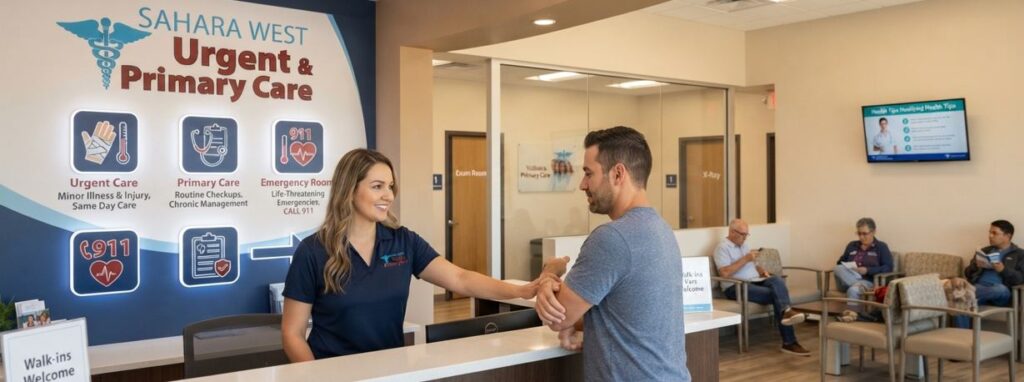
Urgent Care vs. Emergency Room vs. Primary Care: Know Where to Go
Before diving into specific conditions, it helps to understand how urgent care fits between your primary care doctor and the emergency room.
| Situation | Best Option | Why |
| Non-life-threatening illness or injury that needs care today | Urgent Care | Walk-in access, faster than the ER, on-site testing and X-rays |
| Routine checkups, chronic disease management, ongoing prescriptions | Primary Care | Continuity of care and long-term health planning |
| Chest pain, stroke symptoms, severe trauma, uncontrolled bleeding | Emergency Room (or 911) | Requires immediate, hospital-level intervention |
Urgent care exists to fill the gap: it’s for the sprained ankle that happens on a Saturday, the fever that spikes at 7 p.m., or the sinus infection your primary care doctor can’t fit you in for until next Thursday. It’s not a substitute for emergency care, and it’s not meant to replace your ongoing relationship with a primary care provider but for same-day, non-emergency problems, it’s often the fastest and most affordable path to relief.
If you’re building a relationship with a local provider for both urgent needs and everyday health, Sahara West’s primary care and allergy treatment services can work alongside urgent care visits for more complete coverage.
Medical Problems That Need Same-Day Urgent Care
Here’s a comprehensive, condition-by-condition breakdown of what typically sends patients to urgent care rather than their primary doctor or the ER.
1. Fevers and Flu-Like Illness
A fever that’s high, persistent, or accompanied by significant fatigue, body aches, or dehydration is one of the most common reasons people seek same-day care especially when a primary care appointment isn’t available and the person is too uncomfortable to wait it out.
Urgent care can help with:
- Fever evaluation and rapid flu or strep testing
- Guidance on fluids, rest, and fever-reducing medication
- Identifying whether the fever is a sign of something that needs treatment, like a bacterial infection
Go to the ER instead if: the fever is accompanied by a stiff neck, confusion, difficulty breathing, or a seizure, or if it’s in an infant under 3 months old.
2. Cold, Flu, and Respiratory Symptoms
Coughing, congestion, sore throat, and sinus pressure that linger beyond a few days or come on suddenly and severely are classic urgent care visits. Same-day evaluation matters here because respiratory infections can sometimes progress or overlap with conditions like strep throat, sinusitis, or bronchitis that respond better to prompt treatment.
Urgent care can help with:
- Strep and flu testing
- Evaluation for sinus infections and bronchitis
- Prescription treatment when appropriate
Go to the ER instead if: you’re experiencing significant shortness of breath at rest, blue-tinged lips, or chest tightness.
3. Ear, Nose, and Throat Infections
Ear infections, sore throats with white patches, and sinus infections are uncomfortable enough that most patients don’t want to wait days for relief and shouldn’t have to.
Urgent care can help with:
- Ear exams and infection diagnosis
- Rapid strep testing
- Sinus infection evaluation and treatment
4. Urinary Tract Infections (UTIs)
UTIs are one of the most frequent same-day urgent care visits, particularly because symptoms (burning, urgency, pelvic discomfort) tend to worsen quickly without treatment.
Urgent care can help with:
- Urinalysis and rapid diagnosis
- Prescription antibiotics when clinically appropriate
Go to the ER instead if: you have a UTI with fever, chills, and back pain, which can indicate a kidney infection requiring more urgent evaluation.
5. Sexually Transmitted Infections (STIs)
Many patients delay STI testing out of discomfort, but same-day, confidential testing removes a major barrier to early treatment and peace of mind.
Urgent care can help with:
- Confidential STI/STD screening and testing
- Treatment plans and follow-up guidance
If this applies to you, Sahara West offers confidential STD testing and treatment with same-day results guidance and a non-judgmental approach.
6. Vomiting, Diarrhea, and Dehydration
Stomach bugs and food-related illness can escalate quickly, especially in children and older adults. Same-day care helps catch dehydration before it becomes serious.
Urgent care can help with:
- Evaluating for dehydration
- Ruling out more serious abdominal issues
- IV fluids for rehydration in appropriate cases
For patients who need rapid rehydration or nutrient support, IV therapy is available as a same-day option.
Go to the ER instead if: there’s blood in the vomit or stool, severe abdominal pain, or signs of severe dehydration like confusion or fainting.
7. Minor Cuts, Wounds, and Lacerations
A cut that’s bleeding but controllable, or one that may need stitches, is a textbook urgent care visit faster than the ER for something that doesn’t require trauma-level resources.
Urgent care can help with:
- Wound cleaning and closure (stitches, staples, or adhesive)
- Tetanus updates when needed
- Infection prevention guidance
Go to the ER instead if: the bleeding won’t stop with direct pressure, the wound is very deep, or there’s a risk of significant nerve, tendon, or vascular injury.
8. Sprains, Strains, and Suspected Minor Fractures
Twisted ankles, jammed fingers, and pulled muscles are among the most common urgent care visits, especially after weekend activity or sports.
Urgent care can help with:
- On-site X-rays to check for fractures
- Splinting and bracing
- Pain management and follow-up care recommendations
On-site imaging makes a real difference here see X-ray services at Sahara West for same-day diagnostic imaging without a separate radiology appointment.
Go to the ER instead if: there’s an obvious bone deformity, the injury involves the head, neck, or spine, or you can’t bear any weight and suspect a severe fracture.
9. Burns (Minor to Moderate)
Small burns from cooking, sun exposure, or household accidents often need same-day evaluation to prevent infection and manage pain properly.
Urgent care can help with:
- Burn assessment and dressing
- Infection prevention
- Pain management
Go to the ER instead if: the burn is large, deep, covers a joint or the face, or is caused by chemicals or electricity.
10. Skin Conditions, Rashes, and Allergic Reactions
Rashes, hives, poison ivy, and mild-to-moderate allergic reactions are common, especially in a desert climate like Las Vegas where dry skin and seasonal allergens are frequent triggers.
Urgent care can help with:
- Rash evaluation and treatment
- Allergy testing and management for recurring issues
- Prescription medication when needed
Go to the ER instead if: the reaction includes swelling of the face or throat, difficulty breathing, or signs of anaphylaxis; this requires emergency treatment immediately.
11. Asthma Flare-Ups (Mild to Moderate)
A flare that isn’t a full-blown emergency but isn’t improving with a rescue inhaler alone is a reasonable same-day urgent care visit.
Urgent care can help with:
- Breathing treatments and evaluation
- Medication adjustment
- Guidance on when a flare requires a higher level of care
Go to the ER instead if: there’s severe difficulty breathing, blue lips, or the rescue inhaler isn’t providing relief at all.
12. Work-Related Injuries and Car Accident Injuries
Same-day evaluation after a workplace incident or vehicle collision is important both for your health and for proper documentation.
Urgent care can help with:
- Prompt injury evaluation and treatment
- Medical documentation for workers’ compensation or insurance claims
- X-rays and diagnostic imaging when needed
If this applies to you, Sahara West provides dedicated workers’ compensation injury care and car accident injury evaluation with the documentation these claims typically require.
13. Pre-Employment, School, and Sports Physicals Time-Sensitive Needs
While not an “illness,” physicals and TB testing are frequently needed on short notice for a job start date, school enrollment, or sports season deadline, and same-day availability matters.
Same-day sports and work physicals can help you meet these deadlines without a long appointment wait.
14. Pre- and Post-Surgical Evaluation
Patients sometimes need a same-day clearance appointment before a scheduled procedure, or a follow-up check after surgery.
See pre-op clearance and post-op follow-up care for details on what’s typically involved.
When It’s Actually a Medical Emergency (Not Urgent Care)
Urgent care is built for non-life-threatening problems. If you or someone with you experiences any of the following, call 911 or go to the nearest emergency room immediately don’t wait for an urgent care appointment:
- Chest pain or pressure
- Difficulty breathing or shortness of breath at rest
- Sudden numbness, weakness, or slurred speech (possible stroke)
- Severe, uncontrolled bleeding
- Major trauma (car accidents with serious injury, falls from height)
- Loss of consciousness or a seizure
- Severe allergic reaction with swelling of the face/throat or trouble breathing
- Suicidal thoughts or a mental health crisis
This list isn’t exhaustive, and if you’re ever unsure whether your symptoms are an emergency, err on the side of caution and seek emergency care or call 911.
How to Know If You Need Same-Day Care: A Quick Self-Check
Ask yourself these three questions:
- Is it getting worse quickly, or has it lasted longer than it should? If yes, same-day care is reasonable.
- Is it affecting your ability to function today (eat, sleep, work, care for your family)? That’s a sign it shouldn’t wait for a routine appointment.
- Are you experiencing any red-flag symptoms listed above? If yes, this isn’t an urgent care visit seeking emergency care.
If your answer to the first two questions is yes and the third is no, urgent care is likely your best option.
What to Expect at a Same-Day Urgent Care Visit
Knowing what happens once you arrive can make the decision easier:
- No appointment required for most visits walk-ins are generally accommodated, though calling ahead can help you plan around wait times.
- On-site testing many urgent care clinics, including Sahara West, offer X-rays, lab work, and rapid tests (strep, flu, UTI) on-site so you get answers the same day.
- Straightforward pricing asks about self-pay rates and whether the clinic accepts your insurance plan before your visit.
- Documentation when needed for work injuries, accidents, or physicals, ask the front desk what paperwork to bring.
Sahara West accepts most major insurance plans, including Kaiser Permanente, Tricare, Humana, and CareSource, and offers self-pay and financing options for patients without coverage, see insurance and payment information or explore membership plans for reduced self-pay rates on recurring visits.
Same-Day Urgent Care in Las Vegas
If you’re searching for a walk-in clinic near the Sahara West area of Las Vegas, same-day care is available for the conditions outlined above from fevers and infections to sprains, minor injuries, and STI testing without the wait times typical of an emergency room visit.
Ready to be seen today? Call (702) 248-0554 or book your visit online to get started. Walk-ins are welcome during posted hours (Mon–Fri 9am–8pm, Sat 9am–3pm).
FAQs
How do I know if my symptoms need urgent care or the ER?
Urgent care is appropriate for non-life-threatening conditions that need same-day attention, like infections, minor injuries, fevers, and sprains. The ER is for potentially life-threatening symptoms like chest pain, difficulty breathing, severe bleeding, or stroke signs. When in doubt, choose the ER or call 911.
Can urgent care treat a broken bone?
Urgent care clinics with on-site X-ray capability, like Sahara West, can evaluate and often treat minor fractures with splinting. Severe or complex fractures, or those involving obvious deformity, are typically referred to the ER or an orthopedic specialist.
Is same-day urgent care more affordable than the ER?
Urgent care visits are generally significantly less expensive than emergency room visits for comparable non-emergency conditions, though exact costs depend on your insurance plan and the services needed. Ask your clinic about self-pay pricing and available financing.
Do I need an appointment for same-day urgent care?
Most urgent care clinics, including Sahara West, welcome walk-ins without a scheduled appointment, though calling ahead or booking online can help you plan around busier times.
Can urgent care write prescriptions?
Yes. Urgent care providers can prescribe medication for conditions like infections, UTIs, allergic reactions, and other same-day concerns when clinically appropriate.
What should I bring to an urgent care visit?
Bring a photo ID, your insurance card (if applicable), a list of current medications, and any relevant medical history. For work injuries or accidents, bring any incident documentation you’ve received.
Can children be seen at urgent care?
Many urgent care clinics treat patients of all ages for non-emergency illnesses and injuries. Call ahead to confirm pediatric services and any age restrictions for specific treatments.
What if I’m not sure whether my situation is urgent?
Call the clinic directly and describe your symptoms. Staff can help you decide whether urgent care, primary care, or the emergency room is the right fit and if it sounds like an emergency, they’ll direct you to call 911 or go to the ER.
This article is for general educational purposes and isn’t a substitute for professional medical advice, diagnosis, or treatment. If you’re experiencing a medical emergency, call 911 or go to your nearest emergency room immediately.