
You’re dizzy, drained, and running out of patience. The last thing you want to hear right now is “it depends.” So let’s start with the number you actually came here for.
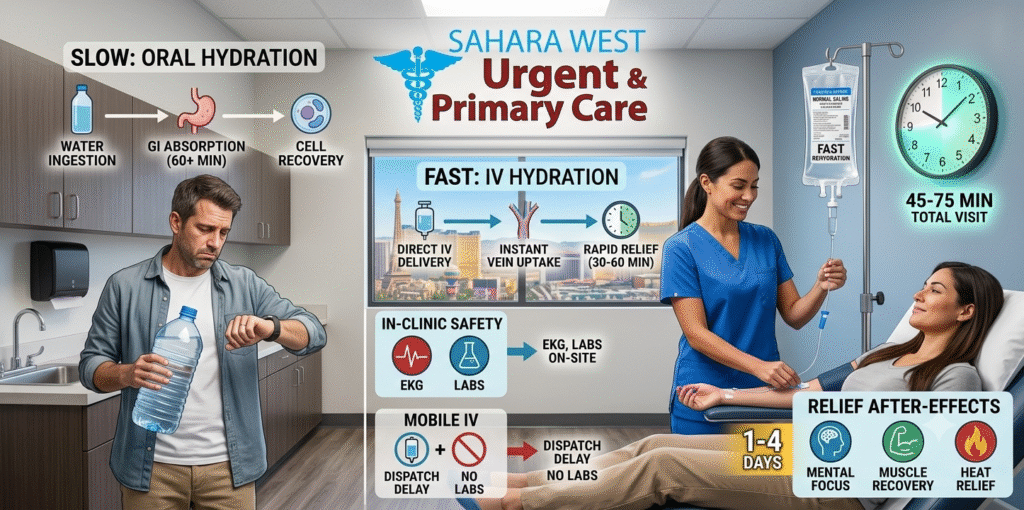
Most IV hydration sessions take between 30 and 60 minutes of active drip time, with a total in-clinic visit from check-in to walking back out the door typically running 45 to 75 minutes.
Compare that to drinking water on your own, which can take an hour or more just to begin absorbing into your bloodstream and that’s assuming your stomach can keep it down in the first place. IV hydration skips the digestive system entirely, delivering fluids and electrolytes directly into your veins, which is exactly why it works exponentially faster than sipping water at home, especially when you’re dealing with desert heat, illness, or serious fluid loss.
And if you’re in Las Vegas, timing matters even more. Between blistering desert heat, big nights out on the Strip, intense workouts, and the occasional stomach bug, dehydration here doesn’t wait around and neither should your treatment.
At Sahara West Urgent Care, our physician-supervised IV therapy is built for speed and safety, so you get real relief without sitting around all day. Here’s exactly what to expect, step by step.
The Step-by-Step IV Therapy Timeline (Door to Discharge)
Step 1: Check-In & Initial Registration (5–10 Minutes)
Your visit starts with quick, no-hassle registration. Walk-ins are always welcome, and if you want to skip even more of the wait, you can reserve your slot online before you arrive, a smart move if you’re already feeling too drained to sit in a waiting room.
Step 2: Medical Evaluation & Vital Signs Check (10–15 Minutes)
Before any fluids go in, our medical team gets a clear picture of what’s going on. This step includes:
- Checking pulse, blood pressure, oxygen saturation, and temperature
- Assessing skin turgor (elasticity) as a physical marker of dehydration severity
- A provider consultation to confirm how severe your fluid deficit is and rule out any underlying conditions
If severe dehydration is suspected, we may also run on-site lab testing checking electrolytes and BUN (blood urea nitrogen) levels so treatment is based on what your body actually needs, not guesswork.
Step 3: IV Line Placement & Drip Setup (5 Minutes)
This is usually the part people dread most and it’s the part that takes the least amount of time and causes the least discomfort. Our trained medical staff place the IV line quickly and with minimal sensation, using proper technique to make vein access virtually painless.
While that’s happening, we’re also preparing your customized fluid blend Normal Saline or Lactated Ringer’s along with any targeted additives like anti-nausea or anti-inflammatory medication, based on your evaluation.
Step 4: Active IV Fluid Infusion (30–60 Minutes)
This is the main event and where you get to relax. You’ll settle into a quiet, climate-controlled treatment room while fluids drip steadily into your bloodstream.
The exact time here depends on a few factors we’ll break down below, including:
- Whether we’re using a gravity drip or a pressure pump bag
- The size of your vein and catheter
- The total fluid volume being administered (500mL vs. 1000mL+)
Step 5: Post-Treatment Monitoring & Discharge (5 Minutes)
Once your infusion wraps up, we recheck your vitals to confirm you’re stable, remove the IV line, apply a bandage, and walk you through simple post-care hydration guidelines so the benefits last as long as possible.
Key Factors That Influence How Long IV Hydration Takes
1. Total Volume of Fluid Administered
A standard 500 mL drip moves faster than a full 1,000 mL (1 Liter) bag, and patients with more severe dehydration may need multi-bag protocols, which naturally extend treatment time. Your provider will recommend the right volume based on your symptoms and evaluation, not a one-size-fits-all default.
2. Flow Rate and Vein Size
Vein diameter and catheter size directly affect how quickly fluid can safely enter your bloodstream. This isn’t a place to rush pushing fluids too fast can cause vein irritation or an uncomfortable cooling sensation as the fluid enters. A steady, well-calibrated rate is safer and more comfortable.
Expert tip: If you’re well-hydrated before you even arrive (drinking some water on your way in helps), your veins are often easier to access, which can slightly speed up placement.
3. Added Medications and Vitamins
Adding prescription anti-nausea medication (like Zofran), anti-inflammatories (like Toradol), or B-complex vitamins to your IV bag can slightly extend your infusion time but it’s almost always worth it, since these additives target your specific symptoms directly rather than just replacing fluid volume.
4. Severity of Dehydration and Patient Health
Patients with kidney conditions, cardiac history, or significant vascular collapse require a slower, more carefully controlled drip rate for safety. This is one of the biggest reasons in-clinic supervision matters: a controlled environment allows your infusion speed to be adjusted in real time if needed.
5. Type of IV Solution Used
Normal Saline (0.9% NaCl) and Lactated Ringer’s (LR) have slightly different absorption dynamics, and your provider will choose the one best suited to your specific fluid and electrolyte needs.
How Quickly Will You Feel the Effects of IV Hydration?
Immediate Benefits During the Infusion (First 15–30 Minutes)
You won’t have to wait until the bag is empty to start feeling better. Many patients notice rapid blood volume expansion within the first 15 to 30 minutes, easing dizziness, headache, and that uncomfortable racing heartbeat almost in real time.
Full Symptom Relief Peak (1–2 Hours Post-Infusion)
The full benefits continue building for another hour or two after your session ends, as fluids fully distribute to your cells. This is typically when patients report the clearest mental focus (goodbye, brain fog), along with noticeable relief from muscle fatigue.
How Long Do the Effects of IV Hydration Last?
Most people feel the benefits of IV hydration for 1 to 4 days, though this varies based on how much physical exertion, desert heat exposure, and ongoing oral fluid intake you’re managing afterward. Staying on top of your water intake post-treatment helps extend those results even further.
IV Therapy Time Breakdown by Medical Condition
Not every dehydration case is the same and neither is the ideal drip time. Here’s a general breakdown:
Heat Exhaustion & Las Vegas Desert Exposure (45–60 Minutes Active Drip)
Desert heat causes rapid, often invisible fluid evaporation. Treatment here focuses on cooling the body down while replenishing what’s been lost usually requiring a slightly longer infusion to fully restore volume.
Stomach Bugs, Vomiting & Food Poisoning (30–60 Minutes Active Drip)
When your GI tract can’t retain oral fluids, IV hydration bypasses the problem entirely. Fast-acting anti-nausea medication is often incorporated here to stop the vomiting cycle while fluids restore your system.
Severe Hangover Recovery (30–45 Minutes Active Drip)
IV therapy helps flush acetaldehyde toxins (a major contributor to hangover misery), rehydrate brain tissue, and rebalance depleted electrolytes often making this one of the faster treatment categories.
Athletic Overexertion & Physical Labor Recovery (30–45 Minutes Active Drip)
After intense workouts or outdoor labor in the heat, IV fluids help restore sodium, potassium, and support muscle glycogen transport getting you back to feeling functional faster than rest and water alone.
In-Clinic Urgent Care vs. At-Home Mobile IV: Which Is Faster and Safer?
Why In-Clinic Care at Urgent Care Offers Faster Overall Relief
It might sound counterintuitive, but heading to a clinic is often faster than waiting for an at-home service. Mobile IV providers require dispatch time meaning you could be waiting an hour or more just for a nurse to arrive at your hotel or home before treatment even begins.
At urgent care, you get immediate access to physician oversight, high-flow clinical setups, and prescription-grade additives the moment you walk through the door.
The Safety Advantage of In-Clinic Testing
Beyond speed, in-clinic care gives you access to diagnostic tools mobile services simply don’t carry including on-site EKG, rapid blood work, and continuous vital sign monitoring. This matters because dehydration symptoms can sometimes overlap with cardiac or renal issues, and catching that early is something only a fully equipped clinic can reliably do.
Why Choose Sahara West Urgent Care for Fast IV Hydration in Las Vegas?
We know that when you’re dehydrated, the last thing you want is to sit around waiting. That’s why Sahara West Urgent Care is built around walk-in convenience and minimal wait times, backed by:
- Dedicated IV treatment suites in a comfortable, climate-controlled setting
- Comprehensive medical evaluation before any treatment begins never a one-size-fits-all drip
- On-site labs and EKG capabilities for complete peace of mind
- Experienced medical staff who customize your treatment plan to your exact symptoms
We’re also a trusted resource for ongoing healthcare needs across the valley serving as a reliable primary care in Las Vegas option for patients who want a walk-in primary care clinic they can count on beyond just urgent visits. Learn more about our full range of services at our urgent care in Las Vegas location page.
Feeling dizzy, nauseous, overheated, or completely wiped out? Don’t wait for it to get worse, walk in today or reserve your slot online and let our team get you back on your feet, often in under an hour.
Frequently Asked Questions
Q1: Can an IV drip be given faster if I am in a rush?
While it’s understandable to want treatment as fast as possible, infusion speed is guided by medical safety parameters, not convenience. Pushing fluids too quickly can cause discomfort or vein irritation, and in patients with certain health conditions, it can even be dangerous. Our providers set your drip rate based on what’s safe and effective for your body, not the clock.
Q2: Does getting an IV hurt, and how long does the needle stay in?
IV placement typically causes only a brief, minor pinch. Importantly, it’s not a needle that stays in your arm during treatment, it’s a small, flexible catheter that’s inserted over the needle, and the needle itself is removed immediately after placement. This makes the treatment comfortable enough that most patients barely notice it once the drip is running.
Q3: How much water should I drink after my IV therapy session?
To maintain your results, aim to continue drinking water steadily throughout the following day general guidance is to sip fluids regularly rather than chugging large amounts at once. Our team will give you personalized post-care hydration targets based on your treatment and activity level before you leave.
Q4: Can I walk around or use my phone while getting an IV?
Yes our treatment rooms are designed for comfort, and most patients relax, scroll their phone, or even nap during their session. Your IV arm has some flexibility, though we recommend keeping movement gentle to avoid disturbing the line.
Q5: Is 1 hour of IV hydration enough to recover from heat exhaustion?
For most cases of heat exhaustion, a 45–60 minute IV session is effective and provides significant relief. However, if you’re experiencing red-flag symptoms of heatstroke such as confusion, a core body temperature above 103°F, or loss of consciousness that’s a medical emergency requiring immediate ER care, not standard IV hydration.
Dehydration doesn’t have to ruin your day. Whether it’s Las Vegas heat, a rough night, or a stomach bug that won’t quit, Sahara West Urgent Care offers fast, physician-supervised IV hydration to get you back to feeling like yourself. Walk in or reserve your spot online now most patients are in and out in under 75 minutes.