When severe dehydration hits, gulping down glass after glass of water often leaves you feeling heavy, bloated, or nauseous without offering actual relief. If your body is burning through fluids faster than your stomach can absorb them, continuing to rely on oral rehydration can delay recovery when you need it most.
You need IV fluids when oral rehydration is impossible, ineffective, or insufficient to keep up with severe fluid and electrolyte loss. This includes persistent vomiting, severe desert heat strain, intense gastroenteritis, acute illness, or intense physical exertion where drinking fluids fails to restore physiological balance.
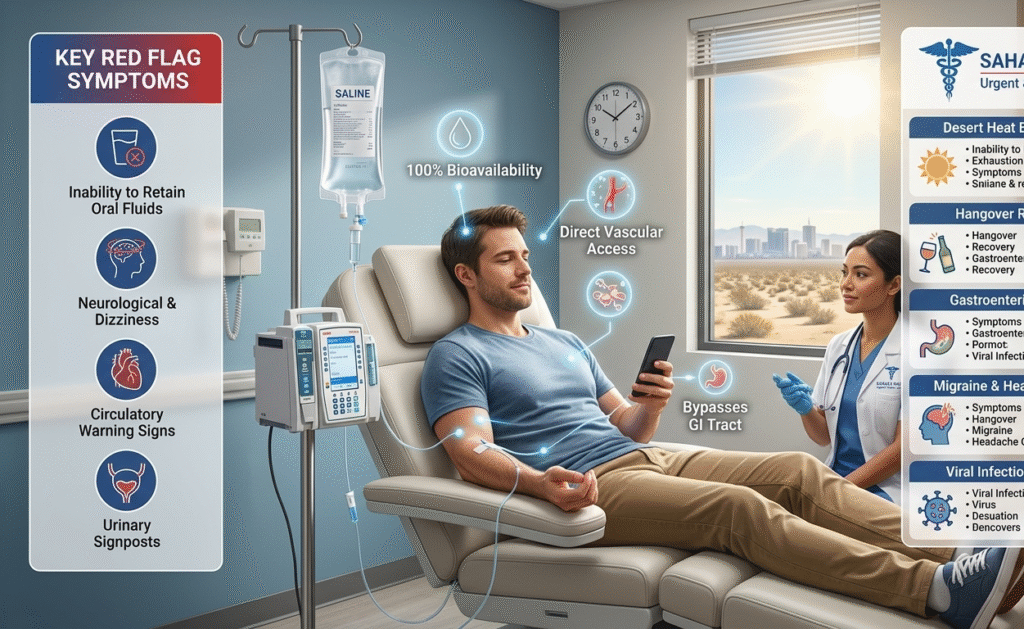
Intravenous (IV) administration remains the gold standard in clinical medicine for treating rapid volume depletion. By bypassing the digestive system entirely, IV hydration delivers sterile fluids, critical electrolytes, and targeted prescription medications directly into your bloodstream with 100% bioavailability.
In Southern Nevada’s hyper-arid Mojave environment, the risk of rapid volume depletion is significantly elevated. Whether you are a Las Vegas resident coping with extreme heat exposure, an athlete recovering from desert workouts, or a visitor dealing with flight cabin dehydration, heat strain, or a long night on the Strip, recognizing when to seek medical IV therapy is essential for preventing dangerous health complications.
At Sahara West Urgent Care, our medical team offers physician-supervised IV hydration protocols tailored to your exact clinical needs. Equipped with rapid diagnostic tools, private infusion suites, and immediate walk-in access, our clinic delivers safe, fast, and long-lasting rehydration.
Key Red Flag Symptoms: How to Know You Need IV Fluids Immediately
1. Inability to Keep Oral Liquids Down
If a stomach virus, foodborne illness, or acute migraine renders your digestive tract hyper-reactive, trying to force down fluids can backfire. Continuous nausea and vomiting prevent fluid absorption while accelerating water loss. When every attempt to drink water triggers immediate emesis, intravenous delivery is the only safe path to rehydration.
2. Neurological & Circulatory Warning Signs
When blood volume drops due to fluid loss, blood pressure decreases, diminishing blood flow to the brain. Pay close attention to:
- Orthostatic Dizziness: Feeling lightheaded, dizzy, or faint when transitioning from sitting to standing.
- Brain Fog & Confusion: Difficulty concentrating, lethargy, or slurred responsiveness.
- Syncope (Fainting): Temporary loss of consciousness triggered by sudden vascular volume loss.
3. Severe Physical & Biological Indicators
Severe dehydration leaves distinct physical markers that indicate systemic strain:
- Resting Tachycardia: A racing, thumping heart rate even while sitting or resting, as your heart pumps faster to push low-volume, thickened blood through your circulatory system.
- Loss of Skin Turgor (Tenting): Pinching the skin on the back of your hand causes it to remain tented upwards rather than snapping back instantly.
- Extreme Dry Mouth & Sunken Eyes: Completely parched mucous membranes, cracked lips, and a lack of tear production.
4. Critical Urinary Signposts
Your kidneys are your body’s primary fluid regulators. When fluid volume plummets, your kidneys conserve every drop of available water:
- Oliguria: Urinating fewer than two times within a 24-hour period.
- Concentrated Urine: Urine that appears dark amber or brown, carrying a strong odor, signaling acute renal strain.
Medical Conditions That Require Intravenous Fluid Therapy
Intravenous rehydration is not just for general exhaustion it is a direct clinical intervention for specific medical conditions.
Acute Desert Heat Exhaustion & Sun Stress
In Southern Nevada, low humidity causes sweat to evaporate almost instantaneously, creating a false sense of security while hidden fluid loss accelerates. Spending time outdoors in high temperatures can rapidly deplete blood plasma, leading to spikes in core body temperature, muscle spasms, and severe heat strain that require rapid fluid volume expansion.
Gastroenteritis, Food Poisoning & Intractable Vomiting
Acute stomach bugs cause rapid, double-ended fluid loss through diarrhea and vomiting. An urgent care IV protocol restores lost fluids while incorporating anti-emetic medications like Zofran (Ondansetron) straight into the bloodstream to stop vomiting within minutes.
Severe Hangover & Alcohol Toxemia
Alcohol acts as a direct renal diuretic, causing your body to excrete up to four times more liquid than consumed. It also leaves behind acetaldehyde, a toxic byproduct responsible for severe nausea, light sensitivity, and pounding headaches. IV fluids rapidly dilute circulating toxins, flush metabolic byproducts, and restore electrolyte equilibrium.
Debilitating Migraines & Cluster Headaches
Severe migraines involve neurovascular inflammation that is heavily aggravated by dehydration. An urgent care “migraine cocktail” combines aggressive fluid rehydration with non-narcotic IV anti-inflammatories (such as Toradol) to interrupt severe pain cycles far more effectively than oral pain relievers.
High Fevers & Acute Viral Infections
Prolonged fevers from influenza, COVID-19, or upper respiratory illnesses accelerate fluid loss through insensible perspiration and elevated metabolic rates. IV fluids counteract this metabolic burnout, keeping your immune system supported during active infection.
Travel Dehydration & Low-Humidity Jet Lag
Commercial aircraft cabins operate at humidity levels under 20% drier than most deserts. Passengers arriving at Harry Reid International Airport often land with systemic cabin dehydration, leading to flight fatigue, dry mucous membranes, and severe jet lag that responds quickly to targeted fluid resuscitation.
The GI Absorption Bottleneck
When you drink liquids, fluids must pass through the esophagus, sit in the stomach for breakdown, and gradually move into the small intestine for absorption. This digestive process can take 1 to 2 hours. If your stomach is inflamed or overwhelmed by illness, gastric emptying slows down significantly, creating an absorption bottleneck.
IV therapy bypasses the digestive tract completely, placing fluids directly into your vascular system with zero transit time.
The Bioavailability Factor
Intravenous fluids provide 100% bioavailability. Every milliliter of sterile crystalloid fluid infused into your arm is instantly available for your heart, kidneys, brain, and cellular tissues to utilize immediately.
Restoring Electrolyte Osmolarity
Drinking massive quantities of plain water when severely dehydrated can actually be hazardous. Flooding your digestive system with pure water without replacing lost salts can dilute your remaining serum sodium, leading to a dangerous condition called hyponatremia (which causes cellular swelling, brain fog, and seizures).
Clinical IV solutions such as Normal Saline (0.9% Sodium Chloride) or Lactated Ringer’s are isotonic, meaning they match your body’s natural fluid chemistry to rebalance cellular pressure safely.
Where Should You Get IV Fluids? Urgent Care vs. ER vs. IV Spas
Choosing where to receive treatment impacts both your safety and your wallet.
When Urgent Care is the Ideal Choice (Moderate Dehydration)
An accredited urgent care center is the ideal setting for most cases of severe dehydration, vomiting, heat strain, or migraines. Urgent care clinics offer:
- Immediate walk-in access with minimal wait times.
- On-site board-certified physician evaluations.
- Ability to administer prescription-grade IV medications (anti-emetics, anti-inflammatories).
- Complete diagnostic labs and safety monitoring.
- Affordable out-of-pocket costs and health insurance coverage.
When You Must Go to the Emergency Room (Severe / Critical Dehydration)
You should bypass urgent care and head directly to the nearest hospital Emergency Room if you observe critical, life-threatening symptoms:
- Complete loss of consciousness or unresponsiveness.
- Profound confusion or severe disorientation.
- Suspected Diabetic Ketoacidosis (extreme thirst paired with fruity breath and high blood sugar).
- Signs of Septic Shock (high fever, severe shivering, abnormally low blood pressure).
The Hidden Risks of Commercial IV Spas & Mobile Services
While boutique IV lounges and mobile drip services focus on convenience, they lack essential clinical safety measures:
- No In-Person Physician Screening: Patients often choose drips off a commercial menu without a formal physical exam or medical clearance.
- No Diagnostic Lab Access: Administering large fluid volumes to a patient with undetected kidney issues or cardiac conditions can trigger fluid overload or pulmonary edema.
- Lack of Prescription Options: Non-clinical spas are typically restricted to basic saline and vitamins, lacking access to prescription-strength medications like Zofran or Toradol.
- High Out-of-Pocket Costs: These cash-only services do not bill medical insurance and often involve long dispatch wait times for mobile nurses.
The Urgent Care Clinical Protocol for IV Fluid Resuscitation
At an urgent care clinic, receiving IV fluids is a controlled, medical step-by-step process designed for safety and quick recovery.
Step 1: Rapid Intake & Vital Sign Assessment
Upon arrival, a clinical team member records your vital signs including blood pressure, heart rate, pulse oximetry, body temperature, and weight to establish your physiological baseline and evaluate fluid deficit depth.
Step 2: On-Site Diagnostic Screening
If severe volume depletion, renal strain, or metabolic imbalance is suspected, providers can draw blood to test kidney function (BUN/Creatinine ratio) and electrolyte levels immediately before starting fluids.
Step 3: Custom Fluid Formulation & IV Placement
Your provider selects the optimal carrier fluid (Normal Saline or Lactated Ringer’s) and orders specific prescription additives based on your clinical evaluation. A trained clinician inserts a small catheter into a peripheral vein using sterile technique.
Step 4: Controlled Infusion Monitoring
You rest in a comfortable, quiet infusion room while fluids are delivered via controlled drip rates over 30 to 60 minutes. Clinical staff monitor your vital signs, drip progress, and overall comfort throughout the session.
Step 5: Post-Infusion Re-Evaluation & Discharge
Once the drip is complete, your provider reassesses your vital signs, checks skin turgor, and confirms symptom resolution. Your IV line is removed, and you are discharged with personalized post-care rehydration guidance.
Special High-Risk Groups Who Need Early IV Intervention
Certain populations suffer metabolic consequences from fluid loss much faster than healthy adults and require low thresholds for clinical IV evaluation.
Seniors & Older Adults
Older adults have a reduced natural thirst sensation and diminished renal reserve capacity. Dehydration in seniors can manifest quickly as sudden confusion, acute weakness, or urinary tract infections, making early clinical intervention vital.
Pregnant Women (Hyperemesis Management)
Severe morning sickness (Hyperemesis Gravidarum) can leave pregnant mothers unable to keep liquids down, threatening maternal hydration and fetal health. Supervised IV therapy delivers pregnancy-safe fluids and anti-nausea treatments to restore stability.
Children & Pediatrics
Pediatric patients have smaller blood volumes and higher metabolic rates, causing rapid dehydration during stomach flu episodes. Watch for critical pediatric warning signs:
- Sunken soft spot (fontanelle) on infants.
- Absence of tears when crying.
- Dry diapers for 3 or more consecutive hours.
- Unusual listlessness or extreme lethargy.
Note: Pediatric patients exhibiting these symptoms require immediate clinical pediatric evaluation.
Insurance Coverage, Cost & Walk-In Access in Las Vegas
High-quality clinical care should be accessible, transparent, and easy to navigate when you feel sick.
Will Insurance Cover Your IV Fluids?
Unlike commercial IV bars (which are strictly cash-only out-of-pocket businesses), IV hydration therapy performed at an urgent care clinic is covered by major health insurance plans when deemed medically necessary by a healthcare provider.
If you visit an urgent care center for dehydration, gastroenteritis, food poisoning, heat exhaustion, or severe migraines, your visit and IV therapy are processed through your health insurance, leaving you responsible only for your standard co-pay or deductible.
Immediate Walk-In Care & Online Reservations
When severe dehydration makes you feel faint or sick, waiting for an appointment is out of the question. Accredited urgent care facilities offer flexible walk-in access. Many clinics also provide online check-in options, allowing you to hold your place in line before leaving your hotel room or house to minimize your wait time.
Why Choose Sahara West Urgent Care for Fast IV Hydration in Las Vegas?
When dehydration, heat stress, or sudden illness strikes in Las Vegas, Sahara West Urgent Care provides high-standard clinical care:
- Board-Certified Physician Oversight: Every treatment is evaluated and prescribed by licensed medical providers.
- Comprehensive On-Site Diagnostics: Immediate blood work, renal screening, and EKG monitoring available on-site.
- Private, Climate-Controlled Infusion Rooms: Relax in clean, sterile, comfortable suites designed for rapid physical recovery.
- Minimal Wait Times: Walk in whenever you need help, or reserve your visit online to streamline your intake.
- Complete Healthcare Support: Beyond immediate emergency rehydration, our facility functions as a leading walk in primary care clinic. Whether you need acute relief today or are seeking to establish long-term health management with a dedicated team providing primary care in Las Vegas, we cover all your medical needs under one roof.
Get Immediate, Physician-Supervised IV Relief Today
Don’t suffer through severe dehydration, vomiting, or exhaustion. Get fast, medical-grade rehydration delivered by board-certified providers.
➔ Walk In Today or Reserve Your Slot Online at Sahara West Urgent Care
Frequently Asked Questions
Q1: How do I know if I need IV fluids or just water?
If you are able to drink liquids without vomiting, sipping an electrolyte solution is usually sufficient for mild dehydration. However, if you are unable to keep liquids down, experiencing severe dizziness upon standing, showing signs of racing heart rate, or producing dark, minimal urine, you need medical IV fluids.
Q2: Does urgent care give IV fluids for dehydration?
Yes. Accredited urgent care centers routinely provide IV fluid resuscitation for patients experiencing moderate-to-severe dehydration, gastroenteritis, heat strain, food poisoning, and severe headaches under direct medical supervision.
Q3: How long does it take for IV fluids to work?
Because IV fluids enter your circulatory system directly, most patients begin feeling initial relief within 15 to 30 minutes of starting the infusion. Peak rehydration and symptom elimination occur within 1 to 2 hours post-infusion.
Q4: Is IV hydration covered by health insurance?
Yes. When IV hydration is prescribed at an urgent care clinic for a diagnosed medical condition (such as dehydration, hyperemesis, stomach flu, or migraine), it is typically covered by major health insurance carriers, subject to standard co-pays and deductibles.
Q5: What happens if severe dehydration is left untreated?
If left untreated, severe dehydration can lead to serious medical complications, including heatstroke, acute kidney injury (renal failure), low blood volume shock (hypovolemic shock), cardiac arrhythmias, electrolyte imbalances, and emergency hospital admission.
Additional Local Resources & Services
- Learn more about our complete urgent care offerings on our Urgent Care in Las Vegas page.
- Establish continuous healthcare coverage via Primary Care in Las Vegas.
- Need fast hydration relief right now? Book your visit online at Sahara West Urgent Care.