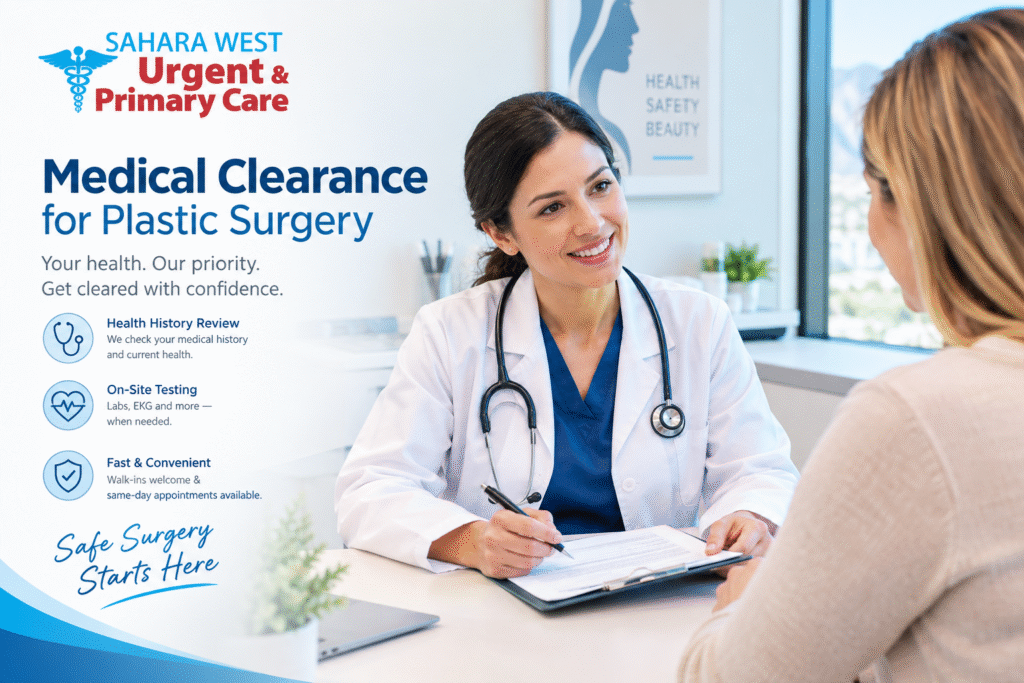
If your plastic surgeon has mentioned “medical clearance” during your consultation, you’re probably wondering what that actually means and whether you’re one of the patients who needs it. The short answer: it depends on your health history, the procedure you’re having, and the type of anesthesia involved. It’s not something every patient is required to get, but for many, it’s a standard and important step before stepping into the operating room.
Medical clearance is simply a way of confirming that your body is ready to safely handle surgery and anesthesia. A qualified medical provider reviews your health history, checks your vital signs, and sometimes orders bloodwork or an EKG to rule out anything that could complicate your procedure or recovery. Your plastic surgeon focuses on the cosmetic outcome; your clearance provider focuses on whether your heart, lungs, blood sugar, and overall system can handle the stress of surgery.
Not every patient needs this evaluation. A 28-year old female who is healthy may not require the same pre-op evaluation performed on a 55-year old woman with high blood pressure who is undergoing a tummy tuck under general anesthesia. This depends on the procedure, the type of anesthesia used, the age, and your medical history, and finally, on what the surgeon and surgical facility need.
The good news is that a pre-op evaluation isn’t just a box to check. It’s a genuine safety net. It can catch an undiagnosed issue like elevated blood pressure or an irregular heart rhythm before it becomes a problem in the operating room, giving you and your surgical team confidence going into surgery.
If your surgeon in Las Vegas has requested medical clearance, Sahara West Urgent Care can typically get you evaluated and cleared quickly, often within the same week.
What Is Medical Clearance for Plastic Surgery?
Medical clearance is a written confirmation from a qualified medical provider stating that you’re healthy enough to undergo a planned surgical procedure. It’s based on a preoperative evaluation, a combination of your medical history, a physical exam, and, when needed, lab work or diagnostic testing.
Is medical clearance the same as a pre-op physical? Largely, yes. “Pre-op clearance,” “pre-op physical,” and “preoperative evaluation” are used somewhat interchangeably in most clinical settings. The goal is the same: confirm you’re a safe surgical candidate and flag anything that needs attention first.
Who provides medical clearance for plastic surgery? It’s typically completed by a primary care provider, an urgent care provider, or another qualified medical professional not usually by the plastic surgeon performing your procedure. Plastic surgeons focus on your surgical plan and outcome; clearance providers focus on your overall medical readiness. Some plastic surgery practices coordinate directly with your clearance provider, while others simply ask that you bring in the completed paperwork.
Can urgent care or a primary care provider perform this evaluation? Yes. Both can conduct a pre-op evaluation, provided the clinic offers the exam and any testing your surgeon has requested. This is one of the most common reasons patients search for pre-op clearance near them; many don’t have a primary care provider, or their PCP has weeks-long wait times that don’t work with a scheduled surgery date.
What information gets sent to the plastic surgeon? Typically a signed clearance letter or form, along with any relevant lab results, EKG readings, or notes about your medical history and current medications. Ask your provider to send this directly to your surgical office to avoid delays.
How long does an appointment take? Most straightforward pre-op evaluations take under an hour, though this can extend if additional testing is needed on-site.
When Do You Need Medical Clearance Before Plastic Surgery?
There’s no single rule that applies to every patient or every procedure. Instead, medical clearance tends to be requested in a handful of common scenarios.
Your plastic surgeon specifically requests it. This is the most direct answer: if your surgeon or their office asks for a clearance letter, you’ll need one regardless of how healthy you feel. Surgical facilities and anesthesia providers often have their own internal policies about who requires clearance before they’ll schedule a procedure.
Before procedures requiring general anesthesia. General anesthesia affects your heart, lungs, and blood pressure more significantly than local anesthesia or light sedation, so many surgeons and anesthesiologists require clearance to confirm your cardiovascular and respiratory systems can tolerate it.
Before procedures requiring sedation. Even moderate or IV sedation can carry more risk for patients with certain health conditions, which is another common trigger for a clearance request.
Before major or lengthy cosmetic procedures. Longer procedures think combination surgeries or larger-scale body contouring carry more cumulative risk (blood loss, longer anesthesia exposure, extended recovery), so clearance is more frequently requested.
When you have existing health conditions. Conditions like high blood pressure, diabetes, heart disease, or respiratory issues are common reasons a surgeon will want a medical provider to confirm things are well-controlled first.
When you take certain medications. Blood thinners, medications that affect heart rhythm, or drugs that interact with anesthesia can all prompt a clearance requirement.
When your surgeon or anesthesiologist wants additional testing. Sometimes clearance is requested simply because your surgical team wants a more complete picture before your procedure date, even without a specific red flag.
When you’re older or have added surgical risk factors. Age alone doesn’t disqualify anyone from cosmetic surgery, but it does increase the odds that your surgeon will want a more thorough pre-op workup.
So, do you require medical clearance for all plastic surgery? No. It is not needed for many minor procedures which are performed under local anaesthetic only. When general anesthesia, sedation, longer operating time or a personal health condition comes into play, however, it is much more likely that it will be cleared and it’s always a good idea to ask the surgical office personally rather than taking a chance.
Which Plastic Surgeries May Require Pre-Op Clearance?
Whether a specific procedure requires clearance depends on the surgeon, the surgical facility, your anesthesia plan, and your individual health, not the procedure name alone. That said, patients researching the following procedures often ask about clearance requirements:
- Breast augmentation commonly performed under general anesthesia, so clearance is frequently requested, especially for patients with any cardiac or respiratory history.
- Breast reduction and breast lift longer procedures that may prompt additional pre-op evaluation depending on scope.
- Tummy tuck (abdominoplasty) is one of the procedures most likely to require clearance, due to longer operative time and general anesthesia.
- Liposuction requirements vary widely depending on the amount of fat being removed and the anesthesia type used.
- Facelift may require clearance depending on anesthesia and patient age.
- Rhinoplasty clearance needs depend heavily on anesthesia type and any existing health conditions.
- Mommy makeover is a combination of multiple procedures, this often extends surgical time and frequently prompts clearance.
- Body contouring larger-scale procedures commonly require more extensive pre-op evaluation.
- Eyelid surgery (blepharoplasty) is often performed under local anesthesia or light sedation, so clearance needs vary by provider and patient history.
- Combined cosmetic procedures combining two or more procedures in a single surgical session typically increases the likelihood that clearance will be required, simply because of the added time under anesthesia.
The takeaway: your surgeon may request clearance for any of these procedures depending on your health and anesthesia plan, but no procedure automatically requires it in every case. Always confirm directly with your surgical office.
Who Needs Extra Medical Evaluation Before Plastic Surgery?
Certain patients are more likely to be asked for a more thorough pre-op workup, including additional testing beyond a standard physical exam:
- High blood pressure. Uncontrolled hypertension can affect bleeding risk and anesthesia safety, so surgeons often want it well-managed and documented before surgery.
- Diabetes. Blood sugar control affects wound healing and infection risk, making it a common focus of pre-op evaluation.
- Heart conditions. A history of heart disease, arrhythmia, or prior cardiac events typically prompts a more detailed cardiac workup, which may include an EKG.
- Respiratory conditions. Asthma, COPD, or sleep apnea can affect how your body tolerates anesthesia.
- A history of abnormal bleeding. This can affect surgical planning and may require additional lab testing.
- Blood thinners. Medications like warfarin or certain anticoagulants often need to be reviewed and sometimes adjusted under physician guidance before surgery.
- Other medications affecting anesthesia or surgery. This is why a full medication review is a standard part of any pre-op evaluation.
- Previous complications with anesthesia. If you or a close family member has had a reaction to anesthesia in the past, tell your provider it can change how your surgical team approaches your procedure.
- Significant allergies. Especially medication allergies, which need to be clearly documented for your surgical and anesthesia teams.
- Previous surgeries. Your surgical history helps your provider understand how your body has responded to procedures before.
- Other concerns identified during the visit. Sometimes a routine pre-op exam turns up something unexpected, like elevated blood pressure the patient didn’t know about, which can lead to a referral for further evaluation.
If any of this sounds like you, it doesn’t mean your surgery is off the table, it usually just means your provider wants a clearer picture before you’re cleared to proceed. Being upfront about your full medical history and current medications at your pre-op visit is one of the most important things you can do for a smooth process. Sahara West Urgent Care’s primary care team can also help manage ongoing conditions like blood pressure or diabetes in the weeks leading up to your surgery date.
What Happens During a Plastic Surgery Medical Clearance Appointment?
A pre-op clearance visit generally covers three areas:
Medical History. Your provider will ask about previous surgeries, current medical conditions, all medications and supplements you’re taking, allergies, any past anesthesia reactions, and relevant family history. Be thorough here leaving anything out, even something that seems minor, can affect your clearance.
Physical Examination. This typically includes blood pressure and heart rate checks, a general physical exam, and any additional exams or measurements your medical history calls for.
Testing. What testing you need if any depends on your age, procedure, surgeon’s requirements, and personal health history. Possible tests can include bloodwork, an EKG, and other testing when medically appropriate. Not every patient needs every test; your provider will tailor this to you.
Most straightforward appointments take under an hour. Your medications and full medical history will be reviewed as a standard part of the visit, and any results are typically sent directly to your plastic surgeon’s office once complete.
What Tests Might I Need Before Plastic Surgery?
Testing before plastic surgery is individualized; not every patient needs every test, and your provider will decide what’s appropriate based on your health profile and your surgeon’s requirements. Commonly used tests include:
- CBC (complete blood count) checks for anemia, infection, and general blood health.
- Basic metabolic panel evaluates kidney function, electrolytes, and blood sugar.
- Blood glucose or A1C relevant for patients with diabetes or risk factors for it.
- Pregnancy testing standard for patients who could be pregnant, since it directly affects anesthesia and surgical safety.
- EKG (electrocardiogram) checks heart rhythm and function, more commonly requested for patients over a certain age or with cardiac risk factors.
- Additional testing based on medical history your provider may order more depending on what your history reveals.
- Additional testing requested by the surgeon or anesthesia team some surgical practices have their own standard requirements beyond what a general pre-op evaluation would include.
Who decides which tests you need? Ultimately your medical provider, often in coordination with your surgeon’s requirements. And yes a provider can determine that additional testing isn’t necessary if your history and exam don’t point to any added risk.
Do I Need an EKG Before Plastic Surgery?
An EKG (electrocardiogram) is a quick, painless test that records your heart’s electrical activity to check for irregular rhythms or signs of underlying heart issues. It’s one of the most commonly requested tests in a pre-op workup, which is why it deserves its own explanation.
Why would you need one? Your surgeon or anesthesia team may request an EKG to confirm your heart can safely handle the stress of surgery and anesthesia, particularly general anesthesia, which affects heart rate and blood pressure more than local anesthesia does.
Is an EKG part of every pre-op physical? Not automatically. It’s more commonly requested for patients with any personal or family history of heart disease, patients over a certain age, patients on medications that affect the heart, or patients undergoing longer procedures under general anesthesia. A healthy, younger patient with no cardiac risk factors may not need one at all.
Does everyone need an EKG before surgery? No it comes down to your age, health history, and the specific requirements of your surgical team.
What happens if your pre-op EKG is abnormal? It doesn’t automatically mean your surgery is canceled. It usually means your provider will recommend further evaluation, sometimes a referral to a cardiologist before your surgical team makes a final decision about proceeding.
Can you get an EKG during your pre-op clearance appointment? Yes, at Sahara West Urgent Care, EKGs are performed on-site as part of our pre-op clearance service, so there’s no need for a separate appointment or referral elsewhere.
How Far in Advance Should I Get Medical Clearance?
Timing matters more than most patients expect. Waiting until the last minute is one of the most common (and avoidable) reasons for a delayed or rescheduled surgery date.
Most surgical offices have a specific window in which clearance needs to be completed often somewhere between two and four weeks before your scheduled surgery date, though this varies by surgeon and facility. Some test results are only considered valid for a limited window before surgery, so getting cleared too early can sometimes mean repeating testing closer to your date.
The safest approach is always to confirm the exact timeline directly with your surgical office rather than guessing. If your surgery date changes for any reason, check with your surgeon’s office about whether your existing clearance and test results are still valid or need to be redone.
Because appointment availability can get tight as your surgery date approaches, it’s worth scheduling your pre-op visit as soon as your surgeon requests clearance rather than waiting. Sahara West Urgent Care offers walk-in and same-day scheduling for pre-op evaluations, which helps patients avoid the multi-week wait times common with primary care offices.
What Should I Bring to My Pre-Op Clearance Appointment?
Coming prepared can make your appointment faster and help avoid delays in getting your paperwork to your surgeon. Bring:
- A valid photo ID
- Any pre-op forms or paperwork provided by your plastic surgeon
- A complete list of current medications and dosages
- A list of known allergies
- Relevant medical records, especially related to any chronic conditions
- Previous test results, if your surgeon has requested them
- Information about any previous surgeries
- Contact information for any specialists involved in your care, if relevant
If your plastic surgeon has a specific clearance form, bring it with you it often outlines exactly what your surgical office needs documented. And yes, most clearance providers can send your completed paperwork directly to your surgeon’s office once your appointment is complete, which saves you the step of relaying it yourself.
Can Medical Clearance Be Done at Urgent Care?
Yes. Many urgent care centers, including Sahara West Urgent Care in Las Vegas, offer pre-op evaluations that include a medical history review, physical exam, and on-site testing like bloodwork and EKGs.
This is often the fastest path to getting cleared, especially if:
- You don’t have a primary care doctor, or your PCP’s next available appointment is weeks away
- Your surgery date is approaching and you need clearance completed quickly
- You’d rather avoid a long wait for a routine physical
Before your visit, bring your surgeon’s specific clearance paperwork so the provider knows exactly what needs to be documented and tested. It’s also smart to call ahead and confirm the clinic offers the specific evaluation and testing your surgeon requires; not every urgent care location performs the same range of pre-op services.
At Sahara West Urgent Care, walk-ins are welcome for most pre-op evaluations, and same-day appointments are frequently available, a significant advantage when your surgery is scheduled and the clock is ticking. Book your pre-op clearance appointment here or call (702) 248-0554 to check same-day availability.
What If I Don’t Have a Primary Care Doctor?
This is one of the most common reasons Las Vegas patients turn to urgent care for pre-op clearance. If you don’t have a PCP, or your PCP’s calendar doesn’t line up with your surgery date, you don’t need to put your procedure on hold.
Urgent care clinics that offer pre-op services, like Sahara West, can perform your complete evaluation history, exam, and any required testing without you needing an established relationship with a primary care provider first. This is especially useful if your surgeon needs clearance quickly and a multi-week wait for a new-patient PCP appointment simply isn’t realistic.
If you’re weighing whether to establish a primary care provider going forward, Sahara West Urgent Care’s primary care services are also available for ongoing health management beyond your surgery date.
What Happens If I Don’t Get Medical Clearance?
If your surgeon or surgical facility requires clearance and you haven’t completed it, a few things can happen:
- Your surgery may need to be postponed until clearance is complete, since most surgical facilities won’t proceed without required documentation.
- Your surgeon or anesthesia team may request additional information before rescheduling.
- Additional testing may be required if your initial evaluation raises any questions.
- An underlying medical issue may need evaluation and treatment first, particularly if something unexpected is found during your clearance visit.
In short: skipping or delaying clearance when it’s required is one of the most preventable reasons a scheduled surgery gets pushed back. Getting your appointment scheduled as soon as your surgeon requests it is the simplest way to keep your surgery date on track.
How Much Does Plastic Surgery Medical Clearance Cost?
Pricing for a pre-op evaluation varies based on the provider, whether additional testing like bloodwork or an EKG is needed, and whether you’re using insurance or paying out of pocket.
Does insurance cover pre-op clearance? Often, yes many insurance plans cover the medical portion of a pre-op evaluation, even though most plans don’t cover the cosmetic procedure itself. It’s worth confirming your specific coverage before your appointment.
What about self-pay patients? At Sahara West Urgent Care, self-pay visits start at a transparent $95 fee, with any additional testing (like labs or an EKG) priced separately depending on what your surgeon requires. Patients without insurance, or with high-deductible plans, can also ask about our monthly membership, which can waive the standard self-pay visit fee altogether a helpful option if you’re also planning other visits, like post-op follow-up care.
The best way to know your exact cost is to call ahead and confirm what your surgeon’s clearance requirements involve, since testing needs are what typically affect the total price. Call (702) 248-0554 and our team can walk you through current self-pay pricing.
Medical Clearance vs. Plastic Surgeon Consultation
These are two different appointments that serve two different purposes, and confusing them can lead to scheduling gaps close to your surgery date.
| Plastic Surgeon Consultation | Medical Clearance |
| Focuses on the cosmetic procedure | Focuses on overall medical readiness |
| Discusses surgical goals and expectations | Reviews medical history and health risks |
| Procedure and technique planning | Preoperative evaluation and testing |
| Led by your plastic surgeon | Usually performed by a separate qualified medical provider |
Do you need both? In most cases requiring clearance, yes your surgeon consultation and your medical clearance appointment are separate visits with different providers. Ultimately, your surgeon and the surgical facility decide whether you’re cleared to proceed, based on the documentation your clearance provider sends over.
What If My Medical Clearance Shows a Problem?
Finding something unexpected during a pre-op evaluation can feel unsettling, but it’s actually one of the most valuable things this process can do. Catching an issue before surgery is far better than discovering it during or after.
The general pathway looks like this: pre-op evaluation → issue identified → additional testing or referral → surgeon and anesthesia team review → decision about how to proceed.
For example, if your blood pressure is elevated during your clearance visit, your provider may recommend a short course of treatment or monitoring before signing off. If an EKG shows an abnormality, you may be referred for further cardiac evaluation. An abnormal result doesn’t automatically cancel your surgery but it typically means your surgical team wants a clearer picture before moving forward, and the final decision about whether to proceed rests with your surgeon and anesthesia provider, based on that additional information.
How to Prepare for a Plastic Surgery Pre-Op Evaluation
A little preparation goes a long way toward a smooth, efficient appointment:
- Bring any required paperwork from your plastic surgeon’s office
- Have a current list of medications, supplements, and allergies ready
- Be ready to discuss your full medical history, including past surgeries and any anesthesia reactions
- Follow any specific instructions your surgical office has given you
- Ask your provider whether fasting is required for any scheduled bloodwork
- Arrive a little early to complete paperwork without feeling rushed
- Bring previous test results if your surgeon has requested them
- Ask where your completed clearance paperwork should be sent, and confirm it gets there
Most patients can take their regular medications before their pre-op appointment itself, but always confirm this with your provider, especially if you’re on blood thinners or other medications your surgeon has flagged.
Ready to Get Cleared for Your Procedure?
If your plastic surgeon has requested medical clearance, don’t wait until the week before your surgery to schedule it. Sahara West Urgent Care offers walk-in and same-day pre-op evaluations in Las Vegas, including physical exams, bloodwork, and EKGs all in one visit, with results sent directly to your surgical office.
📍 6125 West Sahara Avenue, Las Vegas, NV 89146 📞 Call (702) 248-0554 or book your pre-op clearance appointment online today.
Frequently Asked Questions
When do I need medical clearance for plastic surgery? Typically when your surgeon requests it, when you’re having general anesthesia or sedation, or when you have a health condition or take medications that could affect surgery. Requirements vary by patient and procedure.
Do all plastic surgery patients need medical clearance? No. Many minor, local-anesthesia procedures don’t require it. It becomes more likely with general anesthesia, longer procedures, and existing health conditions.
What is included in a pre-op physical? A review of your medical history, a physical exam including blood pressure and heart rate, and sometimes lab testing or an EKG, depending on your health profile.
Can urgent care provide plastic surgery clearance? Yes, many urgent care clinics including Sahara West Urgent Care in Las Vegas offer pre-op evaluations with on-site testing.
Do I need an EKG before plastic surgery? Not always. It’s more commonly requested for patients with cardiac risk factors, certain medications, or those over a certain age, or for longer procedures under general anesthesia.
How long is medical clearance valid? This varies by surgical office, but many require clearance and testing to be completed within a specific window before surgery, often a few weeks. Confirm the exact timeline with your surgeon.
How far in advance should I get pre-op clearance? As soon as your surgeon requests it. Waiting until the last minute risks delaying your surgery date if additional testing or follow-up is needed.
What should I bring to my pre-op appointment? Photo ID, your surgeon’s clearance paperwork, a medication and allergy list, and any relevant medical records or prior test results.
Can I get pre-op clearance without insurance? Yes. Self-pay pricing is available, and asking about membership options can help lower the cost if you anticipate needing other visits too.
How much does pre-op clearance cost? It depends on what testing is required. Self-pay visits at Sahara West Urgent Care start at $95, with additional testing priced separately.
Can I get a walk-in pre-op physical in Las Vegas? Yes, Sahara West Urgent Care welcomes walk-ins for pre-op evaluations, with same-day appointments frequently available.
What happens if my pre-op tests show a problem? Your provider will typically recommend further evaluation or a referral, and your surgical team will make the final decision about how to proceed based on that information.
Does my plastic surgeon need the medical clearance paperwork? Yes most surgical facilities require documented clearance before they’ll allow surgery to proceed. Your provider can usually send this directly to your surgeon’s office.
Can I get medical clearance if I don’t have a primary care doctor? Yes. Urgent care clinics that offer pre-op services can complete your evaluation without an established PCP relationship.
Does every procedure require the same pre-op testing? No. Testing is individualized based on your age, health history, procedure type, and your surgeon’s specific requirements.