
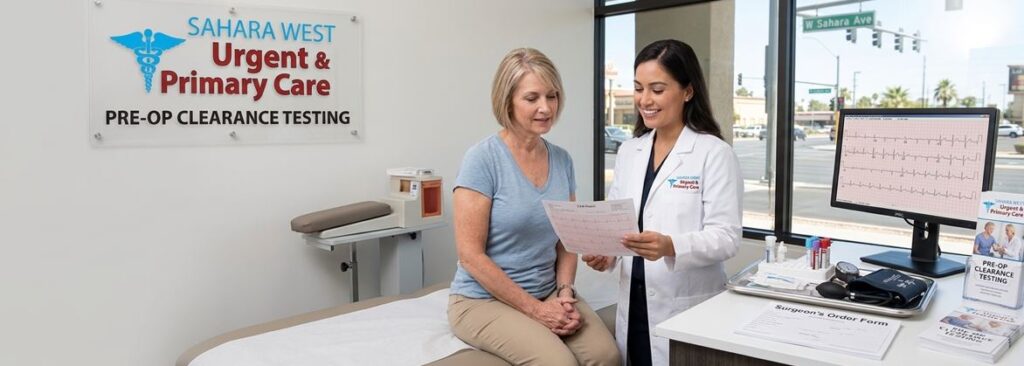
Before surgery, most patients have a medical history review, a physical exam with vital signs, and some combination of blood tests, a urine test, and an EKG. Depending on your age, health, and procedure, you may also need a pregnancy test or a chest X-ray. Your surgeon and anesthesia team decide the exact list, so there is no single set of tests that applies to everyone.
If your surgery date is already on the calendar, the practical question is which of these you need, and how to get them done without delaying the date. This guide explains each test, why it is ordered, and how to complete pre-op testing in Las Vegas in a single visit.
Quick Guide: Common Pre-Op Tests at a Glance
| Test | What it checks | Who commonly needs it |
| Medical history & medication review | Chronic conditions, allergies, blood thinners, supplements | Everyone |
| Physical exam & vital signs | Heart, lungs, blood pressure, oxygen levels | Everyone |
| Complete blood count (CBC) | Anemia, infection, platelet count | Many patients, especially for larger procedures |
| Metabolic panel (BMP/CMP) | Kidney function, electrolytes, blood sugar, liver markers | Patients with chronic conditions, older adults, larger procedures |
| Clotting tests (PT/INR, PTT) | How well your blood clots | Patients on blood thinners, with bleeding history, or having higher-bleeding-risk surgery |
| Urinalysis | Urinary infection, kidney issues, diabetes markers | When ordered by the surgeon |
| Pregnancy test | Pregnancy status before anesthesia or imaging | Patients who could be pregnant |
| EKG (electrocardiogram) | Heart rhythm and electrical activity | Older patients, heart or blood pressure history, or when required by the surgeon |
| Chest X-ray | Lung and heart abnormalities | Patients with lung or heart symptoms or risk factors, or when ordered |
Who Decides Which Tests You Need?
Your surgeon and anesthesia provider set the requirements. Their decisions are based on:
- Your age. EKGs and broader lab panels become more common as age increases.
- Your health history. Diabetes, high blood pressure, heart disease, kidney disease, asthma, and sleep apnea can all add tests.
- The type of surgery. A short cosmetic procedure and a major operation under general anesthesia carry different risks.
- The type of anesthesia. General anesthesia and sedation usually involve more screening than a local numbing procedure.
- Your medications. Blood thinners, diabetes medications, and some supplements affect testing and timing.
If your surgeon or surgical center gave you an order form or checklist, that document is your source of truth. Bring it to your appointment so the right tests are done the first time.
The Most Common Tests Done Before Surgery
1. Medical history and medication review
This is the foundation of every pre-op evaluation. Your provider reviews past surgeries, chronic conditions, allergies, prior reactions to anesthesia, and everything you take, including prescriptions, over-the-counter drugs, vitamins, and herbal supplements. Some medications and supplements increase bleeding risk or interact with anesthesia, so your surgeon may tell you to pause them ahead of time. Do not stop any prescribed medication unless your surgeon or prescriber tells you to.
2. Physical exam and vital signs
Your provider checks your blood pressure, heart rate, oxygen level, heart and lung sounds, and overall physical readiness for anesthesia. This is the step that a standalone blood draw at a lab cannot replace, and it is often what turns test results into an actual clearance.
3. Blood tests
Blood work is the most common category of pre-op testing. Depending on your situation, it can include:
- Complete blood count (CBC): looks for anemia, low platelets, and signs of infection.
- Basic or comprehensive metabolic panel (BMP/CMP): measures electrolytes, kidney function, and blood sugar. A CMP also includes liver-related markers.
- Coagulation studies (PT/INR, PTT): show how well your blood clots, which matters for bleeding risk.
- Blood sugar testing: especially important if you have or may have diabetes, since blood sugar affects healing and infection risk.
- Blood type and screen: ordered for procedures where a transfusion is possible.
For a deeper look, see our guide to blood work required before surgery.
4. Urinalysis
A urine sample can reveal urinary tract infections, kidney problems, or signs of diabetes. A hidden infection can complicate surgery, so surgeons sometimes want it ruled out beforehand.
5. Pregnancy test
If you could be pregnant, a pregnancy test is standard before surgery. Pregnancy affects anesthesia choices, medications, imaging, and whether the procedure should happen at all.
6. EKG (electrocardiogram)
An EKG is a quick, painless test that records your heart’s electrical activity using small sensors on your chest and limbs. It can show rhythm abnormalities that cause no symptoms. It is most often requested for older patients, those with heart or blood pressure history, or when the surgical center requires it. Learn more in Do I Need an EKG Before Plastic Surgery?
7. Chest X-ray
A chest X-ray helps evaluate the lungs and heart. It is typically ordered for patients with lung disease, breathing symptoms, or specific risk factors, or when your surgeon or anesthesia team requests it.
8. Additional tests for specific conditions
Some patients need more than the basics. Depending on your history, your surgeon may ask for a sleep apnea evaluation, an echocardiogram, a stress test, or a letter from a specialist such as a cardiologist. These are not routine for healthy patients having low-risk procedures.
Pre-Op Testing by Type of Surgery
What you need varies by procedure. These are common patterns, not fixed rules. Always confirm with your surgeon.
| Procedure | Tests often requested |
| Plastic or cosmetic surgery | Physical exam, CBC/CMP, EKG (often for older patients), urinalysis or pregnancy test. See what tests are commonly required before plastic surgery |
| Dental or oral surgery with sedation | Health history, physical exam, and sometimes labs or EKG for older patients or those with medical conditions. See pre-op clearance for dental surgery |
| Cataract surgery | Physical exam, blood pressure check, and sometimes basic labs or an EKG. See pre-op clearance for cataract surgery |
| Major or hospital-based surgery | Broader labs, EKG, sometimes chest X-ray and specialist input, as ordered by the surgical team |
Do You Really Need All of These Tests?
Not always, and that is worth knowing. Medical guidance has moved away from “test everyone for everything.” For low-risk procedures in healthy patients without symptoms, routine tests often come back normal and rarely change the surgical plan. That is why your history and physical exam usually guide which tests, if any, are worthwhile.
The practical takeaway: get the tests your surgeon and anesthesia team actually require, no more and no fewer. If you are unsure why a test was ordered, ask. It is a fair question.
What Happens If a Test Result Is Abnormal?
An abnormal result does not automatically cancel your surgery. More often it leads to one of these:
- A repeat test to confirm the result
- A medication adjustment
- A short delay while an issue such as anemia or high blood sugar is corrected
- A referral to a specialist for further evaluation
This is exactly why testing happens before surgery day. It is far better to find and address a problem in a calm clinic visit than in the operating room.
How to Prepare for Your Pre-Op Testing Appointment
Bring:
- Your surgeon’s order form, lab requisition, or clearance checklist
- A complete list of medications, vitamins, and supplements with doses
- Your photo ID and insurance card, if you have insurance
- Your surgeon’s or surgical coordinator’s name and fax or contact details
- Any recent records, such as prior EKGs, lab results, or specialist notes
Also ask your surgeon about:
- Fasting. Many standard panels do not require it, but some tests do, so confirm before your visit.
- Which medications to continue or pause.
- How recent your results must be. Many surgeons want testing completed within a set window before surgery.
Can Urgent Care Do Pre-Op Testing?
Yes. A full-service urgent care can complete a physical exam, blood work, an EKG, and medication review in one visit, which is often faster than waiting weeks for a primary care appointment and then visiting separate labs and imaging centers. Urgent care pre-op evaluation is best suited to low- to moderate-risk patients having elective procedures. If you have complex conditions such as advanced heart disease, uncontrolled diabetes, or a recent cardiac event, your surgeon may want a specialist involved as well.
Learn more about where to get pre-op blood work in Las Vegas and what happens during a medical clearance appointment.
Walk-In Pre-Op Testing in Las Vegas at Sahara West Urgent Care
If your surgery date is coming up, you do not have to bounce between offices. Sahara West Urgent Care & Wellness offers Pre-Op Clearance with a medical evaluation, lab testing, EKGs, and medication review. Completed documentation can be sent to your surgeon’s office.
- Walk-ins welcome, with same-day care available
- On-site X-ray available Tuesdays and Thursdays, walk-ins welcome, if your surgeon requests a chest X-ray
- Insurance and self-pay options available
- Coordination with your surgical team so your paperwork goes where it needs to go
Is your surgery only days away? Read Can I Get Pre-Op Clearance if My Surgery Is Only a Few Days Away? Is your surgeon planning plastic surgery? See what you need for medical clearance for plastic surgery, or explore plastic surgery in Las Vegas at Sahara West.
📍 6125 W Sahara Ave #1B, Las Vegas, NV 89146
📞 (702) 248-0554
🕒 Monday–Friday 9am–9pm | Saturday 9am–5pm
Bring your surgeon’s order form, call (702) 248-0554, or contact us to get your pre-op testing done fast. Patients from Summerlin, Spring Valley, Henderson, Enterprise, and the Strip area are welcome.
FAQs
What tests are done before surgery?
Common pre-op tests include a medical history and medication review, a physical exam with vital signs, blood tests (such as CBC, metabolic panel, and clotting tests), a urinalysis, a pregnancy test when applicable, an EKG, and sometimes a chest X-ray. Your surgeon decides which ones you need.
Do I need blood work before every surgery?
Not always. Requirements depend on your age, health, and the type of surgery. Some low-risk procedures in healthy patients need little or no blood work, while larger procedures or patients with chronic conditions usually need more. Your surgeon’s order tells you what is required.
Do I need an EKG before surgery?
An EKG is commonly requested for older patients, people with heart disease or high blood pressure, and when the surgical center requires it. Younger, healthy patients having low-risk procedures often do not need one.
Do I have to fast before pre-op blood work?
Usually not for a standard panel, but some tests require fasting. Check your surgeon’s instructions or ask when you book your visit.
How long before surgery should I get tested?
It depends on your surgeon and facility. Many want results within a set window before the procedure, so ask for their exact requirement, and do not wait until the last minute.
Can I get pre-op testing at an urgent care?
Yes. A full-service urgent care can perform a physical exam, blood work, an EKG, and medication review in one visit and send documentation to your surgeon. Patients with complex medical conditions may need additional specialist input.
How long does pre-op testing take?
A pre-op visit is often completed in a single appointment. Lab and EKG turnaround varies, so ask about timing if your surgery is close.
What if my pre-op test results are abnormal?
An abnormal result usually leads to a repeat test, a medication change, or a short delay while an issue is corrected. It does not automatically mean your surgery is canceled.
Should I stop taking my medications before surgery?
Do not stop any medication on your own. Your surgeon or prescriber will tell you which medications and supplements to pause and when.
Do I need an appointment for pre-op testing at Sahara West Urgent Care?
Walk-ins are welcome. Calling ahead at (702) 248-0554 can help you plan around lab or imaging needs, such as X-ray availability on Tuesdays and Thursdays.
This article is for general education and is not medical advice. Your surgeon and care team determine which tests are right for you.