
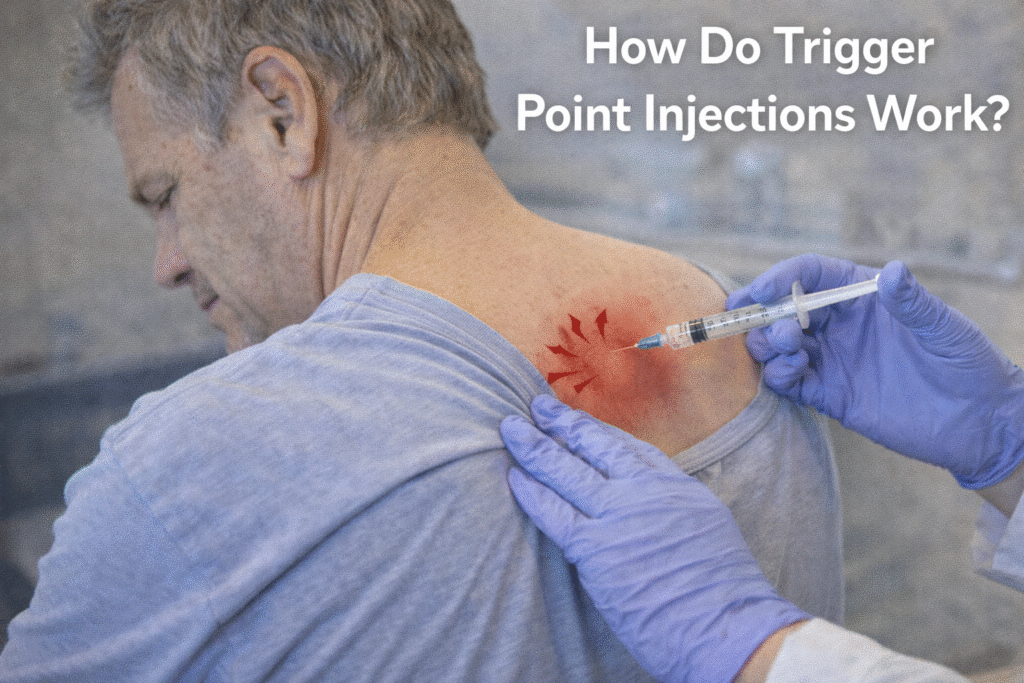
Trigger point injections work due to the direct use of a small needle directly into the painful knot within the muscle (trigger point) to relax tight muscle fibers, dissociate pain responses, increase blood flow and reduce muscle spasm, which in most instances offers temporary pain relief and enables the movement of the muscle as well as its disengagement, thus preventing its involvement in rehabilitation.
How Trigger Point Injections Work: Step by Step
Step 1: Identifying the Trigger Point
The initial one is a physical examination.
The provider:
- Massages (rubs) the muscle to identify knots or lumps.
- Determines the areas that cause pain to the patient upon pressure.
- Confirms typical patterns of referred pains of typical trigger points.
Identification is important because the injection must be placed directly in the trigger point to achieve usefulness.
Step 2: Preparation of the Injection Site
Once the trigger point has been determined:
- An antiseptic solution is applied on the skin.
- The patient will be in a position to ensure that the muscle is relaxed.
- General anesthesia is not needed.
The preparation reduces the risk of infections and proper positioning of needles.
Step 3: Needle Designation into the Trigger Point
One needs to insert a thin needle into the knot of the muscle.
At this stage:
- The tight muscle fibers are disturbed in a mechanical way by the needle.
- A brief muscle twitch response may occur (this is normal and often a sign of correct placement)
- The needle facilitates the breaking of the pain cycle by stimulating the muscle release.
The trigger point can be deactivated by just using a needle without drugs.
Step 4: Medication (When Necessary) Injection
If medication is used, it is injected once the needle is in the trigger point.
The components have different working mechanisms:
- Local anesthetic suppresses the pain impulse and relaxes the muscle.
- Saline assists in removing inflammatory chemicals in the tissue.
- Corticosteroids in severe swelling or chronic irritation cases decrease the inflammation.
The medication diffuses in the muscle, and it goes even deeper to relax the fibers.
Step 5: Waterboarding and Dilated Blood Vessels
After the trigger point has been interfered with:
- The muscle fibers become stretched and relaxed.
- Blood flow improves
- Oxygen and nutrients reach the tissue more effectively
- Waste products in metabolism are eliminated.
The procedure is useful in re-establishing the physiology behind the trigger point in order to make it disappear.
Step 6: Interruption of Pain Signal
Continuous pains are relayed to the nervous system through trigger points.
Trigger point injections:
- Interrupt abnormal nerve signaling
- Minimise central pain sensitization.
- Reset the muscle-nerve feedback loop.
This is why patients normally feel that their pain is relieved in a very short period of time, in some cases taking just a few minutes.
Step 7: After Injection Muscle Recovery
After the injection:
Relaxation of the muscle proceeds hours to days.
- With the subsistence of inflammation, pain reduces.
- Range of motion improves
- Physical treatment and stretching is enhanced.
This is a very important step towards the long-term outcomes and not the short-term fix.
What medications are used in trigger point injections?
Things that can be injected into trigger points include:
- Local anesthetic (e.g. lidocaine) to desensitize the area and sphincter sphincter sphincter
- Occasionally saline or dry needling (needle only).
- A low dose of steroid (at the discretion of the provider) in a few instances.
The goal is muscle release, not long-term numbing.
How quickly do trigger point injections work?
Many patients notice:
- Reduction of tension in muscles in the short time.
- Gradual pain relief over 24-72 hours
- Temporary soreness at the injection site
Relief duration varies. Others get well through weeks and others need more treatment coupled with stretching, posture remedies and strengthening.
Are trigger point injections the cure?
No. Trigger point injections do not work as a permanent treatment.
They are used most effectively in a bigger treatment plan which may include:
- Physical therapy
- Stretching and muscle movement exercises.
- Posture and ergonomic modification.
- Reducing stress and learning to sleep better.
- modification of hydration and activity.
Consider the trigger point pain injections as a reset button that assists in the relaxation of muscles in order to proceed with the healing.
Is the use of trigger point injections safe?
Trigger point injections are relatively safe when used by an experienced medical practitioner. The side effects that may occur are mild and include:
- Temporary soreness
- Minor bruising
- Short term pain improvement.
In cases where appropriate practice and screening of patients are applied, serious complications are unlikely to occur.
Sahara West Urgent Care and wellness- Las Vegas
At Sahara West Urgent Care and Wellness, we assess muscle pain, find trigger points, and assist in determining which will be the better treatment of trigger pain injections or other options depending on the condition.
Make your appointment with Sahara West, no wait.
Arthroplastic pain, muscle tightness or spasms, which are holding you back, our medical team in Las Vegas is here to get you out of this pain as soon and safely as possible. To schedule your appointment with the highest standard of care, visit Sahara West Urgent Care on our website, where you can also explore more informative blogs .
FAQs
Do trigger point injections hurt?
Majority of the patients report mild pain or pressure. The injection is minute and the action is normally fast.
What is the number of trigger point injections required?
It is contingent on the number of trigger points and level of symptoms and response to treatment. A large number of patients require a single or a few sessions.
Is physical therapy a replacement of trigger point injections?
No. They work best in combination with physical therapy or home exercise to ensure recurrence is prevented.
Do I need imaging before trigger point injections?
Usually not. Trigger point injections are also not made on the imaging findings but on the physical examination findings.