Ankle sprains happen in an instant, a misstep on the Strip, a stumble hiking Red Rock Canyon, or a rolled ankle during a pickup basketball game in Henderson. Whatever the cause, one question tends to follow immediately: Is this serious enough for urgent care? In Las Vegas, where you may be far from your regular doctor and still have days of plans ahead, making that call quickly matters more than most people realize.
This guide will walk you through everything you need to know, from recognizing the severity of your sprain to finding the right care in the Las Vegas Valley, so you can make a smart, informed decision and get back on your feet.
What Is a Sprained Ankle, and Why Does It Happen?
A sprained ankle occurs when the ligaments, the tough, fibrous bands connecting your bones, are stretched or torn beyond their normal range of motion. It is one of the most common musculoskeletal injuries in the United States, accounting for roughly 25,000 cases every single day.
In Las Vegas specifically, certain activities increase your risk considerably. Long stretches of walking on casino floors, uneven terrain on desert trails, high heels during a night out, and sports played on artificial turf all place unusual stress on the ankle joint. The lateral ligaments on the outer side of the ankle are the most frequently injured because the foot tends to roll inward during a fall or misstep.
Understanding the mechanism of your injury is one of the first things an urgent care provider will ask about, and it helps them determine which ligaments may be affected and how severely.
The Three Grades of Ankle Sprains Explained
Not all ankle sprains are created equal. Medical professionals classify them into three distinct grades, and the grade of your sprain largely determines whether you can safely self-treat at home or whether you need urgent care for a sprained ankle in Las Vegas right away.
Grade I (Mild) involves microscopic tears in the ligament fibers. You will experience mild tenderness, minor swelling, and some stiffness, but you can typically still bear weight on the foot. Home rest, ice, compression, and elevation, known as the RICE protocol, is usually sufficient for Grade I injuries.
Grade II (Moderate) is a partial tear of one or more ligaments. Swelling is more pronounced, bruising may appear within hours, and walking becomes painful and difficult. This level of sprain benefits significantly from professional evaluation, imaging to rule out fracture, and a structured recovery plan.
Grade III (Severe) represents a complete rupture of the ligament. The ankle may feel unstable, almost as if the joint is “giving out.” Severe swelling, significant bruising, and an inability to bear any weight are hallmarks of a Grade III sprain. This is an injury that absolutely warrants immediate urgent care or emergency evaluation.
Trying to determine your grade at home without proper examination is unreliable and can lead to under-treatment of a serious injury.
Key Signs You Should Seek Urgent Care for a Sprained Ankle in Las Vegas
Many people delay care because they assume a sprained ankle will simply heal on its own. While mild sprains often do, there are clear red flags that should send you to an urgent care clinic the same day.
You should visit urgent care if you hear a popping or cracking sound at the time of injury. A pop often indicates ligament rupture or, in some cases, a fracture. Similarly, if you cannot put any weight on the foot within 30 minutes of the injury, a standard clinical guideline known as the Ottawa Ankle Rules, imaging is strongly recommended.
Rapid, significant swelling that continues to worsen over the first few hours is another warning sign, as is deep bruising that spreads quickly across the foot and ankle. Numbness, tingling, or a cold sensation in the toes could indicate nerve or vascular involvement, which requires prompt assessment. If the ankle looks visibly deformed or the foot is positioned at an abnormal angle, go to the emergency room, not urgent care.
Fever developing in the days following a sprain should also never be dismissed, as it can signal an infection, particularly if there was any open wound involved.
When Home Treatment Is Enough for a Mild Sprain
If your sprain is mild, you heard no pop, you can bear weight with discomfort rather than severe pain, and swelling is minimal, home management is a reasonable starting point for the first 24 to 48 hours.
The RICE method remains the gold standard initial approach. Rest the ankle and avoid activities that cause pain. Apply ice wrapped in a cloth for 15 to 20 minutes every two to three hours during the first 48 hours to reduce inflammation. Use a compression bandage to minimize swelling, wrapping from the toes upward. Keep the ankle elevated above heart level whenever possible, especially during sleep.
Over-the-counter anti-inflammatory medications like ibuprofen or naproxen can help manage pain and inflammation. Acetaminophen addresses pain but does not reduce swelling, so it is a secondary option.
However , and this is critical, if your symptoms are not clearly improving within 48 to 72 hours, or if they worsen at any point, seeking urgent care for a sprained ankle in Las Vegas becomes necessary even if the injury initially seemed minor. Ligament injuries can be deceiving in the first hours before swelling fully develops.
What Urgent Care Providers Do Differently Than Home Treatment
Walking into an urgent care clinic provides access to diagnostic and treatment tools that simply are not available at home. One of the most important is on-site X-ray imaging, which rules out fractures that can mimic the symptoms of a sprain almost exactly. A small fracture of the fibula, for example, can feel nearly identical to a ligament sprain, but treatment differs significantly.
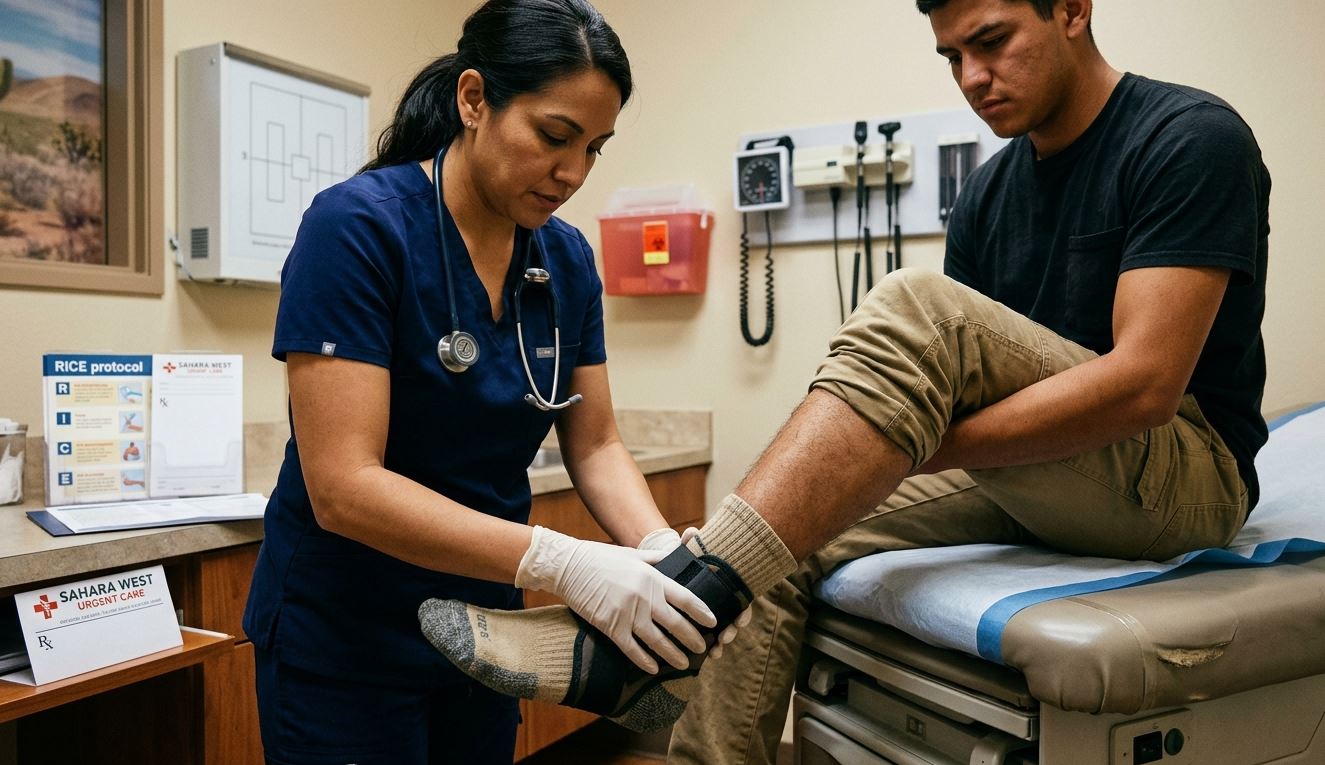
Urgent care providers will perform a physical examination that includes palpating specific bony landmarks, testing the stability of the ankle ligaments, and assessing your range of motion. This hands-on assessment provides information no amount of online symptom-checking can replicate.
Depending on severity, they may fit you with a splint, brace, or walking boot to stabilize the joint during healing. They can also prescribe stronger anti-inflammatory medications or refer you for a follow-up MRI if ligament or tendon damage is suspected beyond what X-rays can show.
Perhaps most importantly for visitors to Las Vegas, urgent care clinics can provide documentation, a structured recovery plan, and referrals to orthopedic specialists if further care is needed after you return home.
How to Find Urgent Care for a Sprained Ankle in Las Vegas Quickly
Las Vegas has a well-developed network of urgent care centers spread across the valley, including locations on the Strip corridor, in Henderson, Summerlin, and North Las Vegas. Most are open extended hours and many operate seven days a week, which is essential in a city that never sleeps.
When searching for urgent care for a sprained ankle in Las Vegas, prioritize facilities that list musculoskeletal injuries among their treatment capabilities and explicitly offer on-site X-ray services. These two features ensure you will not be sent elsewhere after an initial visit.
If you are a tourist, check whether the clinic accepts out-of-state insurance before you go, or ask about their self-pay rates. Many Las Vegas urgent care centers are accustomed to treating visitors and can work with a wide variety of insurance carriers. Your hotel concierge can often recommend the nearest reputable clinic, which can save time when you are in pain.
Urgent Care vs. the Emergency Room for Ankle Injuries
This is a distinction that confuses many patients. Emergency rooms in Las Vegas, including those at University Medical Center and Sunrise Hospital, are equipped for life-threatening situations, and while they can absolutely treat a sprained ankle, their wait times and costs are generally much higher than urgent care.
For most ankle sprains, even moderate to severe ones, an urgent care clinic is the right first stop. They can evaluate, image, stabilize, and refer you efficiently. The emergency room becomes the appropriate choice when the ankle appears fractured with visible deformity, when there is significant vascular or nerve compromise, or when the injury occurred alongside other trauma such as a fall from height or a vehicle accident.
Making this distinction correctly can save you hours of waiting time and substantially reduce your out-of-pocket medical costs.
What to Expect During Your Urgent Care Visit
Knowing what happens at your visit can reduce anxiety and help you communicate your symptoms more effectively. When you arrive, you will complete an intake form that asks about your medical history, current medications, and insurance information. Bring your insurance card if you have one.
The provider will ask you detailed questions: How exactly did the injury happen? Where is the pain located? Can you walk on it? Did you hear anything at the moment of injury? These details guide the clinical decision-making process.
After the physical examination, if X-rays are ordered, results are typically available within minutes. You will then receive a clear diagnosis, a treatment protocol, and instructions for at-home care during recovery. Expect to leave with documentation of your visit, any prescribed medications or supplies, and follow-up instructions tailored to your situation.
The entire visit for a straightforward ankle sprain usually takes between 45 minutes and 90 minutes, making it a practical option even when you have other obligations.
The Role of Physical Therapy in Ankle Sprain Recovery
One of the most commonly overlooked aspects of ankle sprain treatment is rehabilitation. Many patients feel better within a week or two and assume recovery is complete. However, inadequate rehabilitation significantly increases the risk of chronic ankle instability, a condition where the ankle continues to roll and sprain repeatedly because the supporting ligaments never fully healed or the surrounding musculature was not properly retrained.
An urgent care provider who takes sprained ankle treatment seriously will discuss physical therapy or at least recommend specific rehabilitation exercises before you leave. For visitors in Las Vegas who will return home shortly, a referral letter or treatment summary can help your local physical therapist continue care seamlessly.
Proprioceptive exercises, movements designed to retrain your ankle’s sense of position, are particularly important in preventing re-injury and should begin as soon as pain levels allow.
Preventing Future Ankle Sprains: Practical Advice
Treating your current sprain is only half the equation. Taking steps to prevent recurrence protects you in the long term, especially if you are physically active or tend to be on your feet for long stretches during Las Vegas visits.
Ankle strengthening exercises focusing on the peroneal muscles along the outer lower leg form the backbone of prevention. Wearing supportive footwear appropriate to the activity, cushioned walking shoes for long days on casino floors, proper trail shoes for desert hikes, dramatically reduces your risk. If you have a history of ankle sprains, a lace-up ankle brace worn during sports activities provides meaningful mechanical support without restricting normal movement.
Taping techniques applied by a trained athletic trainer or physical therapist can also be effective for athletes returning to sport after a sprain. Proprioceptive training on balance boards is supported by strong clinical evidence and is accessible even through simple home exercises like single-leg standing.
Common Misconceptions About Ankle Sprains
A number of widely held beliefs about sprained ankles lead patients to either over-react or, more dangerously, under-react to their injuries.
The idea that “if you can walk on it, it isn’t broken” is a particularly persistent myth that can result in undiagnosed fractures going untreated. Some fractures, particularly stress fractures and avulsion fractures, are entirely compatible with limping ambulation. Only imaging confirms or rules out a break.
Conversely, the belief that sprains are always less serious than fractures is also misleading. A severe Grade III ligament rupture can require a longer recovery and be more functionally disabling than a simple non-displaced fracture.
“Pushing through the pain” and returning to activity too soon is another common mistake. Athletes and active individuals who resume full activity before the ankle has regained full strength and stability are at substantially elevated risk of re-injury.
Special Considerations for Las Vegas Visitors With Ankle Injuries
Traveling with an ankle injury presents unique logistical challenges that local residents do not face. If you are visiting Las Vegas and sustain a sprain, consider a few important factors beyond the immediate medical care.
Airlines can typically accommodate passengers with ankle injuries with advance notice , mobility assistance, early boarding, and wheelchair service through the terminal are available at Harry Reid International Airport. If your travel date is imminent and your injury is significant, contact your airline as early as possible.
Extended walking on the Strip in a brace or on crutches is feasible but exhausting. Many of the resort casinos are genuinely enormous, and realistic planning may mean scaling back your itinerary for a day or two while prioritizing recovery. Las Vegas rideshare services are extensive and can minimize the walking burden considerably.
Staying hydrated is also relevant to recovery, the desert climate accelerates fluid loss, and adequate hydration supports both swelling management and tissue healing.
When a Sprained Ankle Might Be Something More Serious
Some conditions can present similarly to a simple ankle sprain but require very different treatment. Peroneal tendon tears, for example, cause pain along the outer ankle and are frequently misdiagnosed as sprains. Osteochondral lesions , damage to the cartilage and underlying bone within the ankle joint — may occur alongside ligament injury and cause persistent pain and swelling that does not resolve with standard sprain treatment.
If your ankle sprain symptoms persist beyond four to six weeks despite appropriate treatment, or if you notice persistent deep aching within the joint rather than localized ligament pain, an MRI and orthopedic specialist consultation are warranted. Urgent care providers in Las Vegas can initiate this referral process for you.
Recognizing these possibilities underscores why professional evaluation — rather than self-diagnosis — is so valuable even for injuries that initially seem straightforward.
Conclusion
A sprained ankle in Las Vegas can range from a minor inconvenience to a significant injury requiring immediate professional attention. The most important thing you can do in the first moments after an ankle injury is assess your ability to bear weight, note the intensity of your pain, and watch for the red flags outlined in this guide. When those red flags are present — severe swelling, inability to walk, a popping sound, or visible deformity — do not hesitate to seek urgent care for a sprained ankle in Las Vegas the same day.
Even for injuries that feel moderate, professional evaluation provides peace of mind, accurate diagnosis, and a recovery plan that protects your long-term ankle health. Las Vegas has excellent urgent care options staffed by experienced providers who see musculoskeletal injuries daily. Take advantage of them.
Call to Action: If you are dealing with a painful ankle right now, stop walking on it, apply ice, and locate your nearest Las Vegas urgent care center with on-site imaging. Your future self — and future trips to Las Vegas — will thank you for taking the injury seriously from the start. Call or come by Sahara West Urgent Care today to get the professional care and support necessary for a safe and successful recovery from alcohol.
FAQs
How long does a sprained ankle take to heal? Mild Grade I sprains typically heal within one to two weeks. Moderate Grade II sprains can take three to six weeks. Severe Grade III injuries may require three to six months of structured rehabilitation before full return to activity.
Can I walk on a sprained ankle to get to urgent care? If walking causes sharp pain, use a brace, wrap the ankle with a compression bandage, and ask someone to assist you. Limping to the car or to a rideshare vehicle is generally acceptable, but putting significant force on a potentially severe sprain before evaluation is not recommended.
Will urgent care in Las Vegas do an X-ray for a sprained ankle? Yes. Most Las Vegas urgent care centers have on-site X-ray equipment and routinely use it to distinguish between sprains and fractures for ankle injuries. Always confirm imaging availability when you call ahead.
Does insurance cover urgent care for a sprained ankle? Most major health insurance plans cover urgent care visits, including for musculoskeletal injuries. Your copay and deductible apply as they would for any medical visit. Call your insurer or the clinic directly to verify coverage if you are unsure.
Is it safe to fly home with a sprained ankle? For mild to moderate sprains, flying is generally safe. Keep the ankle elevated during the flight and stay hydrated. For severe sprains or injuries involving significant swelling, consult your urgent care provider about timing, compression sock use, and any risk of clotting on long flights.
What is the difference between a sprained ankle and a broken ankle? Both can cause swelling, bruising, and pain, and they cannot be reliably distinguished by symptoms alone. X-ray imaging is the standard method for differentiating between them. Certain patterns — such as bony tenderness directly over the fibula or the inability to bear any weight — increase the clinical suspicion for fracture.
Can a sprained ankle heal without medical treatment? Mild sprains often heal adequately with home care. However, untreated moderate and severe sprains can result in chronic instability, persistent pain, and recurring injuries. Professional evaluation ensures the correct diagnosis and a recovery plan that addresses all aspects of the injury, not just immediate pain relief.