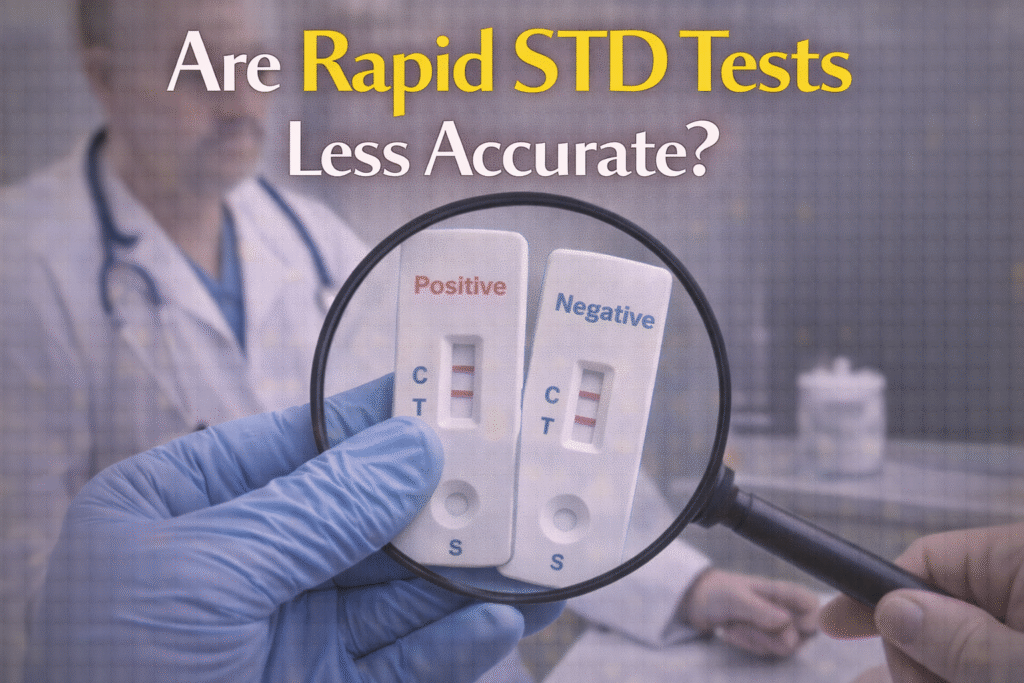
Waiting for STD test results can feel like an eternity. That knot in your stomach, the endless what-ifs, the days of uncertainty, it’s no wonder more people are turning to Fast testing options that promise answers in minutes instead of days. But with speed comes skepticism: Does getting results in 20 minutes mean sacrificing accuracy?
The short answer is no. The belief that “fast” automatically equals “flawed” is a dangerous myth that keeps people from getting tested when they need it most. The reality is more nuanced and far more reassuring: Fast tests are highly reliable diagnostic tools when performed at the right time and by clinical professionals. Understanding when and how to use them can transform your approach to sexual health screening.
Breaking Down the Science: Accuracy vs. Speed
To understand Fast test reliability, you need to know two critical terms that medical professionals use to evaluate any diagnostic tool:
Sensitivity measures how well a test identifies people who actually have an infection. A highly sensitive test catches nearly every positive case, minimizing the chance of missing an infection.
Specificity measures how well a test avoids false alarms. A highly specific test rarely tells someone they’re positive when they’re actually negative.
Most FDA-approved Fast STD tests deliver impressive performance on both fronts, with accuracy rates ranging from 90% to 99% depending on the specific infection being tested. These aren’t experimental technologies,they’re proven diagnostic tools used in medical facilities worldwide.
The primary difference between Fast point-of-care tests (results in 15-30 minutes) and traditional laboratory-processed tests like PCR or NAAT (results in 2-5 days) isn’t necessarily accuracy,it’s methodology. Lab tests may offer slightly higher sensitivity for certain infections, particularly when detecting very low levels of infection. However, for most common STDs, rapid tests performed by healthcare professionals deliver results that are clinically equivalent to their slower counterparts.
The “Window Period”: Why Timing Matters More Than the Test Type
Here’s what many people don’t realize: test accuracy is often limited by your body’s biological response, not the test technology itself. Every infection has a “window period”,the time between exposure and when the infection becomes detectable. Test too early, and even the most sophisticated technology will miss it.
Standard Detection Windows
| STD | Minimum Detection Window | Recommended Testing Time |
| HIV | 18-45 days for Fast blood tests | 4-6 weeks post-exposure (3 months for definitive results) |
| Chlamydia & Gonorrhea | 1-2 weeks post-exposure | 2 weeks post-exposure for reliable results |
| Syphilis | 3-6 weeks for antibody detection | 6 weeks post-exposure |
| Hepatitis C | 8-12 weeks | 12 weeks for conclusive results |
Testing during the window period is the most common cause of false negatives,not the test itself. This is why healthcare providers may recommend follow-up testing if you’ve had a recent high-risk exposure, regardless of whether you use a Fast or traditional test. The solution isn’t choosing a different test type; it’s understanding your exposure timeline and scheduling appropriately.
Fast Tests at Urgent Care vs. At-Home DIY Kits
Not all Fast tests are created equal, and the environment where you take them matters tremendously.
At-home STD test kits have made testing more accessible, but they come with significant limitations. Studies show that self-collected samples result in 3-5% “inadequate specimens”,samples that can’t be properly analyzed due to collection errors. In clinical settings with trained professionals, that rate drops to less than 1%.
The difference comes down to three critical factors:
Proper technique matters. Collecting a urethral swab, throat swab, or blood sample correctly requires training. Healthcare professionals know the proper depth, rotation technique, and collection methods that maximize sample quality. A poorly collected sample doesn’t just risk inaccuracy,it often requires you to retest entirely.
Storage conditions affect results. Fast test reagents are sensitive to temperature fluctuations and humidity. Clinical facilities maintain controlled environments that preserve test integrity. Your bathroom cabinet or mailbox doesn’t offer the same protection.
Expert interpretation prevents panic. A faint line on a Fast test can mean different things depending on the specific test, timing, and context. At Sahara West Urgent Care, a healthcare provider evaluates your results alongside your symptoms, medical history, and physical examination,not just a colored line on a strip. This integrated approach dramatically reduces both false positives and the anxiety that comes with ambiguous results.
Which STDs are Best Suited for Fast Testing?
Fast testing technology has evolved significantly, but some infections are better suited to point-of-care screening than others.
HIV testing represents the gold standard for Fast diagnostics. Modern Fast HIV tests achieve 99% specificity and over 98% sensitivity when used outside the window period. Fourth-generation Fast tests can detect HIV antibodies and antigens, significantly reducing the detection window.
Chlamydia and gonorrhea Fast testing has improved dramatically with newer Fast PCR technologies approaching 97% accuracy for urogenital infections. While traditional NAAT lab tests may still have a slight sensitivity edge for rectal or throat infections, the clinical difference is minimal for genital screening.
Syphilis Fast tests excel at initial screening with excellent sensitivity for detecting antibodies. However, positive results typically require confirmatory laboratory testing to distinguish between current infection, past treated infection, or rare false positives. This two-step approach ensures you receive appropriate treatment without overtreatment.
Hepatitis C Fast antibody screenings are highly effective, with some tests demonstrating over 99% sensitivity and specificity. Like HIV, the challenge isn’t test accuracy, it’s respecting the window period between exposure and antibody development.
Dealing with “False” Results: What Happens Next?
No diagnostic test is perfect, which is why understanding what happens when results are unclear is crucial to peace of mind.
False positives are relatively rare with Fast STD tests but can occur due to cross-reactivity with other antibodies in your system or, very rarely, laboratory error. This is why reactive results for infections like syphilis or HIV trigger a confirmatory testing protocol. Your initial rapid test provides immediate actionable information, but a follow-up laboratory test ensures diagnostic certainty before beginning long-term treatment.
False negatives are more common and almost always related to the window period. Testing too soon after exposure,before your body has produced detectable antibodies or before infection levels are high enough,yields negative results even when infection is present. This is why healthcare providers consider your exposure timeline alongside test results.
The Sahara West approach addresses both scenarios by integrating Fast test results with a comprehensive clinical evaluation. Your symptoms, physical examination findings, sexual history, and exposure timeline all inform the interpretation of your test. A negative Fast test with symptoms consistent with an STD prompts additional testing or empirical treatment. A positive result is explained in context, with immediate access to treatment and counseling.
Why Choose Sahara West Urgent Care for Your Screening?
The advantage of clinical Fast testing extends beyond test accuracy to encompass the entire care experience.
Immediate treatment access represents perhaps the biggest benefit of Fast testing at an urgent care facility. If your test comes back positive for a treatable infection like chlamydia or gonorrhea, you can start antibiotics before leaving the clinic. No waiting, no additional appointments, no days of anxiety while infection potentially worsens or spreads to partners.
Confidentiality and privacy are guaranteed under strict HIPAA standards in a professional medical environment. Your results, conversations with healthcare providers, and treatment records are protected by federal law. Unlike at-home tests that may share data with third-party companies, medical facilities maintain absolute privacy.
Walk-in convenience eliminates the barriers that prevent many people from getting tested. No referral required, no weeks-long wait for an appointment with your primary care physician, no juggling work schedules to fit testing into business hours. Sexual health concerns don’t operate on a 9-to-5 schedule, and neither does Sahara West.
Peace of Mind is Only 20 Minutes Away
Fast STD tests are powerful, accurate diagnostic tools that have revolutionized sexual health screening. They deliver laboratory-quality results in a fraction of the time, enabling same-day diagnosis and treatment for infections that were once detected only after days of anxious waiting.
The accuracy concerns that keep some people from choosing Fast testing are largely unfounded. When performed at the appropriate time, by trained professionals, in a clinical environment, Fast tests rival traditional laboratory methods for reliability while offering unmatched convenience and speed.
The real risk isn’t the test accuracy,it’s the testing delay. Every day you wait to get tested is another day that an undiagnosed infection can damage your health, affect your partners, and cause unnecessary stress. Don’t let fear of “accuracy” stop you from taking control of your sexual health. The technology, the expertise, and the treatment you need are available right now. To schedule your appointment with the highest standard of care, visit Sahara West Urgent Care on our website, where you can also explore more informative blogs .
FAQs
How long do I have to wait after exposure to take a Fast test?
The waiting period depends on which infection you’re testing for. For chlamydia and gonorrhea, testing is reliable starting 1-2 weeks after exposure. Syphilis requires 3-6 weeks for antibody detection, while HIV Fast tests are most accurate starting at 18-45 days post-exposure, with follow-up testing at 3 months for definitive results. Testing too early increases the risk of false negatives, regardless of test type. If you’ve had a recent high-risk exposure, discuss timing with a healthcare provider who can recommend the optimal testing schedule and may suggest follow-up screening.
Can a Fast test detect an STD with no symptoms?
Yes, absolutely. Most STDs cause no symptoms in their early stages,or ever,which is precisely why routine screening is so important. Fast tests detect infections based on the presence of antibodies, antigens, or genetic material from the pathogen, not your symptoms. Chlamydia, gonorrhea, HIV, syphilis, and hepatitis C can all be accurately detected through Fast testing even when you feel completely healthy. In fact, asymptomatic infections are extremely common and represent one of the primary reasons STDs spread so widely. Regular screening, not symptom watching, is the most effective way to protect your sexual health.
What is the “Gold Standard” for STD testing?
The term “gold standard” refers to the most reliable testing method available for a specific infection, but it varies by STD. For bacterial infections like chlamydia and gonorrhea, nucleic acid amplification tests (NAATs) processed in laboratories are considered the gold standard due to their superior sensitivity. For HIV, fourth-generation laboratory tests that detect both antibodies and p24 antigen represent the most sensitive option, though rapid tests are remarkably accurate outside the window period. For syphilis, the gold standard involves a two-step process: an initial screening test (which can be rapid) followed by confirmatory treponemal testing in a laboratory. However, “gold standard” doesn’t mean other methods are inadequate,it simply identifies the benchmark against which other tests are measured. Modern rapid tests often perform nearly as well as gold standard methods while offering the critical advantage of same-day results and treatment.