
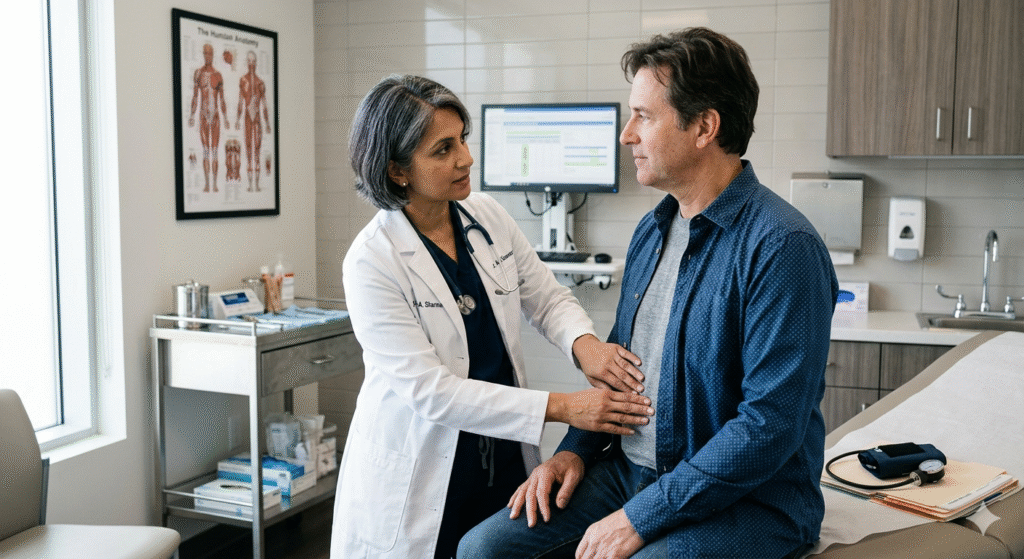
In modern diagnostic medicine, the clinical physical examination remains the most critical tool for early detection and accurate diagnosis. While advanced imaging and laboratory tests provide data, the four physical examination techniques, Inspection, Palpation, Percussion, and Auscultation, allow healthcare providers to gather real-time physiological evidence.
Achieving clinical accuracy requires a systematic approach. Below is a detailed breakdown of these four pillars, their medical significance, and how they form the basis of a comprehensive health assessment.
1. Inspection: The Art of Clinical Observation
Inspection is the first and most vital step of any physical exam. It begins the moment a clinician encounters the patient and involves a deliberate, systematic visual search for physical signs.
-
Process: Observations are made under adequate lighting, comparing bilateral body parts for symmetry.
-
Key Indicators: Clinicians look for skin color (cyanosis, jaundice, or pallor), respiratory rate, gait, scarring, and non-verbal cues of pain or distress.
-
Clinical Utility: Initial inspection often provides the “first clue” to systemic conditions, such as thyroid enlargement or peripheral vascular disease, before a single instrument is used.
2. Palpation: Tactile Assessment of Body Structures
Palpation involves using the hands and fingers to touch and feel the body to determine the characteristics of underlying structures.
-
Light Palpation: Used to assess surface characteristics such as skin temperature, moisture, texture, and superficial tenderness.
-
Deep Palpation: Used to determine the size, shape, and consistency of internal organs (like the liver or spleen) and to identify abnormal masses or deep-seated pain.
-
The Technique: The pads of the fingers are highly sensitive to tactile discrimination, while the dorsum (back) of the hand is best for sensing temperature.
3. Percussion: Evaluating Tissue Density via Sound
Percussion is a diagnostic technique where the clinician taps the body’s surface, usually with a finger, to produce sound waves. These vibrations indicate the density of the tissue or organs underneath.
-
Resonance: A clear, hollow sound found over healthy, air-filled lung tissue.
-
Tympany: A drum-like, high-pitched sound heard over air-filled structures like the stomach or intestines.
-
Dullness: A thud-like sound produced by solid organs (the liver) or fluid-filled spaces (pleural effusion).
-
Flatness: An extremely dull sound heard over dense tissue like muscle or bone.
4. Auscultation: Listening to Internal Physiological Sounds
Auscultation is the act of listening to sounds produced by the body’s internal organs, typically performed using a stethoscope to amplify frequencies.
-
Cardiovascular: Listening for the “lub-dub” of heart valves and detecting abnormal murmurs or gallops.
-
Respiratory: Assessing breath sounds to identify wheezing, crackles (rales), or areas of diminished air entry.
-
Gastrointestinal: Evaluating bowel sounds to determine the motility of the digestive system.
-
Technique Tip: High-pitched sounds (breath/heart) are best heard with the diaphragm of the stethoscope, while low-pitched sounds (bruits/certain murmurs) are captured by the bell.
Why Routine Physical Examinations Matter
A thorough physical examination in Las Vegas is the foundation of preventative healthcare. By integrating these four techniques, healthcare providers can establish a baseline for your health, identify silent “red flag” symptoms, and create a personalized wellness plan.
Early detection saves lives. Whether you are managing a chronic condition or seeking a routine wellness check, a professional physical assessment ensures that your health is monitored with clinical precision.
Take Charge of Your Health Today. > Don’t wait for symptoms to appear. Our board-certified clinicians utilize advanced diagnostic techniques to ensure you receive the highest standard of care. [Click Here to Schedule Your Comprehensive Physical Exam]
Frequently Asked Questions (FAQ)
Q: What is the correct order of the four physical examination techniques? A: The standard order is Inspection, Palpation, Percussion, and Auscultation. However, for an abdominal exam, the order changes to Inspection, Auscultation, Percussion, and then Palpation to avoid altering bowel sounds.
Q: Can a physical exam replace blood tests? A: No. While a physical exam provides immediate clinical data, it works in tandem with laboratory diagnostics to provide a complete picture of your internal health.
Q: How long does a full physical examination take? A: A comprehensive head-to-toe assessment typically takes between 30 to 45 minutes, depending on the patient’s medical history and specific health concerns.