
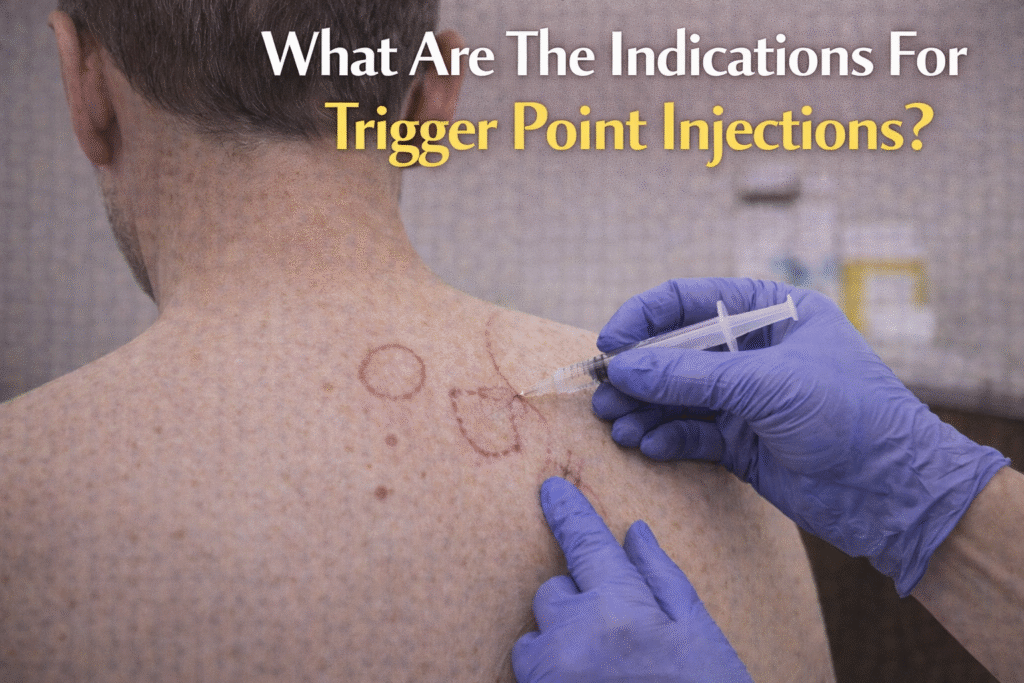
Trigger point injections in an individual are indicated when the person has myofascial pain due to a distinctly identifiable muscle trigger point that causes localized or referred pain, restricts movement or function, and has not resolved satisfactorily with the use of non-invasive methods to manage pain like stretching, physical therapy or oral medications.
What are the trigger point injection indicators?
Trigger point injections (TPIs) are used to treat painful, irritable knots in muscles (trigger points) which may result in local pain, muscle spasm and referred pain (pain felt elsewhere).
The most frequent indications that clinicians use are shown below.
1) Presence of a palpable, painful trigger point
One of the signs is a trigger point identified clinically as a tight band/knot in the muscle that is tender and when pressed makes your usual pain.
2) Myofascial functional limitation with pain syndrome.
Myofascial pain syndrome is most commonly attended to by TPIs where pain is disrupting the normal functioning of life such as work, sleep, exercise, or even simple movement.
Common patterns include:
- Tightness of neck/ upper back (and commonly trapezius/shoulder girdle)
- Back pain (low back) (paraspinals).
- Hip/glute triggers of buttock/hip pain.
3) Referred pain caused by muscle trigger points
Trigger points may cause irritation of the related nerves as well as referred pain (such as the muscles of the neck extending pain into the head or shoulder). TPIs can be considered when the examination results can be compared to a pattern of referred-pain.
include:
- Neck trigger points causing headaches
- Shoulder trigger points causing arm pain
- Gluteal trigger points causing hip or leg discomfort
4) Reduced muscle range of motion due to muscle spasm/ tight bands.
In case there is a trigger point that is causing stiffness and range of motion and the limitation seems to be muscular rather than joint-related, TPIs can be incorporated into the plan of restoring movement.
5) Symptoms remain regardless of conservative therapy (or you cannot bear it)
Numerous evidence-based care pathways suggest the initial use of less invasive interventions (such as physical therapy, massage/manual therapy, stretching, and activity modification). TPIs are usually contemplated when said measures do not offer sufficient relief or the pain is making meaningful interest in rehabilitation impossible.
6) To help you participate in physical therapy or return to activity
An indication that would be practical would be when you can reduce muscle pain/spasm on a short-term basis so that you:
- Start or progress PT
- Improve posture/ergonomics
- Gentle strengthening/mobility exercises on the resume.
This window may be significant–since permanent recovery may need rehab and treatment of contributory causes.
7) Certain headache/neck pain presentations tied to trigger points (selected cases)
Other patients experience head/neck pain in areas where the examination points highly to the presence of myofascial trigger points in the neck/shoulder muscles as part of the pain pattern. The TPIs can be applied in such situations as a part of the overall management (and not as a separate treatment).
When trigger point injections are not the right move
Red flags → urgent ER evaluation instead
Go to the ER (or call 911) for:
- Pain in the chest/pressure, extreme dyspnea.
- Weakness, drooping of the face, difficulty in speech.
- Neurologic headache with severe headache.
- Signs of serious infection (high fever, confusion), or rapidly worsening symptoms
Cases in which TPIs tend to be shunned or delayed.
The clinicians usually test against risk enhancing factors, which include:
- Infection of skin on the injection site.
- Risk of bleeding (some anticoagulants/bleeding disorders)
- Medication allergy (e.g., local anesthetic)
- Failure to cooperate/hold still to safe technique.
(Your clinician will also consider pregnancy status, whether steroid is deemed important and consider other individual factors).
What to Expect From Trigger Point Injections
The procedure of a trigger point injection usually entails a small needle inserted into the trigger point, sometimes with a local anesthetic, (but any other agent may be used at the discretion of the clinician). Mostly, patients experience soreness during either one or two days and symptoms improve depending on the individual and whether rehabilitation is undertaken afterward.
Sahara West Urgent Care and Wellness (Las Vegas)
Long shifts on feet, travel, dehydration, and stress are some of the factors that cause individuals to tighten muscles in Las Vegas. When the pain seems to be driven by a muscle-knot, a close-up inspection will help in differentiating what you are experiencing as myofascial trigger points and what is related to the joint, nerve pain or spine related pain because each will require a different treatment.
At Sahara West Urgent Care & Wellness, we can evaluate muscle pain, red flags screening, and identify the reasons why either conservative care, imaging, referral, or procedures such as trigger point management can be a reasonable approach to your case. Book your appointment with Sahara West today — with no wait. Whether you’re dealing with neck pain, back pain, shoulder tension, or muscle spasms, our team provides fast, professional care so you can get relief and get back to moving comfortably.
FAQs
How do I know if I have trigger points?
A clinician examines muscle to identify a tender knot/taut band that causes your pain and can be a source of pain that is referred in a recognizable pattern.
Do all patients with back or neck pain require trigger point injections?
No. They are best used in the case when pain is most likely to be myofascial in nature and a trigger point is visible on examination.
Do I need to try physical therapy first?
Yea, many times several of such guidelines and reviews put in less invasive treatments initially, with pain injections of various kinds used selectively where conservative treatment fails to suffice or pain is severe enough to prevent rehabilitation.