
Introduction: Navigating Sexual Health Care in Las Vegas
Finding out you might have been exposed to a sexually transmitted infection is stressful enough without also trying to figure out where to go and what actually happens once you walk through the door. Should you book a lab test online? Wait weeks for a primary care appointment? Or head to an urgent care clinic?
Here’s the truth: proactive sexual health care isn’t something to be embarrassed about its basic preventive medicine, no different from getting a flu shot or a blood pressure check. The sooner you get screened, the sooner you protect your health, your partner’s health, and your peace of mind.
In Las Vegas, residents generally have three paths for sexual health services: specialized diagnostic labs, public health clinics, and urgent care STD testing centers like Sahara West Urgent Care on West Sahara Avenue. Each option has trade-offs in speed, cost, and follow-up care.
The single most important thing to understand before you go anywhere is this: testing and treatment are two separate clinical phases. Testing identifies what’s going on in your body. Treatment is the medical response to that diagnosis. A quality clinic doesn’t just hand you a test kit, it walks you through both stages, seamlessly, under one roof.
This guide breaks down exactly what happens at each phase, so you walk into your appointment informed, confident, and ready to take control of your health.
Why Choose an Urgent Care Clinic for Sexual Health in Las Vegas?
A. Walk-In Flexibility vs. Traditional Primary Care Backlogs
Booking a same-week appointment with a primary care physician for confidential STD testing can take days, sometimes weeks. Symptoms don’t wait, and neither should you. Urgent care clinics are built for walk-in access, meaning you can often be seen the same day you notice a concern.
B. The Value of Clinician-Guided Testing Over Self-Ordered Panels
Online lab-ordering services let you pick tests off a menu without ever speaking to a medical provider. The problem? Most people don’t actually know which panel fits their specific exposure. A same-day STD testing clinic with an in-house provider tailors your testing to your actual risk, not a generic checklist.
C. The “One-Stop” Advantage: Testing to Treatment, Seamlessly
This is where urgent care truly shines. If your results come back positive, you don’t need to hunt down a second appointment somewhere else. STD treatment in Las Vegas can begin the same visit, in many cases with medication prescribed and dispensed before you even leave the building.
D. Confidentiality, Privacy, and a Judgment-Free Environment
A well-run clinic treats every patient with the same discretion and respect, regardless of the reason for the visit. Confidential STD testing near me is one of the most searched phrases for a reason privacy matters, and it should never be in question.
Ready to stop wondering and start knowing? Walk into Sahara West Urgent Care today no judgment, no long waits, just answers.
The Initial Consultation: What Actually Happens When You Arrive
A. Private Conversation and Clinical Intake
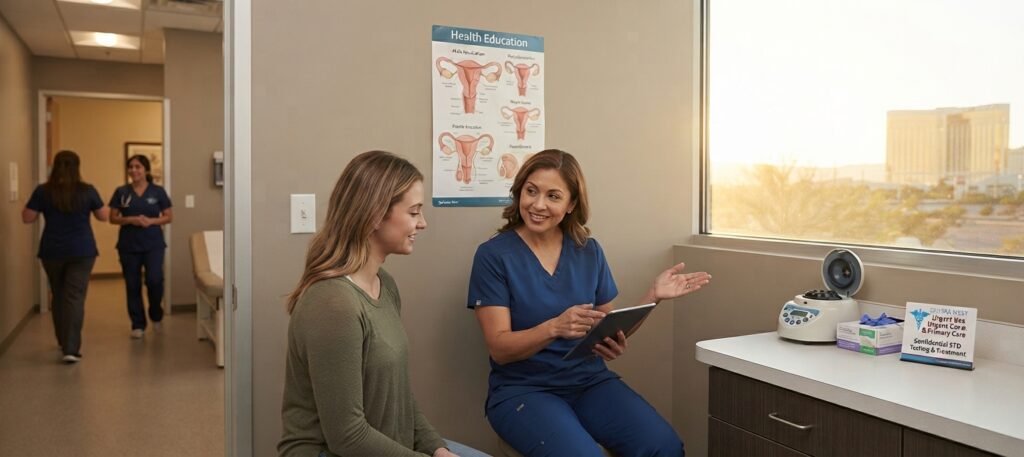
Before any swab or needle comes near you, you’ll sit down with a healthcare provider for a private, one-on-one conversation. This isn’t a formality, it’s the foundation of accurate STD screening in Las Vegas.
B. Key Questions Your Provider Will Ask
Expect an honest, direct conversation covering:
- Symptoms what you’re feeling, or confirming you feel nothing at all (many infections are silent)
- Exposure timeline roughly when the potential exposure occurred
- Type of sexual contact vaginal, oral, or anal, since each requires different testing sites
- Partner status for example, if a partner has already been diagnosed with an infection
- STI and medical history prior diagnoses, treatments, and relevant health background
C. Tailoring the Panel: Why One Size Doesn’t Fit All
A 22-year-old with a new partner and no symptoms needs a different panel than someone with visible sores and a partner who just tested positive. This is precisely why clinician-guided STD testing consistently outperforms blind, self-ordered lab panels; the test list is built around your actual risk.
Comprehensive Breakdown of Available STD Tests
A. Chlamydia Testing
Chlamydia is notoriously asymptomatic; most people carrying it feel completely fine, which is exactly why it spreads so easily. Testing typically involves a urine sample or a site-specific swab, depending on your reported exposure.
B. Gonorrhea Testing
Gonorrhea can infect more than one site genital, throat, or rectum depending on the type of contact. This is why disclosing oral or anal exposure honestly during intake is critical; skipping that detail means the infection could be missed entirely.
C. HIV Testing (Fourth-Generation Blood Tests)
Modern HIV testing near me searches usually lead people to fourth-generation antigen/antibody blood tests, drawn from a vein for higher accuracy than older rapid tests.
The window period matters. Testing too soon after exposure can produce a false negative. According to CDC guidance, the reliable detection window generally falls between 18 and 45 days post-exposure. If your visit falls within a recent, high-risk window, your provider will discuss retesting timelines and any time-sensitive prevention options available to you.
D. Syphilis Testing
Syphilis is diagnosed through blood testing combined with a clinical exam. One of its most dangerous traits: visible symptoms can disappear entirely while the infection remains active and progressing in the body, another reason to trust lab results over how you feel.
E. Hepatitis B & Hepatitis C Testing
Whether you need Hepatitis B or C blood panels depends on your vaccination history, overall health background, and specific risk factors, another area where a provider conversation beats guessing from an online menu.
F. Herpes (HSV) Evaluation
If you have an active lesion, a direct swab of that lesion is the most accurate testing method. Routine blood screening for herpes has real limitations, including a meaningful risk of false positives which is why the CDC does not recommend routine HSV blood screening for asymptomatic, low-risk individuals. Your provider can walk you through whether testing makes sense in your specific situation.
Testing Strategies Based on Specific Types of Exposure
A. Vaginal or Penile Exposure
Standard genital-site testing protocols apply, typically combining urine samples with clinical assessment.
B. Oral Sex and Throat Testing
Many patients don’t realize throat infections from oral exposure are common and often missed because standard urine tests don’t detect them. If oral contact occurred, say so it changes the testing site.
C. Anal Sex and Rectal Testing
Similarly, rectal exposure requires a rectal swab for accurate gonorrhea and chlamydia detection. Skipping this disclosure means a real risk of a false “all clear.”
D. Partner Diagnosis Scenarios
If a partner has already tested positive, tell your provider immediately. This shifts you into a targeted exposure workup, often with treatment considered even before your own results return, depending on the infection.
E. Managing Visible Symptoms
Sores, ulcers, or blisters warrant a direct clinical exam in addition to lab testing visual assessment gives your provider real-time diagnostic clues that labs alone can’t provide.
Screening Without Symptoms: Who Needs It and When?
A. The Reality of Asymptomatic STIs
You can feel perfectly healthy and still be carrying an infection. This single fact is why routine screening, not just “testing when something feels wrong” is the standard of responsible sexual health care.
B. CDC Screening Recommendations by Risk Group
The CDC recommends routine screening for:
- Sexually active women under 25 (annual chlamydia and gonorrhea screening)
- Pregnant individuals (as part of standard prenatal care)
- People with new or multiple sexual partners
- Men who have sex with men (MSM) (more frequent screening intervals)
C. Building a Routine Personal Screening Schedule
Talk to your provider about a screening cadence based on your lifestyle that turns sexual health into ongoing preventive care rather than a one-time panic response.
Not sure which screening group you fall into? Book a consultation and let a provider map out the right schedule for you.
Recognizing Potential STD Symptoms
A. Urogenital Signs
- Burning sensation during urination
- Unusual discharge
- Testicular pain or swelling
B. Dermatological and Localized Signs
- Sores or blisters
- Unexplained rashes
- Genital itching or irritation
C. Pelvic, Rectal, and Systemic Indicators
- Pelvic discomfort or pain during sex
- Rectal pain or bleeding
- Flu-like symptoms (fatigue, fever, body aches)
If any of these sound familiar, don’t wait it out, urgent care for STD symptoms exists precisely for situations like this.
The Sample Collection Process: What to Expect
A. Urine Collection
Simple, non-invasive, and typically the first step for chlamydia and gonorrhea screening related to genital exposure.
B. Blood Draws (Venipuncture)
Used for HIV, syphilis, and hepatitis panels a quick draw from a vein, generally taking just a few minutes.
C. Swab and Lesion Sampling
For throat, rectal, or active lesion testing, a clinician performs a targeted swab. It’s brief, and your provider will explain each step before doing it.
Results, Turnaround Times, and Same-Day Realities
A. “Same-Day Testing” vs. “Same-Day Results” Know the Difference
This is one of the most misunderstood parts of the process. Same-day STD testing means you can be tested that day; it does not always mean you’ll have results in hand before you leave.
B. Typical Laboratory Turnaround Times
Most standard panels return in 24–48 hours. Certain cultures or confirmatory tests (particularly for herpes or specific syphilis confirmations) can take longer.
C. Questions to Ask Your Provider About Results
- How will I be notified by call, text, or patient portal?
- What’s the expected turnaround for my specific panel?
- What’s the next step if a result comes back positive?
Transitioning from Testing to STD Treatment
A. What Happens When a Test Comes Back Positive?
Your provider will call or message you, explain the diagnosis clearly, and outline next steps immediately: no vague voicemails, no guessing games.
B. In-Clinic Medical Management
Many common infections chlamydia, gonorrhea, and others can be treated directly at urgent care with prescribed medication, often dispensed the same visit. This is the real power of the one-stop testing-to-treatment model.
C. When Specialist Referrals Are Necessary
Some diagnoses, particularly chronic viral conditions requiring long-term management, warrant a referral to a specialist for ongoing care. A good clinic will make that handoff smooth, not leave you to figure it out alone.
D. Partner Notification and Co-Treatment
Treating just one partner while the other remains untreated creates a reinfection cycle. Providers can guide you through partner notification sometimes anonymously and coordinate co-treatment to break that cycle for good.
E. Follow-Up and Repeat Testing
Depending on the diagnosis, a repeat test at a set interval (often 3 months later) confirms the treatment worked and screens for reinfection.
Already have a diagnosis and need fast, judgment-free treatment? Sahara West Urgent Care treats what it tests the same visit, when clinically appropriate.
Practical Logistics: Cost, Insurance, and Accessibility in Las Vegas
A. Insurance Coverage Considerations
Coverage can differ between the office visit itself and the laboratory testing component; it’s worth confirming both with your insurance provider ahead of time when possible.
B. Self-Pay Options and Cost Transparency
For patients without insurance or who prefer discretion, transparent self-pay STD testing cost estimates should always be available upfront with no surprise billing.
C. Location Access
Patients throughout West Las Vegas, Spring Valley, Summerlin, and surrounding neighborhoods have convenient access to walk-in sexual health services without crossing town.
D. Hours and Scheduling
Extended hours and walk-in availability mean you’re not boxed into a 9-to-5 appointment slot that fits your schedule, not the other way around.
Final Takeaway: Don’t Wait, Don’t Guess Get Answers Today
Sexual health isn’t something to put off until it becomes an emergency. Whether you’re due for routine screening, managing a specific exposure concern, or need treatment after a diagnosis, the right clinic makes the entire process faster, more private, and far less intimidating than you might expect.
Testing and treatment don’t have to be two separate headaches handled by two separate providers on two separate days. At Sahara West Urgent Care, they happen under one roof with a provider who guides every step.
Stop searching, start healing. Visit Sahara West Urgent Care’s STD Testing page to walk in today or check current hours and location details near West Sahara Avenue.
Frequently Asked Questions
Q: Can I walk in without an appointment for STD testing in Las Vegas?
Yes. Urgent care clinics like Sahara West Urgent Care are built around walk-in access, so you generally don’t need to schedule days in advance to be seen.
Q: Is confidential medical care truly private regarding insurance billing?
Confidentiality applies to your clinical visit and records, but if you use insurance, billing statements may reference the visit. If privacy from a shared insurance plan is a concern, ask about self-pay options during intake.
Q: Do I need testing if I have zero symptoms?
Yes. Most STIs, including chlamydia and gonorrhea, are frequently asymptomatic. Feeling fine is not the same as being infection-free, which is exactly why routine screening matters.
Q: Can I get tested specifically after oral or anal exposure?
Absolutely and you should specifically mention this type of contact during intake, since it determines whether throat or rectal swabs are needed in addition to standard testing.
Q: What is the appropriate window period to wait before getting tested after sex?
It depends on the infection. HIV detection is most reliable between 18–45 days post-exposure with a fourth-generation test. Other infections like chlamydia and gonorrhea can often be detected sooner. Your provider can advise the right timing based on your specific exposure.