
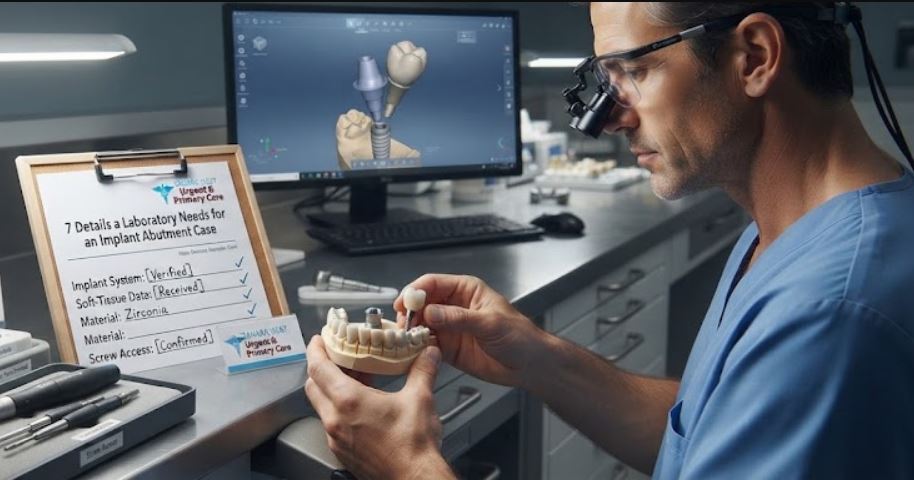
An implant restoration can be delayed when the laboratory receives an accurate scan or impression but incomplete component information. The implant system, connection, tissue conditions, restorative space, material, and screw-access requirements all affect the proposed abutment.
A structured prescription gives the clinician and laboratory the same case reference before design or fabrication begins. The following seven details should be confirmed.
1. Implant System and Platform
Identify the implant from the surgical record, package label, or other verified documentation.
Provide:
- Manufacturer
- Product line
- Connection
- Platform
- Implant diameter
- Placement site
- Placement date
- Product reference
A brand name alone may not identify the restorative interface. Manufacturers can offer several implant families with different platforms, connections, screws, and drivers.
If the implant was placed elsewhere, obtain the original records rather than asking the laboratory to identify the system from appearance alone.
2. Implant Position and Orientation
The laboratory needs to understand the implant’s three-dimensional relationship to the planned restoration.
Supply appropriate records showing:
- Mesiodistal position
- Buccolingual position
- Implant depth
- Long-axis inclination
- Relationship to adjacent teeth
- Interarch space
- Proposed screw-access direction
The scan body or impression component must match the confirmed implant system and be seated completely when the definitive record is made.
Review the digital scan or impression before submission. Missing tissue, incomplete margins, movement, or an improperly seated component can compromise the information sent to the laboratory.
3. Soft-Tissue Information
Record the tissue conditions that affect cuff height, emergence profile, margin position, and cleansability.
The laboratory may require:
- Tissue depth
- Gingival contour
- Desired margin location
- Esthetic requirements
- Available restorative space
- Photographs
- Provisional-restoration records
- Intended emergence profile
For a cement-retained restoration, consider whether the planned margin will permit access for excess-cement removal. For a screw-retained restoration, evaluate the access-channel position and available material thickness.
4. Selected Abutment Category
When reviewing dental abutments, clinicians should confirm the connection, platform, dimensions, material, angulation, screw, driver, and intended restorative application before prescribing a component.
The case may involve:
- Stock titanium abutment
- Angulated abutment
- Zirconia abutment
- Temporary abutment
- Ti-base component
- Multi-unit component
- Another system-specific option
The prescription should state whether the laboratory is selecting from approved options or working with a component already chosen by the clinician.
Do not treat visually similar parts from different product lines as interchangeable.
5. Restorative Material and Design
Describe the planned restoration and the factors that may affect its design.
Include:
- Crown or bridge
- Screw-retained or cement-retained design
- Restorative material
- Shade requirements
- Occlusal clearance
- Contact requirements
- Pontic design, when applicable
- Required contour
- Provisionalization plan
The abutment and restoration should be planned together. Changing the material or retention method after fabrication begins may require a revised design or component.
6. Screw and Driver Requirements
Identify the prosthetic screw and compatible driver for the selected component.
The case record should state:
- Screw reference
- Driver interface
- Driver length
- Applicable tightening instruction
- Whether a laboratory screw is required
- Whether a new clinical screw will be used at delivery
Do not apply a tightening value from another implant system or component. The clinician should confirm the current instructions for the exact screw and abutment.
7. Approval and Delivery Records
Define what the clinician must approve before fabrication.
Approval may include:
- Digital design
- Margin position
- Angulation
- Emergence profile
- Access-channel location
- Material thickness
- Final component reference
When the case returns, compare the laboratory documentation, component label, prescription, and approved design.
Record the abutment, screw, material, product reference, and relevant delivery details in the patient file. Share only the patient information required for laboratory work through the practice’s approved method.
Make the Prescription Verifiable
A useful laboratory prescription identifies the implant, communicates the tissue and restorative requirements, and defines which component has been approved.
Complete records reduce reliance on visual estimation and give the laboratory a clear basis for designing a restoration that follows the clinician’s treatment plan.