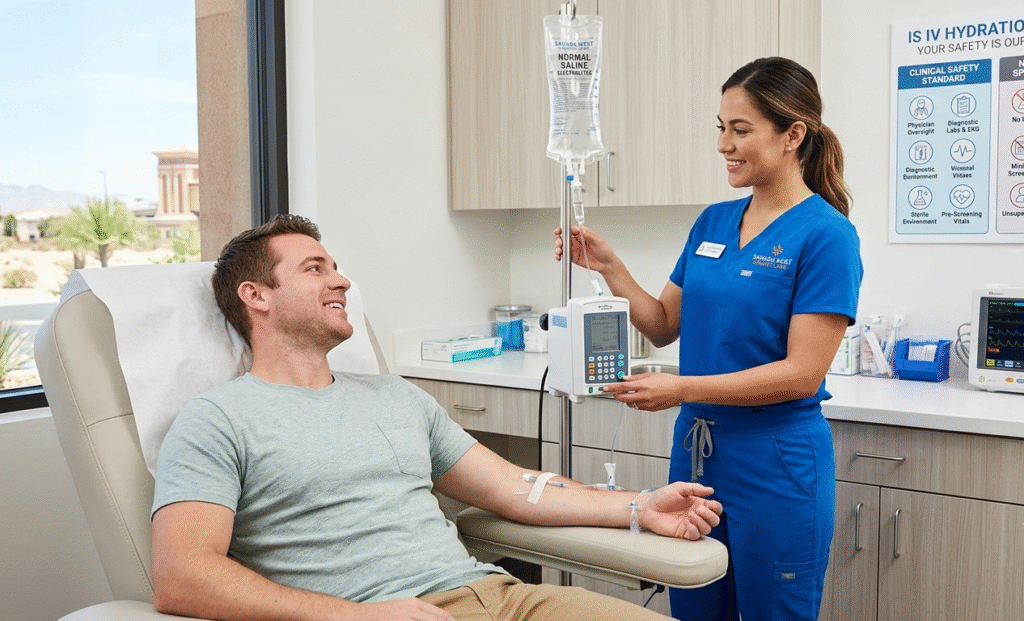
The short answer is yes IV hydration is a routine, highly safe medical procedure when administered by licensed healthcare professionals in a controlled clinical environment.
However, as IV therapy explodes in popularity across Southern Nevada, the setting where you receive your drip matters immensely. There is a vital distinction between medical-grade IV therapy in a physician-supervised urgent care clinic and non-clinical spa treatments, hotel delivery services, or unregulated DIY hydration setups.
When you are dealing with severe desert dehydration, extreme summer heat, travel fatigue after a long flight into Harry Reid International, or acute fluid loss from a stomach bug, safety must come first. Restoring your body’s fluid balance is a medical intervention, not just a trendy wellness gimmick.
At Sahara West Urgent Care, every IV hydration session is backed by strict medical safety standards, comprehensive provider evaluations, and on-site diagnostic equipment. Before you schedule a session anywhere in town, here is what you need to know about the science, risks, and clinical standards that keep IV therapy safe and effective.
The Medical Science: Why IV Hydration is Safe
IV hydration is not a new concept; it has been a foundational pillar of modern medicine for well over a century. Understanding how it works biologically clarifies why it is both safe and exceptionally effective.
Decades of Clinical Use in Emergency & Outpatient Care
Intravenous fluid administration has been safely performed millions of times daily in emergency rooms and outpatient clinics worldwide. The base fluids used in clinical IV drips most commonly Normal Saline (0.9% Sodium Chloride) and Lactated Ringer’s (LR) are specifically engineered to match your body’s natural fluid osmotic pressure.
Because these solutions mirror the concentration of human blood plasma, they are recognized by your body immediately, allowing for gentle, rapid cellular rehydration without causing fluid shifts that damage red blood cells.
100% Bioavailability and Controlled Rate Delivery
When you swallow water or electrolyte beverages, fluids must travel through your gastrointestinal tract, surviving stomach acid and intestinal absorption limits. If you are already nauseous, vomiting, or severely dehydrated, your GI tract slows down, leading to digestive distress and delayed absorption.
IV hydration bypasses the digestive system entirely, delivering 100% bioavailability directly into your bloodstream. Furthermore, clinical administration uses controlled gravity drips or automated infusion pumps. This precise drip rate regulation prevents your circulatory system from being overwhelmed, giving your heart and kidneys time to adjust smoothly to expanding blood volume.
Sterile Equipment and Protocol Controls
In a legitimate medical facility, contamination risks are virtually eliminated through strict aseptic protocols. Every component of an IV setup from the flexible, single-use catheter to the IV tubings and sterile fluid bags is sealed, sterile, and opened only immediately prior to insertion. Medical providers sanitize insertion sites using clinical-grade antiseptic preparations like chlorhexidine or isopropyl alcohol, ensuring a safe barrier against infection.
Potential Risks, Side Effects, and Rare Complications
While IV therapy is overwhelmingly safe for healthy individuals, no medical procedure is completely without risk. Transparency is a cornerstone of patient trust, so it is essential to understand normal reactions versus potential complications.
Common, Mild Side Effects (Normal Responses)
During or immediately after an infusion, you may experience minor, expected physical sensations that are completely harmless:
- Cool Sensation in the Arm: Room-temperature saline entering your warm bloodstream often creates a cool feeling moving up your arm. This is normal and subsides quickly.
- Minor Insertion Site Tenderness or Bruising: A slight pinch during insertion and minor tenderness or a small bruise afterward can happen, just like with a routine blood draw.
- Temporary Metallic Taste: Certain high-dose vitamin additives, particularly B-complex vitamins, can temporarily trigger a harmless, faint metallic taste in your mouth during the drip.
Minor Localized Complications (And How They Are Prevented)
On occasion, minor localized issues can arise during an infusion. In a clinical setting, these are identified and corrected in seconds:
- Infiltration: Occurs when the flexible catheter accidentally shifts out of the vein, allowing fluid to enter surrounding tissue. This causes localized swelling and firmness. If this happens, a trained provider immediately stops the flow, removes the line, and repositions it smoothly.
- Phlebitis: Mild inflammation of the vein wall. This is prevented by selecting the appropriate catheter size for your vein diameter and maintaining strict aseptic technique during placement.
Severe Risks in Unscreened Patients (Why Screening is Mandatory)
The most serious risks associated with IV therapy happen when individuals receive drips without a thorough medical screening first:
- Fluid Overload (Hypervolemia): Administering excessive fluids too rapidly can overwhelm the heart and lungs, particularly in individuals with undiagnosed congestive heart failure or kidney disease.
- Electrolyte Imbalances: Introducing concentrated potassium, sodium, or magnesium without evaluating baseline levels can disrupt cardiac rhythm and nerve signaling.
- Infection Risks: Receiving an IV in a non-sterile environment (such as a crowded event space or an uncleaned room) significantly raises the risk of localized vein infections or bloodstream contamination.
Pro Insight: Safety in IV therapy isn’t just about placing the needle correctly; it’s about knowing whether your body should receive fluids in the first place. Comprehensive medical pre-screening is what transforms a risky trend into a safe, therapeutic medical treatment.
Medical Screening: The Secret to Safe IV Therapy
At a physician-supervised clinic, you never simply walk in, point to a menu, and get hooked up to a bag. Safe treatment relies on a systematic, pre-drip evaluation.
[ STEP 1: Intake & Vitals ]
(BP, Heart Rate, Pulse Ox, Temp, History)
│
▼
[ STEP 2: Diagnostic Check ]
(On-site Labs & EKG if clinically indicated)
│
▼
[ STEP 3: Provider Customization ]
(Select Normal Saline / LR + Prescriptions)
│
▼
[ STEP 4: Monitored Drip ]
(30-60 min Controlled Infusion Suite)
Vital Signs & Health History Evaluation
Before a single drop of fluid enters your body, a clinical professional conducts a complete vital sign assessment:
- Blood Pressure & Heart Rate Check: Screening for severe hypertension or tachycardia (abnormally rapid heart rate).
- Pulse Oximetry & Temperature: Measuring oxygen saturation and checking for systemic fever or underlying infection.
- Medical History Review: Documenting pre-existing conditions, active prescription medications, allergies, and recent surgical history.
On-Site Diagnostic Testing (Labs & EKG)
For patients presenting with acute symptoms, clinical diagnostic tools provide absolute safety that wellness bars cannot match:
- Serum Electrolyte & Kidney Panels: On-site blood testing measures sodium, potassium, chloride, Blood Urea Nitrogen (BUN), and creatinine to evaluate organ stress before administering complex hydration blends.
- On-Site EKG Screening: If you are experiencing chest tightness, heart palpitations, or severe heat exhaustion, an immediate electrocardiogram ensures your heart rhythm is completely stable prior to therapy.
Customizing the Fluid and Additive Blend
Once diagnostic data and vitals are confirmed, your provider selects the precise base carrier (Normal Saline vs. Lactated Ringer’s) and determines whether prescription-grade additives are safe for you:
- Ondansetron (Zofran): Rapidly halts severe nausea and vomiting.
- Ketorolac (Toradol): Non-narcotic anti-inflammatory medication to eliminate severe headaches and body aches.
- Targeted Vitamins & Antioxidants: High-potency B-complex, Vitamin C, or Magnesium tailored to cellular recovery.
Urgent Care vs. Mobile IVs vs. Boutique IV Bars: Comparing Safety Standards
Not all IV hydration options are built equal. Comparing settings side-by-side demonstrates why clinical oversight matters for your health and peace of mind.
| Safety Feature | Urgent Care Clinic | Mobile IV Delivery | Boutique IV Spa / Bar |
| Physician / Provider On-Site | Yes (Continuous supervision) | No (Remote or off-site) | Rarely (Often nurse-only staff) |
| On-Site Diagnostic Labs & EKG | Yes (Immediate testing) | No | No |
| Prescription Additives Available | Yes (Zofran, Toradol, etc.) | Limited | Minimal or None |
| Sanitizing / Environment Control | Clinical Medical Facility | Variable (Hotel/Home) | Commercial / Spa Setting |
| Emergency Intervention Ready | Yes (Full medical response) | Basic First Aid | Basic First Aid |
Physician Oversight & Immediate Medical Intervention
When receiving IV fluids at an urgent care facility, board-certified providers are steps away. If your blood pressure drops, an allergic reaction occurs, or you feel lightheaded, immediate clinical intervention is available on the spot.
Diagnostic Accuracy vs. Symptom Masking
A major hidden danger of non-medical IV bars is symptom masking. Feeling temporarily refreshed after a saline bag can disguise underlying, dangerous conditions like acute heatstroke, early kidney failure, severe electrolyte abnormalities, or cardiac arrhythmias. A medical evaluation catches the root issue rather than putting a temporary band-aid on serious symptoms.
Controlled Sterile Environment
Medical clinics operate under strict healthcare regulatory standards. Treatment rooms are continuously disinfected using medical-grade sanitation protocols, drastically reducing exposure to environmental pathogens compared to residential hotel rooms or lounge spaces.
Who Should Exercise Caution or Avoid IV Hydration?
While IV hydration is a game-changer for many, certain health profiles require extreme caution or complete avoidance.
HIGH-RISK CATEGORIES REQUIRING STRICT CLINICAL APPROVAL:
┌───────────────────────────┬───────────────────────────┬───────────────────────────┐
│ Congestive Heart Failure │ Chronic Kidney Disease │ Uncontrolled Hypertension │
│ (CHF) │ (CKD) │ (High Blood Pressure) │
└───────────────────────────┴───────────────────────────┴───────────────────────────┘
High-Risk Health Conditions Requiring Pre-Approval
- Congestive Heart Failure (CHF): Extra fluid volume strains an already weakened heart pump, potentially pushing fluid into the lungs (pulmonary edema).
- Chronic Kidney Disease (CKD): Impaired kidneys cannot process excessive fluid or clearance of concentrated electrolyte additives efficiently.
- Severe Uncontrolled Hypertension: Rapid blood volume expansion can push blood pressure levels into dangerously high ranges.
Special Demographics
- Pregnant Patients: IV hydration can be exceptionally helpful for severe morning sickness (hyperemesis gravidarum), but fluid selection and medication additives must follow strict OB-GYN clinical safety protocols.
- Pediatric & Senior Patients: Children and elderly individuals have much narrower margins for fluid tolerance. Doses must be calculated precisely based on body weight, renal clearance, and baseline metabolic rates.
Questions to Ask Before Getting an IV Drip in Las Vegas
Protect your health by asking these four vital safety questions before booking an IV drip anywhere:
- “Will a licensed medical provider (MD, DO, NP, or PA) perform an evaluation before my drip starts?”
If the answer is no, walk away. You should always be cleared by a medical professional first. - “Do you have on-site diagnostic testing (labs and EKG) if I start feeling unwell?”
Only accredited medical facilities carry full diagnostic suites to evaluate acute chest strain or renal stress. - “Are medication additives prescription-grade and selected specifically for my symptoms?”
Ensure you are getting targeted medical treatment, not a pre-mixed, generic formula. - “What is your emergency protocol if a patient has an adverse reaction?”
A true medical facility has code-certified response equipment, emergency protocols, and trained providers ready on standby.
Why Choose Sahara West Urgent Care for Safe IV Hydration in Las Vegas?
At Sahara West Urgent Care, we balance fast, convenient relief with uncompromising medical safety. When you visit our clinic for IV therapy, you receive:
- Walk-In Convenience & Online Reservations: Walk straight in when you feel terrible, or reserve your slot online to skip the wait.
- Private, Climate-Controlled IV Suites: Rest and recover comfortably in clean, quiet, temperature-regulated treatment spaces.
- Full On-Site Diagnostic Suite: Complete laboratory testing and rapid EKG diagnostics available immediately if clinical necessity dictates.
- Comprehensive Healthcare Capabilities: Beyond acute rehydration, we are a trusted, fully equipped walk in primary care clinic. Whether you need immediate rehydration or long-term management from a dedicated provider offering primary care in Las Vegas, our medical team is here to support your complete health journey.
Don’t Risk Your Health with Unsupervised Drips
If you are experiencing severe dehydration, heat strain, nausea, or exhaustion, get safe, physician-supervised care.
➔ Walk In Today or Book Your Slot Online at Sahara West Urgent Care
Frequently Asked Questions
Q1: Can you get too much IV hydration?
Yes. Receiving more fluid than your body can process causes fluid overload (hypervolemia), which can strain your heart, lungs, and kidneys. This is precisely why Sahara West Urgent Care performs vital sign checks and health screenings before every session to calculate exact fluid requirements.
Q2: Is IV hydration safe if I am taking prescription medications?
For most standard medications, yes. However, certain drugs (such as diuretics, blood pressure medications, or heart therapies) interact with fluid volumes and electrolyte balances. Our providers conduct a full drug interaction check during intake to ensure absolute safety.
Q3: How do I know if an IV therapy provider is qualified?
Look for a permanent, state-licensed medical facility with on-site physicians, nurse practitioners, or physician assistants. Qualified providers display medical credentials, conduct formal intake evaluations, and maintain professional emergency response equipment on-site.
Q4: Are there allergic reactions to IV fluids or vitamins?
Allergic reactions to standard saline or Lactated Ringer’s are non-existent because they match bodily fluids. While rare, hypersensitivity to specific vitamin additives or prescription medications can occur. Receiving your drip in an urgent care setting ensures immediate clinical treatment if an allergic response develops.
Q5: Is IV therapy safe for hangover recovery or desert heat exhaustion?
Yes, it is highly effective and safe for mild-to-moderate heat fatigue and hangover symptoms. However, severe heatstroke (characterized by confusion, lack of sweating, high body temperature, or fainting) is a medical emergency. Receiving treatment at an urgent care clinic ensures that severe, life-threatening conditions are immediately identified and managed appropriately.
Additional Local Resources & Services
- Learn more about our comprehensive urgent care capabilities on our Urgent Care in Las Vegas page.
- Establish continuous health management with our team for Primary Care in Las Vegas.
- Ready to feel human again safely? Reserve your visit online now.