
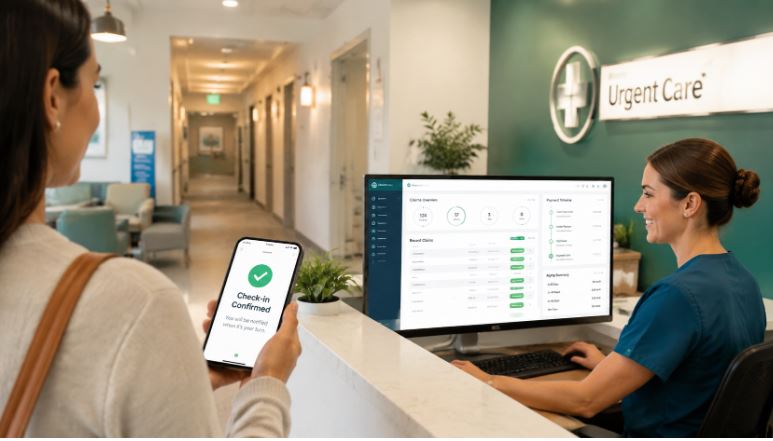
Walk into an urgent care clinic today and the experience looks nothing like it did ten years ago. Patients check in on their phones before they even leave the house. Wait times appear on a screen near the front door. Lab results show up in an app within the hour. Behind every one of those conveniences is a layer of technology that most patients never think about until something goes wrong with their bill.
The operational transformation happening inside urgent care clinics right now is not just about comfort. It is about financial survival. With over 12,000 urgent care centers across the United States seeing roughly 160 million visits every year, the margins are thin and the administrative complexity is high. As operational demands grow, many medical facilities also implement HSI Donesafe health and safety software to streamline compliance tracking, support staff wellbeing, and manage workplace risks alongside day-to-day clinical operations. How a clinic handles everything from scheduling to payment collection determines whether it thrives or struggles.
That is why the financial side of urgent care has become just as important as the clinical side. Providers that invest in optimized urgent care billing services are finding they can reduce claim denials, speed up reimbursements, and free their staff to focus on patients rather than paperwork. And for patients, that investment translates directly into clearer bills and fewer surprises.
The Scheduling Revolution: Before a Patient Walks In
It might seem like scheduling is a minor detail compared to the clinical work happening inside a clinic. But in urgent care, the intake process sets the tone for everything that follows including whether a claim gets paid on time.
Modern urgent care platforms now offer online check-in tools that allow patients to register, upload insurance cards, and answer intake questions from their car or couch. This is not just about convenience. Every piece of information captured at intake is information that the billing team does not have to chase down after the fact.
Real-time insurance eligibility verification
One of the oldest problems in urgent care billing is discovering after a visit that a patient’s insurance was inactive, or that a specific service required pre-authorization. Traditional eligibility checks took 12 minutes or more per patient when a staff member had to call a payer directly. Modern API integrations complete the same check in seconds, automatically, the moment an appointment is confirmed.
The downstream effect on billing accuracy is significant. Fewer coverage gaps mean fewer denied claims. Fewer denied claims mean faster cash flow and less time spent on appeals and rework.
Inside the Exam Room: Clinical Documentation and the Billing Connection
What a provider documents during a patient visit is not just a medical record. It is the source data for every code that will appear on the insurance claim. In urgent care, where visits are fast and documentation windows are short, the gap between what happens clinically and what gets captured in writing can cost a clinic thousands of dollars in unbilled or underbilled services.
E&M coding and why it matters
Evaluation and management coding the system used to determine the complexity level of a patient visit changed significantly in 2021, when the AMA moved away from counting physical exam elements and shifted to medical decision-making complexity and total clinician time. Many urgent care centers are still adapting to those changes.
Getting this right is not about gaming the system. It is about accurately reflecting the work that was done. An undercoded visit means the clinic is paid less than the service warranted. An overcoded visit creates audit risk. The goal is precision, and technology is making that precision increasingly achievable through real-time documentation prompts, AI-assisted coding tools, and integrated EHR platforms that flag documentation gaps before a claim is ever submitted.
| “Urgent care centers without specialist billing support typically see denial rates between 8 and 15 percent and lose 15 to 25 percent of ancillary revenue to services that were performed but never billed.” Qualigenix RCM Benchmark Report, 2026 |
From Exam Room to Payment: How the Billing Cycle Works
After a patient is seen, the clinical notes move to the billing team whether that team is in-house or outsourced. What happens next determines how quickly and completely the clinic gets paid.
A clean claim one that reaches a payer without errors, with the right codes, the right place-of-service designation, and complete supporting documentation is processed and paid in a matter of days. A claim with errors enters a denial-and-appeal cycle that can stretch into months and sometimes results in no payment at all.
Ancillary services: the most commonly missed revenue
In an urgent care visit, the main encounter is usually straightforward to bill. The complexity comes from ancillary services, the X-ray taken in the same visit, the wound cleaned and sutured, the strep swab processed in the on-site lab. Each of these is a billable service with its own code set, and each must be captured and submitted correctly to receive reimbursement.
Managing this complexity accurately requires both clinical knowledge and billing expertise that most front-desk teams are not trained to provide. This is precisely the gap that specialized medical billing services are designed to fill not just processing claims, but ensuring that every billable element of a visit is captured, coded correctly, and submitted on time.
The Patient Payment Experience: Where Technology Meets Trust
Even when the insurance side of a claim is handled correctly, the patient-facing payment process can create friction. High-deductible health plans have shifted more cost responsibility onto patients, and urgent care with its mix of visit fees, lab charges, and procedure costs can generate bills that arrive in multiple installments and confuse patients who thought they were covered.
Technology is addressing this in two ways. First, better upfront cost estimation tools allow clinics to give patients a realistic picture of their out-of-pocket responsibility before they leave the building. Second, digital payment platforms text-to-pay, patient portals, and automated payment plans are replacing paper bills and phone calls as the primary collection method.
The result is higher collection rates, fewer write-offs, and patients who feel informed rather than blindsided. In a consumer-driven market where online reviews often mention billing experiences as prominently as clinical care, that trust has real competitive value.
Why Specialist Billing Partners Are Becoming the Standard
Running an urgent care clinic well requires focus. Clinical staff need to focus on patients. Front-desk staff need to focus on intake and experience. When billing complexity pulls those teams into claims management, authorization chasing, and denial appeals, the quality of care and the quality of the financial operation both suffer.
This is driving a significant shift toward outsourced billing partnerships across the urgent care industry. Specialists who work exclusively in urgent care revenue cycle management bring payer-specific knowledge, up-to-date coding expertise, and dedicated denial management workflows that in-house teams with broader responsibilities simply cannot match.
For clinics evaluating this option, partnering with an experienced urgent care billing company that understands the specific demands of walk-in, high-volume environments can be the difference between a billing operation that drains resources and one that actively supports the clinic’s financial health.
The Bigger Picture: Technology as a Patient Benefit
It is easy to think of billing technology as something that benefits the clinic faster payments, lower denial rates, reduced administrative overhead. But the patient experience is equally transformed when billing runs well.
Patients who receive accurate cost estimates upfront, clear itemized bills, and easy digital payment options are patients who trust their healthcare provider. In a market where urgent care has become the first point of contact for millions of Americans who do not have a regular primary care physician, that trust is foundational.
The clinics that are getting this right are not just investing in technology for operational efficiency. They are investing in a patient experience that begins the moment someone searches for care and extends well past the moment they walk out the door. That is what modern urgent care looks like and the financial infrastructure behind it is finally catching up to the clinical care in front of it.